Published
Name: Łukasz Polowczyk
Nationality: Polish, Berlin-based
Occupation: Poet, sound artist, composer, vocalist, producer
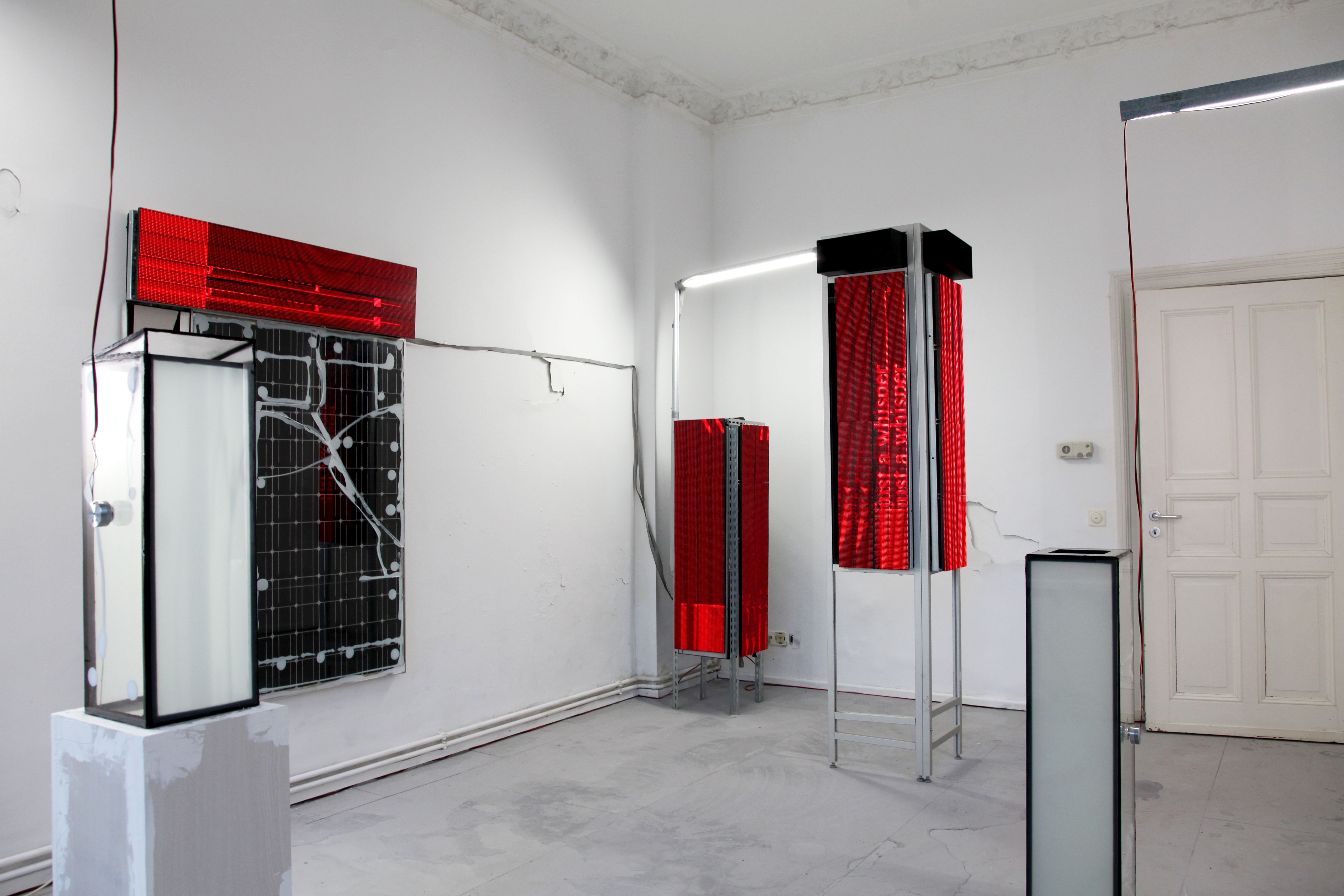
Current Release: Łukasz Polowczyk's collaborative album with Prairie (aka Marc Jacobs), Pink Warm Belly of a Dying Sun, was presented in a Berlin off-space as an immersive installation—an attempt to let visitors walk inside the album’s content. The exhibit featured interpretations of the album’s “verbal paintings,” translated into sculpture, video, and sound art by artists such as Clemens Behr, Brigitte Fässler, TiND, and Manuel Carbone. It has now been thoroughly documented and expanded into a book featuring photography, interviews with all contributors, and essays by Laurent Fintoni, Forty, Theo Bark, Will Hagle, Stephan Kunze, and Martyn Pepperell. The release is available from Adventurous Music.
If you enjoyed this Łukasz Polowczyk interview and would like to know more about his music, visit the official Aint About Me homepage. He is also on Instagram, and bandcamp.
For a deeper dive, read our earlier Aint about Me interview.
In your conversation with Clemens Behr he mentions that the music triggered the association of a scene from a sci fi movie in him. How interested are you actually in science fiction – or, to out it differently, a fiction of the future?
That’s all Clemens Behr — he’s really big on Mark Fisher right now: hauntology, abandoned futures … That’s why the installation referenced Blade Runner and had those overt cyberpunk inflections — the red LED screens, that broken, industrial look with the messy, exposed cables, and such.
I could meet him there because I also love Blade Runner and Ghost in the Shell, the original Matrix — the classics. Solaris, the Tarkovsky version, and of course, 2001: A Space Odyssey. But I think the reason these particular flicks resonate with me is not so much because of their modeling of potential futures, but rather their investigation into the nature of consciousness.
As far as my relationship to the future — potential or fully speculative — I’m more interested in frameworks you find in Indigenous philosophies or Buddhism. Like, for example, the idea of the ever-present now, the cyclical nature of time, or the fractal architecture of reality.
I’ve also been thinking a lot about how modernism sold us on this notion that technological progress, in and of itself, is a net positive — and that to not abide by this logic is to be retrograde. Yet, looking at the state of the world, I’m starting to wonder if perhaps the more nature-based frameworks proposed by Indigenous cultures are actually the more advanced ones.
Nature technologies — as expressed all around us by all sorts of living creatures and plant life — blow my mind, like, all the time. It’s almost like we, as humans, just create toys that emulate, in a very primitive way, what’s already been perfected by nature. Take, for instance, the expression and conjugation of the nervous system across the animal kingdom, and compare that to the advances made in computing and robotics.
What was the concrete point of departure for this project?
First of all, I wanted to have the experience of actually being able to walk inside the content of the album — like, literally. I wanted to translate the recordings into something that exists out in the real world, something you can interact with in some way.
I also wanted to see what happens to this material when it’s refracted through the practices and languages of other artists — to get a glimpse of how they see it, experience it, feel it …
And finally, I wanted something that would outlive the exhibit and also stand in for the album as a physical object. That’s how the idea for the book came to be.
The way I remember it, you were somewhat worried that the work might be too dark. Looking back, how do you see that with some hindsight?
Yeah, you remembered that correctly.
After Glacier Gospel came out, I was distraught and confused. I was surprised by the fact that it had rippled out the way it did — got played on so many different radio stations. It deals with the realities of war and, indirectly, with climate change. And although it’s impressionistic in its rendering, it’s also very graphic.
I started to question the utility of art that reiterates the negative aspects of reality without offering any solutions. Cornering the listener and leaving them in a dark place. You know, the headlines are already full of this type of information. I started to think about my responsibility — how what I produce modulates someone’s consciousness, what emotional spaces it drags them into.
But the thing is, I didn’t intend to write this or address these particular topics in this specific way — it just happened. I write in a stream of consciousness, so the writing literally just happens. I’m not in control, nor do I fully understand what’s being written in the moment.
Looking back on it now, this body of work is a reflection of how I felt processing what was going on in the world at the time — it was a way of coping for me. That’s how I would interpret it.
And once I started to work on the exhibit and the book, I made it a soft objective for myself to transmute those darker energies into something more positive. I didn’t know how I was going to do it, but that was the intention, if you will.
You spent quite some time in that space with your own work. In a way, you're literally spending time within yourself. What was that like?
This didn’t feel like my work anymore — it had become something entirely new, something prompted by what I had made. So it didn’t feel like I was spending time within myself, which is what I do a lot. Like, all the time, anyway … (laughter).
Instead, I was spending time with the work of others — learning how they see and hear the world, trying to absorb it all. Every day, I noticed something new. It might’ve been a detail in one of the video pieces, the way a particular sound worked with a certain visual, or even something like seeing the installation from the outside at night — how it suddenly became a kind of painting.
It’s funny — the exhibit was, in part, inspired by the idea of experiencing my own work through the work of others. But in the end, I didn’t think about mine much at all. I just fell in love with theirs.
I thought it interesting that, in the book, you also interview the other artists. This seems to reflect to me an ideal of collaboration similar to that of a leader within a jazz band rather than a director for a movie. Can you tell me about this ideal, and how the collaboration unfolded in practise?
If the definition of a jazz band is a group of soloists collaborating and having equal voice, with the bandleader as the person who provides the framework and organizes the gig, then I think that’s an apt analogy.
For me, what’s important in any project is that there’s a framework in place — some set of limitations — but within that frame, everyone is free to do what they do best, to express themselves as they wish. When you’re working with a few different artists, like was the case here, sensitivity to the voices of others — and finding a pocket for yourself where you can do you, but in resonance or in tune with the others — is fundamental. Everyone involved was used to this kind of approach, and also to working with a process — allowing the work to unfold naturally.
For the installation, the exhibition space was one of the limitations, along with the material Clemens had at his disposal. Manuel Carbone brought the idea of working with transducers to the table — with that, it became clear that the installation would also act as a speaker or sound source. The audio was created from the recorded material using a chopped-and-screwed remix approach.
As for the videos, we had just a few aesthetic coordinates that we predetermined. Brigitte Fässler works a lot with dancers, so I suggested abstracting the dance performance. Instead of showing a dancer moving through space, I thought it could be more interesting to shoot the dancer underwater — but as a series of extreme close-ups.
With TiND, the prompt was “Rothko on acid.” From that point on, everything was game.
Now the project is over, is it a shame that that the space of the work no longer exists in a physical manifestation – or is it maybe even a good thing?
I was taking with Julian Sartorius the other day, and we realized that we share an interest in impermanence and mortality. All things will pass, right?
The point is to try to be present for every moment, for every occasion — for life at large. Appreciate what’s in front of you. Do what needs to be done. There’s this beautiful saying in Japan: Only once, never again. It’s a reminder to treasure every bit of your life — no two moments are alike.
Okay, this is a bit of a tangent, but I think this is also why I don’t like copy-and-paste music! Every note, even if it’s the same note, should have its own soul — its own expression.
[Read our Julian Sartorius interview]
As we discussed at the time, I feel like this kind of work asks questions about what constitutes a performance – the presence of a defined beginning and an end, or the mere presence of the work in the space. How do you see that yourself?
That’s a great question. Again, context is everything — and so is your intention.
I’m not really a formalist of any sort; I don’t think in terms of rules or fixed definitions. With everything I do, no matter the scale, I try to make sure that whatever this thing is I’m working on is honored and experienced as what it is. So my job is to see it clearly — and to make sure the conditions are there for it to be experienced that way.
Of course, you're always limited by resources and time, and those are two pretty assertive voices that often shape what you make in all sorts of ways. But hey, that’s life, right? You make the best of what you’ve got to work with.
One thing I will say about performance: for the time being, I’m not performing live. So something like this exhibit becomes a kind of proxy for performance — an expression of the recorded music in the real world, though not necessarily a performance per se.
Maybe the ritual deep listening session at the finissage, when we powered down the installation — maybe that could be seen as a performance? Maybe.