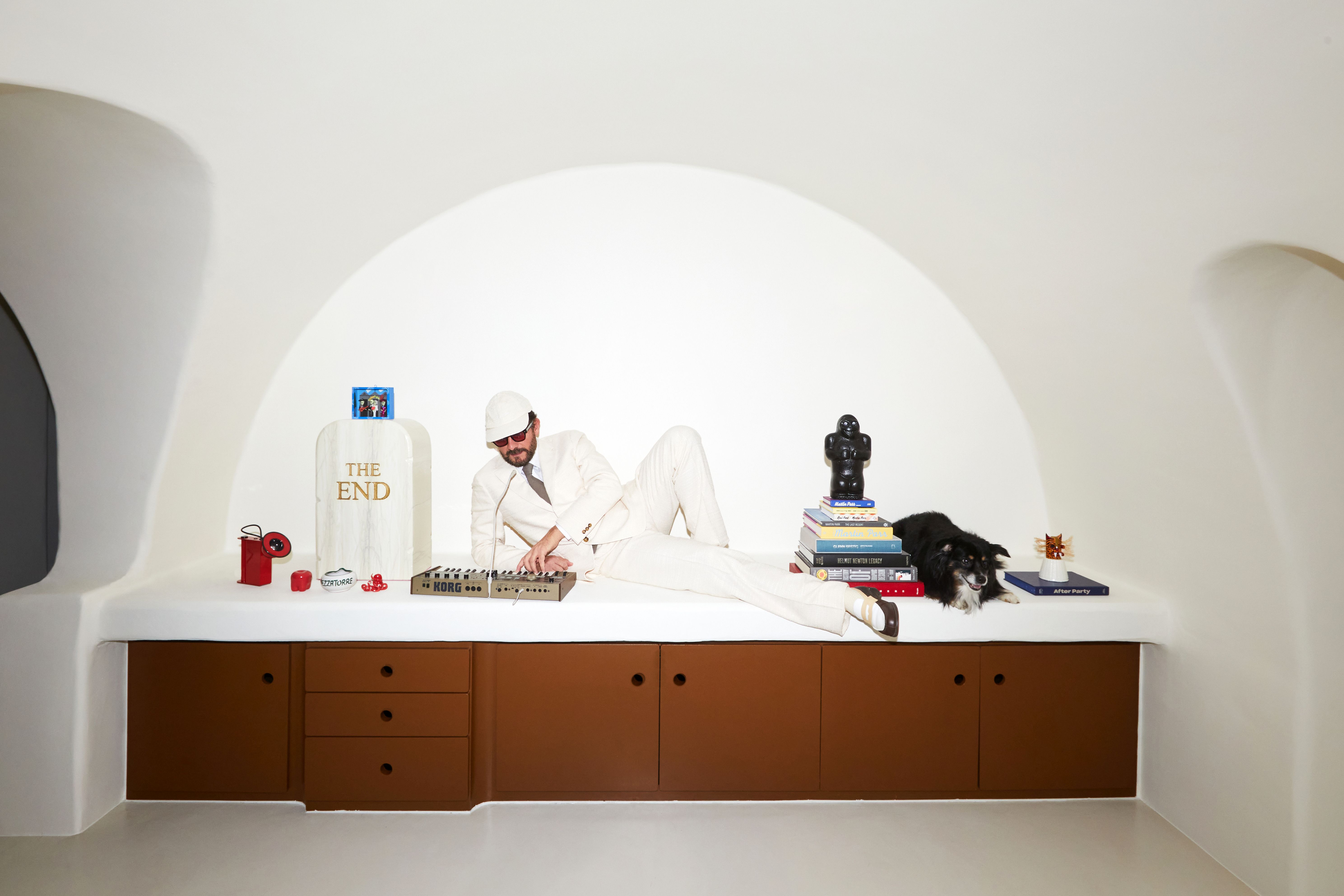
Published
Name: Stephen Fasano aka The Magician
Nationality: Belgian-Italian
Occupation: Producer, songwriter, composer, DJ
Current release: The Magician's "Never Alone," featuring Alioth, is out via Potion. Full-length album VOYAGE will follow in November 2024.
If you enjoyed this interview with The Magician and would like to stay up to date with his music, visit him on Instagram, Facebook, and tiktok.
In 2024, disco seems to be everywhere. What makes this music so incredibly timeless and which of the current wave of commercially successful artists do you personally appreciate as well?
To me disco, disco/funk is the first genre that built so many DJs. It has some rules, you need a 4/4 kick drum, a snare, a clap or both, some hats, a bass line real or synth, a hook vocal or synth, some chords and a good arrangement / structure of all to make you dance. It’s actually pretty simple.
From house to techno, a lot of electronic music genre are derived from disco and are timeless. I really like Braxe + Falcon, Eagles and Butterflies, Jimi Jules, Lindstrom, DJ Koze, Gerd Janson, ANOTR, Justice, SG Lewis and many more.
[Read our Braxe + Falcon interview about the Buchla 208 + 200e]
Do you still remember the first time you discovered disco for yourself? What drew you in?
Very young my dad used to listen late 70s and early 80s music with artists like Abba, Chic, Giorgio Moroder, Michael Jackson, Cerrone, Kool and the Gang, Alan Parson Project, … But I had no idea it was called disco.
Then I was about 12 years old and I was fascinated by mixing 2 records together on vinyl. My uncle was a DJ, not professional but passionate. He offered me a turntable and some records for my birthday. Those records were from the 70s and 80s and I started to dig funk and disco.
A bit later, as I had not much money to buy records, I had no choice to train myself by mixing old disco records with the occasional new house record from Chicago or New York.
Why is disco such a great and rewarding area for you personally as an artist?
I have the feeling in the old disco era, everything was possible. It was so creative, so rich musically. When I make music I always think of this and that gives me motivation and happiness.
Also, probably because I grew up in the late 70s/80s, and my spirit has been marked by that era.
From your point of view, what of your personality and individual approaches do you add to the classic sound?
Probably a modern version of it with my own ideas and feelings.
There are several countries with a strong disco tradition. I wasn't aware of Belgium so much in that respect. Tell me about your perspective on it, please. What is the relationship between the original American disco and your personal take on it?
Each country has its own part of the genre. Where the music was allowed to be played on the radio, there was disco. American disco is different than German disco, Nigerian disco or Belgian disco.
To me Belgian disco has always been a bit surrealist and made with the Belgian humor touch. Belgians do not take themselves too seriously.
But I’m half Italian and that’s why my music doesn't sound 100% Belgian. The Italian’s emotion and melodies have a big role in my music.
What defines disco for you?
Happiness, energy, nostalgia.
I find it fascinating that disco, even more perhaps than rock, has always had an entirely universal appeal and animated musicians as far away as India or Africa to make music in this style. What is it about disco that makes people everywhere like it?
Because disco is happy and people need happiness everywhere in the world.
I love the fact that elements from each country are added.
Disco has always been negatively compared as a purely hedonistoc music compared to the supposed “seriousness” of rock. How do you see that yourself?
Yes for sure, but again, it’s all about a mindset. I know disco producers with a rock mindset and the in the other way.
I love the mix of both, especially happened mid 80s with group like The Human League, Blondie or Roxy Music.
There have been groundbreaking experiments in disco – from “I feel love” to “Love to love you Baby.” Which of these interest you and how much room for experimentation is there in your own work?
I don’t consider myself as an experimentalist. I used to be like this younger as a DJ.
Talking about those songs ... they are timeless classics to me and I always keep them on my mind when I compose music.
Everything has been made in disco, the new disco we hear nowadays are just revivals/remakes.
Disco has always included electronic means, but it was built on a foundation of tightly performing live musicians. If ones recreates disco with electronic means on a computer, what gets lost, what is gained?
This happened with Italo disco. With massive new synths coming to the market in the early 80s, producers used to experiment on those new synths by recreating bass, melodies, chords and even vocals with vocoder.
What is lost is a certain groove with real instruments but what is gained is the easiest way to produce music.
Your upcoming full-length Voyage is a big, ambitious work. What were some of your considerations when starting work on it?
Thank you. Before the pandemic I used to tour a lot and I never took the time to really sit down and compose an album from A to Z. In 2020 I had time to think about my career and I had the feeling I was running out of time, running to a certain success. I realized also that I wanted to make the music I like 100% without making any concession.
I started to compose new music from scratch in my studio then I developed more and more ideas until I had about 20 demos. So I was like: maybe it’s time to make an album.
I really feel like Voyage is getting stronger with each listen – I was actually deeply moved by the intro today. What do you still remember about the recording process for the new material and how did it unfold?
LIke I said, I made about 20 demos that I developed to have a good instrumental structure. From there I started to look for singers, singers I really like. Most of them accepted to work on my music. I went to record each of them, from LA to London or New York to Paris. I followed the whole process of recording.
I also needed the help and a different ear from another producer to make the process smoother and have a little French touch on the album. I thought about a producer from Paris called Etienne Copin (alias Samaran, Peter & The Roses).
A great disco piece needs to find the balance between songwriting and groove. Taking the songs "Voyage" as an example, how did this for this album?
It’s interesting you’re talking about that “Voyage” track, it’s a pure instrumental composition. Very inspired by some of my favorite 80s TV series.
What were some of the most important pieces of equipment and gear for Voyage?
As analogue gear, I used a lot the JUNO-106, The Moog One, Kong Triton, DX-7 and the Solina.. As drum machines a lot of tr-707 and Linn Drum. But also some software synths like OBX or Jupiter 8.
[Read our Juno-106 feature]
What's your perspective on using vintage equipment versus contemporary one, especially when working within a style which originated many years ago?
It’s more pleasant to work on a vintage synth than a software, the object is beautiful, it’s pure pleasure actually.
The sound itself is pretty similar though. I use both, analogue and software instruments.
I saw a great video on your Instagram of the Brionvega turntable. Is this actually yours? Can you tell me a bit about your connection to vinyl culture, hifi culture and design?
Yes it’s mine, I love the design, and I love design and furniture in general.
The sound fo the Brionvega is not very good though. It’s more a nice object. I have Technics SL-1200 to a nice JBL Soundsystem to listen to music.