Published
Part 1
Name: Manuel Pasquinelli
Occupation: Drummer, composer
Nationality: Swiss
Recent release: Manuel Pasquinelli's new album HEARTBEAT DRUMMING: Bellmund Session is out now. The concept behind this solo project is simple, as Manuel explains: "I play the drums at the tempo of my own heartbeat. That is, I take my heart as an unsteady natural metronome. Playing the drums in this way is an intense, I’d even say transcendent experience."
Recommendation for his hometown: I don’t live in a “town,” but in a small village in the countryside. If you happen to walk by, you should take a moment to enjoy the view from the two linden trees on the hill called Ballenbühl.
If you enjoyed this Manuel Pasquinelli interview and would like to stay up to date with his music, visit his official homepage. He is also on Instagram, Facebook, and bandcamp.
Over the course of his career, and through bands like AKKU Quartet, and Sonar, Manuel has worked with a wide range of artists, including Stephan Thelen, David Torn, J. Peter Schwalm, Jon Durant, Andi Pupato, Markus Reuter, Tobias Reber.
[Read our Stephan Thelen interview]
[Read our David Torn interview]
[Read our J. Peter Schwalm interview]
[Read our Jon Durant interview]
[Read our Andi Pupato interview]
[Read our Markus Reuter interview]
[Read our Tobias Reber interview]
It seems as though most aspiring artists are drawn to the drums and percussion for one of two reasons: Creating sound/noise and creating rhythm. What captivated you?
I think for me it was the fascination with creating rhythm, and the possibility to play with all four limbs. As a kid, I used to drum on tables with my hands and later built my first drum set out of wooden crates.
I had an early fascination with odd and polyrhythms, which still continues today. But of course, the sound those rhythms are played with is crucial.
When I listen to music, I see shapes, objects and colours. Others experience emotions. Everything around drums, on the other hand, is based on touch, vibration, and movement. Does this mean that your own perception as a listener is also more connected to touch, vibration, and movement? What happens in your body when you're listening?
When I listen to music, I associate each song with a certain feel, texture, surface, and consistency. The drums and the sounds of the drums have a big influence on that surface quality.
For me, groove definitely has an emotional component. The touch—how the drums are played—significantly shapes the emotional message of a song. For me, it's not an either-or; touch, vibration, and movement directly influence the emotions and the plasticity of the music.
I'm an emotional listener. When it comes to evaluating the mixes of a new production, for example, I rely heavily on the physical sensation I get while listening. If the mix is not yet balanced, I feel physical discomfort and have to force myself to listen through the song. When everything is in its place and the sounds are right, it feels good and relaxing, and I feel like turning up the volume.
The challenge in this process is putting what I feel into words.
What was your first drum set like and what are you using today? What, to you personally, are factors in terms of build and design that you appreciate in drums and percussion instruments?
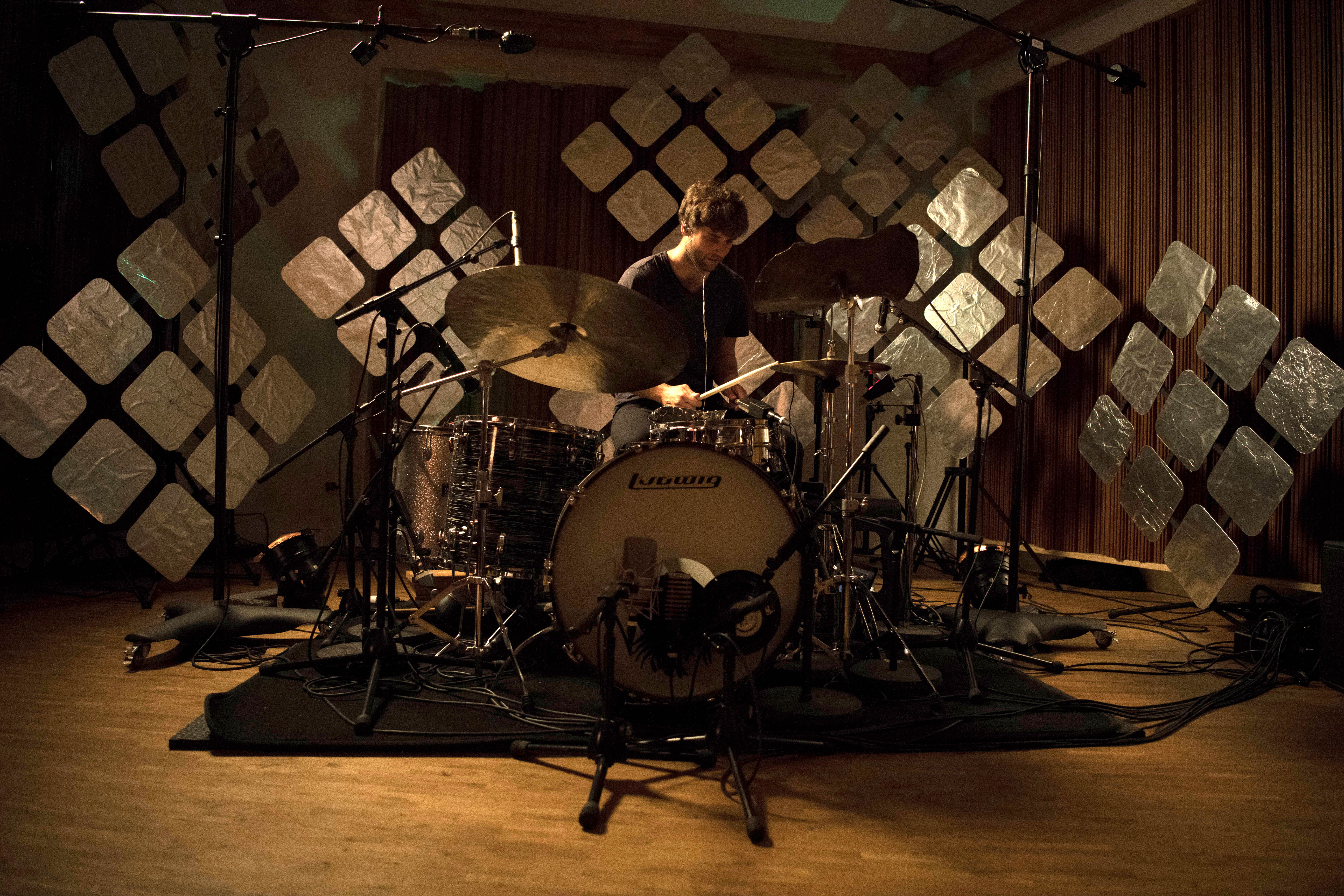
My first drum set was homemade, built from wooden crates. After that, I played a basic Sonor rock drum set. For about ten years now, I’ve been playing a Ludwig kit from the mid-’70s. In general, I prefer warm sounds and cymbals that don’t sound too harsh or annoying.
Most of the time, I use a 22" bass drum and 12" and 16" toms—but it depends on the music. If a lighter sound is needed, for example when playing with a string ensemble, I use my Hanus & Herth kit with wooden hoops and an 18" bass drum.
I prefer incorporating individual percussion elements (repurposed objects or broken splashes) over mass-produced standard gear, to give my drumming a more personal touch.
Late Rush-drummer Neil Peart said: “The equipment is not an influence. It doesn't affect the way I play. It's an expression of the way I play.” What's your take on that?
For me, the sound of the instrument does affect the way I play—a lot. Depending on how the equipment sounds, I come up with different ideas. As much as I love my Ludwig, it's always refreshing to play on other kits.
But again, it depends on the music—whether I want to impose "my sound" on the kit, or whether I adapt to and explore the sound of the kit I'm given to play.
What were some of the main challenges in your development as a drummer / percussionist? Which practices, exercises, or experiences were most helpful in reaching your goals?
On the one hand, I enjoy defined, sophisticated grooves; on the other hand, I love the raw energy and playfulness that can be expressed through the drums.
I find it an exciting challenge to bring these two approaches together and to strike a balance—varying composed grooves without deconstructing them, and playing minimalist patterns with energy without being flashy or gimmicky.
A particularly meaningful experience in this regard was the recording session for the Vortex album with the band SONAR and David Torn.
It was David's first time playing with us, and his approach added a raw, emotional layer to SONAR’s carefully constructed music. He inspired me to breathe life into the structured grooves and to navigate the edge between discipline and playing with abandon.
Also in my solo project HEARTBEAT DRUMMING, it's a balancing act between active, soloistic expression and a minimalist, stripped-down style played at the tempo of my pulse. This tension is a major source of fascination for me.
How would you describe the physical sensation of playing the drums?
By its very nature, drumming involves the whole body. I generally feel the resonance most strongly in my chest and abdominal area.
Tension and relaxation are important elements in this. A certain amount of body tension is needed, but at the same time, the drums should be played in a relaxed way. Musically, it can make sense to explore the limits of tension and release and use them as expressive effects.
After a concert, I often feel so full of energy that I’d love to play another one right away. I love the physicality and directness of drumming. This comes through especially strongly when I play loudly—as is often the case during live performances with SCHRÖDINGER’S KATZE.
When I play the same rhythm for a long time, I enter a flow state that feels really good. When I practice coordination—independence exercises involving all four limbs—it makes me feel happy.
And funnily enough, during intense practice phases, I come up with way more wordplays. I believe making music has a greater influence on us than we’re usually aware of.
What is the relationship between harmony, rhythm and melody? How do non-percussion instruments contribute to the overall rhythmic texture of a piece?
It depends on what the music is focused on. These three elements—harmony, rhythm, and melody—are deeply interdependent, and I don't think it makes sense to view them in isolation.
The effect of a harmony depends on the rhythm in which it’s played. There's a big difference between a passing chord and a pad that sustains for several minutes. A melody always has rhythm, whether it's metronomic or agogic. And rhythm is always shaped by its musical surroundings.
In HEARTBEAT DRUMMING, for example, the harmony of the background sound influences the way I play. The melody defines the direction of the rhythm. Even percussive elements can take on melodic functions, without the presence of a typical melodic instrument.
I find it exciting to break up the typical roles of instruments. As a composer, I see my band AKKU QUINTET as a single organism, in which harmony, rhythm, and melody are not tied to specific instruments.
Every instrument—even non-percussive ones—plays rhythmically and contributes to the rhythmic texture. At the very least, they highlight the rhythm and help shape how it’s perceived.