Published
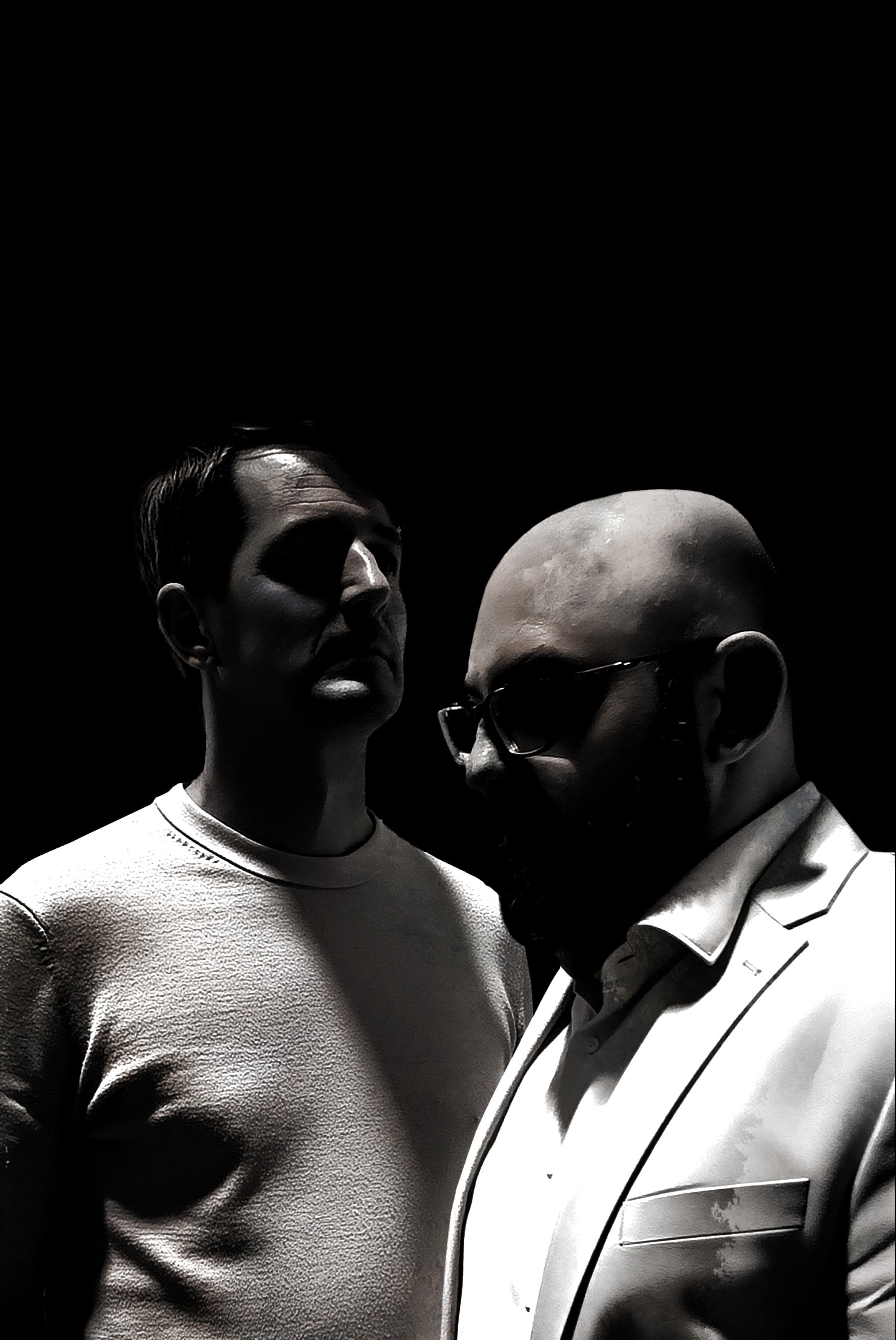
Names: Markus Guentner, Joachim Spieth
Nationality: German
Occupations: Producers, composers, sound artists
Current release: Joachim Spieth's latest solo album Vestige is out now. Markus Guentner has a new full-length out on May 15th 2026, Aeris. They also teamed up with via Pepo Galán for Obreel, slated for release on June 5th 2026 – all on AFFIN.
If you enjoyed this interview with Markus Guentner and Joachim Spieth and would like to know more about their music and upcoming performances, visit their official websites: Markus Guentner; Joachim Spieth.
For a deeper dive, read our earlier Markus Guentner interview and Joachim Spieth interview.
Joachim, can you briefly talk about how your musical collaboration with Markus Guentner started and why you think it's turned out to be so synergetic?
Joachim Spieth: We had been in contact for many years and had talked about collaborating long before it actually happened. When we finally started, it felt very natural.
There’s a certain understanding that doesn’t require much explanation. That makes the process very fluid. You send something, the other person reacts, and it develops organically. Furthermore, musical collaboration is "only" one aspect of our collaboration.
Whether visually, where he is naturally the driving force, or from a release perspective - demos, collaborations with others ... there's always a lot to discuss, and this has become more consistent over the last few years.
AFFIN, from the beginning, was a label based on physical formats, beautiful packaging, and a distinct visual style. How do you see the connection between image and music yourself?
Joachim Spieth: I would be lying to say that everything is mutually dependent and that there is always only one possible solution. They are spaces of possibility, and within them exist connections, preferences, a fundamental aesthetic that one likes, and that's how things come together.
Over the time, we’ve developed a shared visual language that reflects the music quite closely. Through ongoing exchange, there’s a strong alignment in how we perceive things, which makes the visual side feel like a natural extension rather than something separate.
Markus, can you tell me a bit more about the starting points and ideas behind your work with the photographs? Were they intended as cover art from the outset, or were they meant to stand on their own?
Markus Guentner: I hadn’t actually worked on record label artwork for quite some time.
When Joachim and I started discussing possible new graphic approaches for AFFIN, it became clear very quickly which direction we wanted to take. Joachim and I seem to share the same thoughts, ideas and tastes when it comes to visual matters and how certain things can and should be presented.
We agreed very quickly that it should involve something ‘organic’ (nature photographs) and digital editing. And of course, the priority is that the works should function as covers … yet they can and should also be allowed to stand on their own.
What do you express through music, and what through visual art?
Markus Guentner: The strange thing is that I don’t really want to express or say anything specific … and initially, I can’t really do that anyway. Both the graphic and the musical works arise for the most part from a whim, or rather, a feeling … which I can never quite put into words and therefore don’t consciously incorporate or process into anything.
Since I rarely approach anything with specific ideas, it’s more about the state I’m in at that moment … what then comes to expression tends to emerge during the process … somehow even like a kind of therapy, in which you reflect on what’s happening right now or why it turned out the way it did.
I never force myself to compose or produce anything … or to create something in my visual work. I don’t want to have to force myself into anything… it happens when it happens.
Joachim, I believe that's quite similar with you, right?
Joachim Spieth: Inspiration often arises for me through walks, so often in nature, the weather, the clouds, the light. This often creates a general mood, which probably goes beyond a picture in the classical sense. It seems to be spatially represented; one is immersed in spaces that are then translated into sound. The inner life connects with the outer.
Sometimes, while I'm doing it, I don't even know if it feels euphoric or sad ... it blends together, but that's essential
The series, as I understand it, is based at least partly on your interest in the ‘unpredictable’ structures of nature. What, exactly, interests you about them? Is this ‘randomness’ something that is also reflected in your music?
Markus Guentner:That’s right, it’s definitely the random, the organic, that makes it so appealing to work with. A photograph of a plant, a tree, a stream is a purely random snapshot of a moment that will never happen again … a second later the stream looks different, a leaf has turned in the wind, and so on.
And it’s exactly the same in my music, where I use field recordings to a large extent. That natural sound existed only in that one moment and isn’t really reproducible … and is therefore always something special.
And even when actually working with the material, it’s always a matter of chance whether you can and want to use it… and, above all, HOW. Ways and means can open up that you hadn’t even thought of before or hadn’t yet discovered.
Where do the originals come from? Are the photos taken with a specific aim in mind, or independently of the subsequent editing?
Markus Guentner: Funnily enough, the whole thing is almost a collaborative effort between Joachim and me when it comes to the work for AFFIN.
Joachim spends a lot of time out in nature and takes a lot of photos … he usually supplies me with plenty of photos. That’s why it’s usually only afterwards that my thoughts start to turn to what could be used and how it could be processed.
But of course, sometimes there are certain ‘motifs’ that you photograph and somehow already know you can use them well and how you could edit and process them.
What transformations do the photographs undergo from the original to the final edit?
Markus Guentner: It varies considerably. For the most part, the whole process is digital. Most of the time it’s based on a ‘layering principle’ … cross-fades … bringing out details … adjustments … retouching.
Sometimes, though, I also print out certain motifs, then photograph or scan them again for further processing, because this adds another layer over something ‘analogue’, which can have a (rather subconscious, but) significant influence on the final result.
I like how this mirrors the increasing sensation of “depth” that I've noticed in your music, Joachim, this feeling of the work extending into space. What were some of the concrete steps to arrive at that sound?
Joachim Spieth: Perhaps it's the interplay of space, and volume levels ... I think, compared to earlier productions, I'm more conscious of volume levels, so that sometimes one element stands out, sometimes a beat is more noticeable ...
From a spatial perspective, things have improved a bit, too ... I use a lot of EQs, less obvious effects ... not 20 different reverbs in one track ... this seems to allow the "ensemble" to divide the space better, sometimes highlighting one element, sometimes another ... The goal was definitely to achieve a cleaner sound... But you're never really finished with that ... (laughs)
Sometimes reducing something can create more depth than adding layers. It’s about tension, contrast, and allowing certain elements to breathe.
Would you say that the process is very much “guided”/controlled by precise ideas, or is it one of constant discovery?
Markus Guentner: To be honest, a great deal happens by chance, or rather, much of it arises from previous steps. For me, it’s rarely a guided process … things emerge as they must … it grows naturally. Through trial and error, adding, taking away, and so on.
Of course, you can steer certain things through technical skills, and you know what needs to be done to achieve something … but you shouldn’t be too controlling, as that would limit yourself too much.
Do you listen to music whilst working on the photos?
Markus Guentner: Mostly, yes. Music is very helpful … especially, of course, when it comes to creating specific artwork for an album. In that case, the mood and theme are crucial - and also helpful.
However, there are also projects outside of that. But even then, music is a good companion.
Is the final cover abstract art?
Markus Guentner: It’s definitely abstract. And that was/is also the underlying concept behind the work created specifically for AFFIN.
The union of the organic and the digital … just like in music … abstracting the organic, engaging with the material, rather than simply using functional elements and mechanisms.
Also taking things out of context to create something new and different that isn’t immediately obvious.
How do you see the connection between the music and the artwork? How would you describe the synergy?
Markus Guentner: I do consider the visual aspect of music to be extremely important. You start to associate certain things … and with music, it’s primarily visual imagery that you link to the music. And people always associate the cover and artwork with the music.
Unfortunately, this aspect gets rather lost in the age of streaming and playlists, even though it is precisely this that constitutes the connection and also a certain value (and absolutely not primarily monetary).
And I think that is exactly what my work is about and what I want to ‘make clear’ in a way. One supports the other, they go together, intertwine… and it is not meant to be a purely musical or purely graphic work.
Does looking at Markus's cover images change your own view of the music you created – or even inspire you to move into a certain direction musically?
Joachim Spieth: I think it's a kind of interaction.
As I've already mentioned, we're in contact very regularly, showing each other things, discussing new ideas, the next steps, or reflecting on the past. This creates a dynamic, and to some extent, a collective memory. So I'd say it's probably not "that one cover" that moves me to new music, but rather the exchange itself.
Before Markus took over the visual storytelling at Affin, he had plenty of time to get a feel for what had been released up to that point. And at a certain point, we defined certain parameters that the label should be guided by. This wasn't a "to-do" list from my side, but rather a shared understanding.
Many things fall into place almost automatically this way; we almost never disagree, and one of us can concede to the other because, fundamentally, everything fits together. It's very relaxed and productive.
Some of the covers on the Affin website are marked ‘on canvas’ – are the images also available as prints?
Markus Guentner: Yes, that’s right; many of the works are available as art prints on canvas, Dibond, etc.
One piece (ONDA) is available to buy on 30x30cm aluminium Dibond from AFFIN. The rest are currently in my own collection.