Published
Name: Markus Mehr
Nationality: German
Occupation: Sound artist, field recorder, composer
Current release: The stereo version of Markus Mehr's SUPRA is out via gruenrekorder.
If you enjoyed this Markus Mehr interview and would like to know more about his music, visit his official homepage. He is also on Instagram.
Do you experience strong emotional responses towards certain sounds? If so, what kind of sounds are these and do you have an explanation about the reasons for these responses?
Field recording has opened my ears and readjusted my definition of noise. Engine noises can carry a beautiful tonality, a city doesn't just have to produce an annoying cacophony, but can create stimulating clusters.
It is focussed listening, consciously letting in instead of blocking out. Every environment becomes a sound space. Whether indoors or outdoors, we are always surrounded by sound and an undiscovered noise could be hiding behind every corner.
As my works always follow a concept, I always find myself in places with specific sounds, e.g. airports or bodies of water, during a period of searching and recording over longer periods of time. However, there are generally no specific sounds that evoke strong emotional reactions in me. A unique recording always inspires me.
SUPRA deals with very specific aspects of nature. How would you describe your own connection to - and relationship with – nature? How intimate and deep can this relationship be in an increasingly urban world?
I grew up in a tower block on the outskirts of a medium-sized southern German city in the 70s and 80s; a typical ‘central heating child’.
What I mean by that is that my view of nature is initially a view through the window. I don't have to spend all my time in nature or moving around, talking to the trees or walking barefoot over moss. But if you spend the early morning hours in the forest, as happened for SUPRA, pressing the record button and putting on the headphones, then after a short time something contemplative happens, a feeling of humility sets in, an inner balance.
Of course, this is devotion to the moment, but at the same time there is a sense that we are actually a small part of this overwhelming web. This fundamental connection to something bigger is increasingly being lost in our digital everyday lives, but on the other hand, it cannot simply be ‘evolutioned away’ in just 200 years of industrialisation.
So when I look out of my window at the trees in front of my studio and see the stress they are under in summer, I feel a strong sense of empathy, but also responsibility, helplessness and guilt.
In a few conversations with Michael Begg, specifically about climate change, he mentioned that, to him, one goal was to establish “new musical forms for the anthropocene,” as well as “new relationships between sound makers and listeners.” How do you see that yourself?
‘New musical forms for the Anthropocene’ ... boah, that's a very ambitious goal. I have a vague idea of what Begg means by that, but for me it's too big, too powerful, not even remotely comprehensible in its complexity and therefore artistically irrelevant for the time being.
I do think that as an artist, just like as part of civil society, you should participate in political and cultural design processes. In my case, however, this happens on a small scale, in seclusion, in the artistic concepts that I pursue and develop. I don't think in terms of epochal scales, but in terms of spaces of possibility that allow for intervention and design. Anything else leads to frustration. These are subtle, intimate, often barely perceptible movements and interdependencies whose work contributes to something greater, to the common good, a supraorganism.
But this is where we humans come up against a problem: altruism. I think we are currently living in a kind of Egopocene. We still have our foot on the gas as if there were no tomorrow. In my opinion, this self-centredness can also be found in the relationship between musicians and listeners. It's not just the industry or ‘the system’ that is bleeding musicians dry. It is essentially the consumerism of us all; the greed that everything is always available for next to no money and above all available to ‘me’.
The centrifugal forces of our egocentrism affect both areas of your question. If we don't create a real U-turn here as quickly as possible, we will see merciless supraorganisms in the form of climatic and cultural changes. And these will then be of epochal proportions.
When it comes to field recordings of nature, what interests you? What role does your personal taste play for works like SUPRA, versus the role of specific sounds as part of the composition?
My personal taste plays virtually no role at the time of shooting. At this moment, I'm just a hunter-gatherer and procure the ingredients for the dish. Processing and ‘flavouring’ is done later.
The territory in which I hunt determines the concept that precedes all my works. The role of the sounds within the composition only comes into play later and is customised to my taste, so to speak.
The press release to SUPRA speaks about a “fascination emerging from complex creations of nature and their interaction.” What,to you, were concrete objects of this fascination – what was the starting point for the creative process?
It all started about three years ago with a check of a new microphone in nearby woods. These ‘pilot recordings’ were a kind of initial spark.
The forest as a blueprint is easy to imagine for a concept that revolves around superorganisms. All the lichens, mosses, fungi, trees communicating with each other, exchanging information, fending off external threats, taking care of and protecting each other, forming alliances, and so on.
At the same time, it was clear that I didn't want to work exclusively with recordings of flora and fauna, but would also take other ‘ecosystems’ into consideration. Let's broaden our view to the human body: a fascinating interplay of processes, mutual conditions and interactions. Think of metropoles and the countless interactions that keep them running.
From classical orchestras to the intersecting oscillators of a modular system, from chemical fusions to the merging of two black holes - everywhere reciprocal, crystalline processes that, after their transformation, produce something superordinate that is more significant than the individual elements. I wanted to depict all these phenomena acoustically.
What do you think can sound capture about these creations that maybe some of our other senses can not?
I think it depends on your personal preferences. I have friends who cook out of this world. It makes you realise that taste or smell can catapult you into new spheres. Personally, I am an audio person and prefer the sense of hearing to the other senses. But of course I can be deeply moved by photographs, paintings or graphics.
What is important is that we sensitise the respective sense, that the imagination is triggered, that we are gripped by emotional waves on which we can surf away from everyday life for a certain period of time. Eye, ear, mouth, nose, each sense can be a gateway to a new world.
The press release also speaks about “interrelationships of different natural phenomena leading to an individuality of a higher order through complex communication, but without hierarchy, are their inspiration.” Thinking about it, this could very well be a description of musical processes as well. What do you make of the idea that art in many respects mirrors the complex processes of nature?
Absolutely. Whether you're working on a sound sculpture, playing in a band or in an orchestra, it only works if all the components harmonise with each other. And the better the components harmonise, the more coherent the result.
Our entire planet is a huge bioreactor with countless micro-subsystems that all make a specific contribution to the whole. Everything vibrates, everything morphs, everything is mutually dependent.
I found a passage quite interesting which speaks about “searching for the sound behind the sound.” What does that mean, precisely, and how did that goal guide the creative process?
I don't use my recordings in a documentary sense. They are source material for further, often very drastic processing. What I mean is a microscopic, dissecting process. An original sound that is broken down, enlarged, stretched, shortened, slowed down, accelerated, granulated, refined and reassembled reveals sound surprises that we do not perceive when listening to it regularly.
Everything is allowed in this step, there are no limits, I am only guided by the search for something touching. It is exciting to distil and cultivate such sound discoveries from the original. Whether a sound is suitable for a loop, for a synth-like pad, for a supporting element of a later composition or whether it only appears briefly will become clear as the composition progresses.
Tell me a bit about the process of collecting the recordings for SUPRA, please, and where they are from?
In my home town of Augsburg, you can get to the countryside very quickly and the sound reservoirs are almost inexhaustible. All the recordings of communicating ants, mating frogs, nesting birds, gurgling biotopes and swamps, drinking trees, etc. are from my neighbourhood.
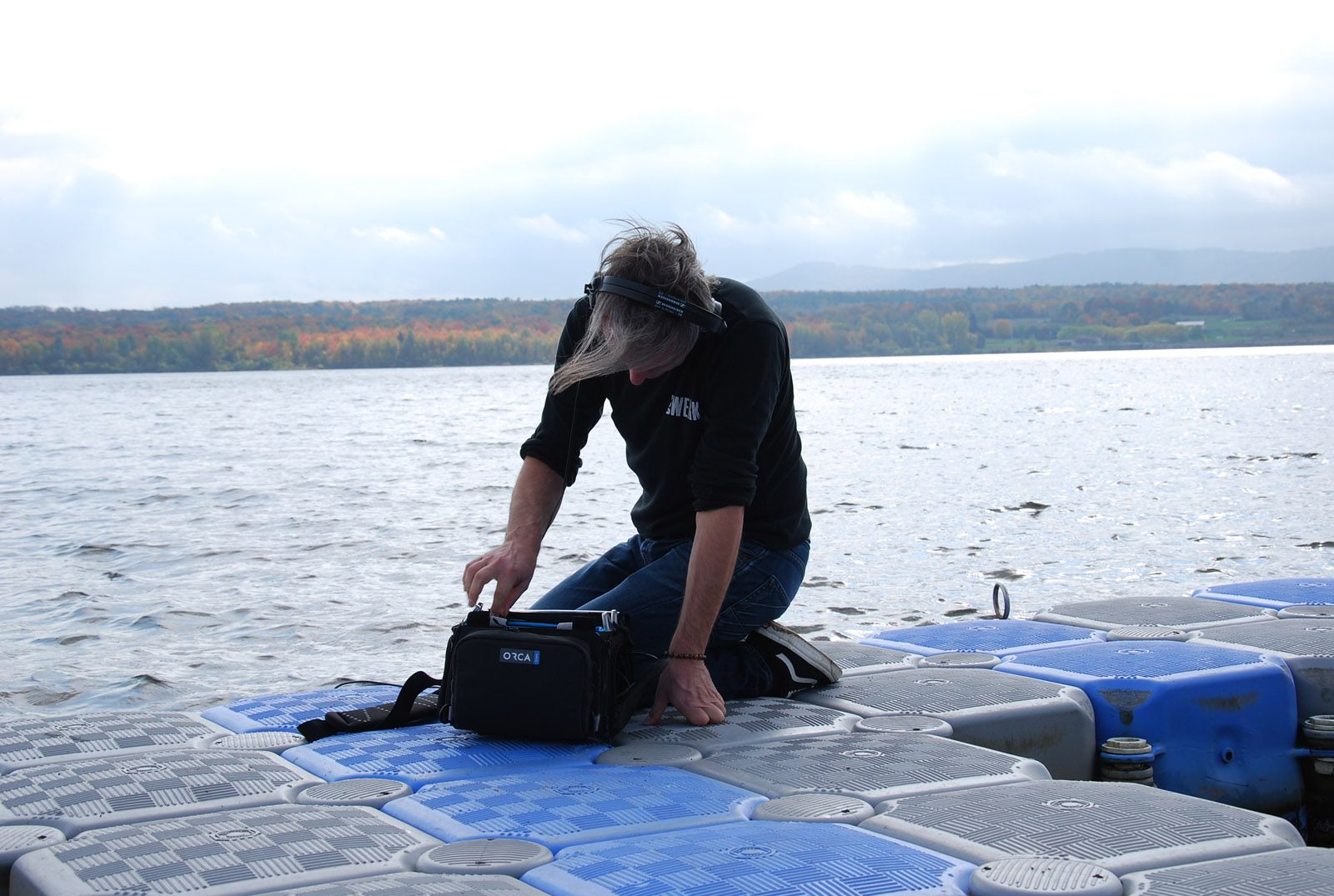
Most of the recordings were made with a Soundfield microphone, omnidirectional microphones and various contact microphones as well as a geophone. For a few sounds of the human body, I got tips from my daughter, who studied medicine and who led me to some very useful websites.
The merging black holes were sent to me by my friend and companion Florian Jung, physicist and budding astronomer, who also developed and built the incredibly aesthetic sound system for the SUPRA installation.
What's your take on how you, as a recording artist, influence the results we hear in the finished piece? Does it matter?
100%. As I said, I proceed exclusively conceptually and therefore I determine certain fixed points through the task alone. So I try to exclude pure arbitrariness.
And yet it happens that the unplanned recordings, i.e. sound foundlings, acoustic coincidences or artefacts, enrich the recording session and sometimes even become the supporting pillars of a composition.
Mistakes are friends, not enemies.
What was the arrangement process for SUPRA like, and how did you approach the LP version compared to the surround sound installation?
In the meantime, I have developed my ‘navigation system’, which has also guided me in the creation process at SUPRA.
After editing the recordings, I start arranging them. In this very free-spirited phase, I sound out which sounds suit the main and supporting roles - a kind of sound casting. The next steps are more serious and often tedious. Goal-orientated, sometimes painful decisions have to be made: what can stay, what has to go?
Sound engineering also plays a role now, because not everything that sounds interesting sounds good and vice versa. How do I distribute the dynamics in a composition and how long can the tension be maintained? The decision-making process often takes days, if not months, and a choreography of sounds is often discarded and rearranged several times.
In the end, I always create a stereo mix first, which in this case was also used as the LP version. If the sound plot is coherent in the two-dimensional version, then it will also be coherent in the Atmos version. The transformation to the 7.1.4. system is then a wonderful, delicate work step and is once again full of creativity.
But discipline is also necessary. You very quickly fall into a kind of ‘Mickey Mouse trap’ if you let the sounds ‘fly through the air’ too much. The statics of the composition must not suffer from the technical possibilities.
One of the ideas behind SUPRA was to create an “homage to the diversity of nature.” How did that influence your involvement in terms of maintaining a balance between careful composition and leaving the natural sounds intact, just the way they were?
I'm not so much interested in just collecting sounds and playing them back in a different context. As described, no sound really remains unprocessed - sometimes less, sometimes beyond recognition. In this respect, there is no compulsion to make a decision and no weighing up in the sense of your question. I abstract the sounds very much and try to tell a story with them and through them, not about them.
The bowing quoted above takes place through the intensive and sensitive examination and not through a museum-like ‘display’. Deciphering what is still hidden deep beneath the surface in a sound particle is my artistic offer. All my recordings don't need me, but I need them. My reverence lies in this realisation alone.
SUPRA is presented as an “audio sculpture.” In which way do music and sound feel “material” to you? Does working with sound feel like you're sculpting or shaping something?
Yes, and in German we differentiate between "Sculpture" and ‘Plastik’.
While in a sculpture - as in sculpturing - a work is carved out of something solid, in a "Plastik," element by element is added. Everything builds on and depends on each other.
The latter describes my working method more precisely. I gradually reassemble the previously created sound fragments into something new. This creates something new from something that already exists. By arranging them as an Atmos installation, the sounds become even more spatial and differentiated, but not really ‘material’.
Sound is moving air, so it is not tangible and that is wonderful.
Even under headphones, SUPRA is a powerful, sometimes even unsettling experience which will remain personal for every listener. Still, is there something that you wish for the audience to take away from it?
Oh, first of all, thank you very much for the positive feedback, that really makes me happy. It's a bit of a ‘wolf in sheep's clothing’ principle:
SUPRA is intended to be an enchanting listening experience, but it can also be disturbing, because the situation is serious. The six pieces have very poetic, melancholic, elegant passages, only to come across as threatening, almost aggressive in the next moment.
These are again the dynamics and cycles that we find everywhere.
Seth S. Horowitz called hearing the “universal sense” and emphasised that it was more precise and faster than any of our other senses, including vision. How would our world be different if we paid less attention to looks and listened more instead?
In view of the fact that the ear can perceive omnidirectionally and the eye cannot, Seth S. Horowitz is probably not entirely wrong. In former times it used to be very important to know what was lurking behind or above you.
It is precisely this instinct that SUPRA utilises as a multi-channel installation and it is fascinating how this listening experience captivates you. Audio art via 12 speakers is a deep, almost mystical experience, and closing your eyes feels natural. The sensory overload of our urban world applies equally to images and sound.
However, you don't have to look everywhere where it's shrill and not every message is worth listening to. Our conversation is also visual for the reader and hopefully proves that the origin of the sensory impression is less important than the content.