Published
Part 1
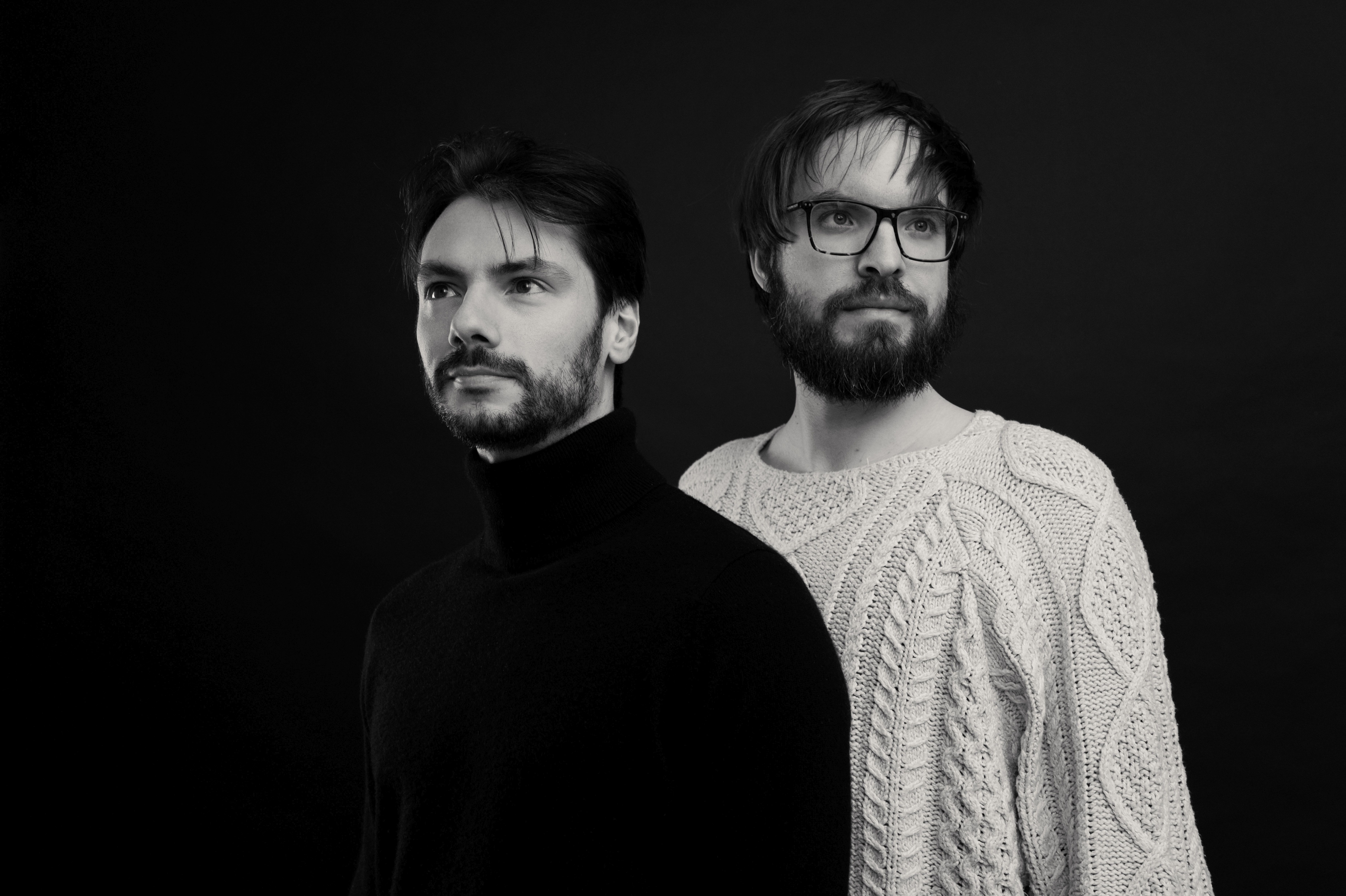
Names: Matteo Pagamici, Michael Künstle
Nationality: Swiss
Occupation: Composers
Current release: Matteo Pagamici and Michael Künstle's collaborative album Dimensions is out via Handcrafted.
Hometown recommendations:
MP: I’m currently based in Zurich. I recommend a simple stroll by the river during sunset. It’s where all the magic happens!
MK: I’m travelling between Warsaw and Basel and both cities have so much to offer. Basel in summer offers so many music festivals worth going to. Warsaw strikes me every time with the history of the city and how you feel it walking through the streets.
Things I am passionate about but rarely get to talk about: MP: Icebergs! Why aren’t more people talking about icebergs?
If you enjoyed this Matteo Pagamici and Michael Künstle interview and would like to stay up to date with their music, visit their respective websites: Matteo Pagamici; Michael Künstle.
The borders between producers, sound artists, and even songwriters are becoming increasingly blurry. What does being a composer mean today, would you say?
MK: I think it’s an extremely exciting time to be a composer today. That the borders become increasingly blurry partly has to do with budget constraints, partly thanks to the tools that are much easier available for everyone.
Today a much more holistic approach is possible to achieve, especially when writing music for speakers. I also think that music can be much more personal, e.g. because a composer performs an instruments extremely different from anyone else.
Many people perceive classical music and contemporary composition as having high barriers of entrance, both for listeners and musicians. What have your own experiences been in this regard?
MP: I actually had a similar experience when I was studying composition in university.
I felt a strong division between functional music (e.g. music for film or television) and absolute music, almost as if non-academic music were less worth listening to, or less valuable. I was left with the impression that contemporary music should be academic, elitist and require more background knowledge to access, which is a shame because there are so many exciting works out there, that in my opinion could be enjoyed by the average person.
I’d say it’s so much more about the perception than about the music itself.
MK: I always find it uplifting to see how many young musicians are still fascinated by classical music. It gives me a lot of hope for the future of the orchestras.
What I see is that most unexperienced classical music listeners are fascinated by the orchestra, but intimidated by the notion that classical and contemporary music is “music for an elite“.
I think it’s important to remember that classical music indeed was popular music not so very long ago. A lot more could be done by the institutions to foster musical formats that act like intersections between classical, contemporary and today’s popular music.
As of today, what kind of materials, ideas, and technologies are particularly stimulating for you?
MP+MK: Trying to implement electronic techniques in acoustic music or orchestral works is currently one of the things that fascinate us and something which we’re exploring in our upcoming release DIMENSIONS.
It seems that the default approach is to try to make electronic instruments sound more like acoustic ones, e.g. by crafting a synth sound that resembles the timbre of violins. But what if we simply try to do the opposite and try to use the orchestra as if it were a synth?
Often composers manipulate acoustic sounds electronically, but now we're kind of manipulating electronic concepts acoustically, if that makes sense. We used effects that come from electronic music or synth music and translated them into notation.
For example, a delay effect, where the melody travels throughout the room and each player repeats the phrase of the previous one, maybe a little quieter or in a softer timbre (e.g. sul tasto for strings). You can hear this effect in the track “Lighthouse.”
In my opinion it works so well that when I first heard it being played live during the recording session at Abbey Road Studios, I was amazed at how this was not a delay plugin, but a real performance.
In “Love Letters” we also experimented with distortion by letting the string players apply a lot more pressure to the bow to create an aggressive, saturated sound. It’s almost as if the cello sound went through a guitar amp, except it’s again actually performed live.
Some textures in “Beautiful Lies” resemble white noise by letting the players perform fast aleatoric lines, trying to hit as many frequencies at the same time, which is the closest you can get to white noise (which is all frequencies simultaneously).
Where do most of your inspirations to create come from – rather from internal impulses or external ones? Which current social / political / ecological or other developments make you feel like you need to respond as an artist?
MP: A lot of my inspiration comes from places I visit, and I like to be very conscious about it and give myself the inputs needed to create the music that interests me. So in a way, even though the inspiration itself comes from outside, the impulse to look for it is internal.
One of the places that I found particularly inspiring for writing Dimensions was Greenland. It’s a place that looks like a different planet and its vast landscapes really put you as a human being into a different scale. The track that captures the experience the most is "Isbjerge."
MK: For me, a lot of inspiration comes from the music writing process itself. New doors that open, new directions worth to be explored. Usually this is coupled with what I experience in my personal life. As my father once told me: “You have to experience life in order to create“.
In regards to current sociopolitical developments, we should not forget that it’s possible to disagree with someone, but still get along with each other. More so: if we’d listen a bit more to each others views, I’m sure much more solutions would present themselves.
And so the response from any musician should be to make more music. Music teaches us exactly what is important in any conversation. To listen. To know that nobody knows an absolute truth. And that the outcome is usually vastly better when you collaborate with each other.
Composing has always had an interesting relationship between honouring its roots and exploring the unknown. What does the balance between these two poles look like in your music?
MK: I always worked with the thought that something new can only be written if you study the roots extensively.
For me the roots build the foundation to explore the unknown. The goal is to be conscious enough to know exactly which elements are new and which elements belong to our mutual musical heritage. And so an exciting part of the writing process really is to balance these poles out.
Our goal is to write music that touches the heart and soul and that leaves an emotional impression. The “unknown“ elements are rather like the spices than the bones.
One of the tracks that are the spiciest on the record is “BRUTALIST.”
The idea was to feel a similar energy you feel in rhythmic music, but without the rhythm. The track has also a very electronic music approach, focusing more on the impact of sound than the development of musical material.
How much potential for something “new” is there still in composition? What could this “new” look like?
MK: I truly think the more you write the more potential you see for something new to explore.
But in order to let something feel “new“ to more people than just yourself, often radical choices must be made. For DIMENSIONS we chose to approach the orchestra like a synthesiser, meaning to write with techniques and forms that we usually know from electronic music.
In “ABSTRACT 2.0” the form builds around the typical “drop“ we know from electronic music.
In the build-up to the drop you’ll hear orchestrated white noise in the strings and flutes. Some of the violin lines are treated like oscillators, having a main voice that’s played ordinario and a second voice that’s intonated slightly lower and played sul tasto.
This way a sound mixture is created in a similar fashion like you would create a synthesiser patch.
MP: One would think that after centuries of orchestral and symphonic traditions, everything that can be done has been done. But then you look a bit further or search for inspiration in more unlikely places and suddenly there is a spark. And then it’s like a domino effect and one little thing that feels fresh is the door to a whole new playground of experimentation.
In more practical terms, looking for inspiration in the same realm of the music that I’m trying to create feels counterintuitive.
For example, if I’m making film music, I try to avoid film music as a source of inspiration – instead I look for concepts and ideas in contemporary music, art, poetry, anything that features an artistic process.