Published
Name: it's me?
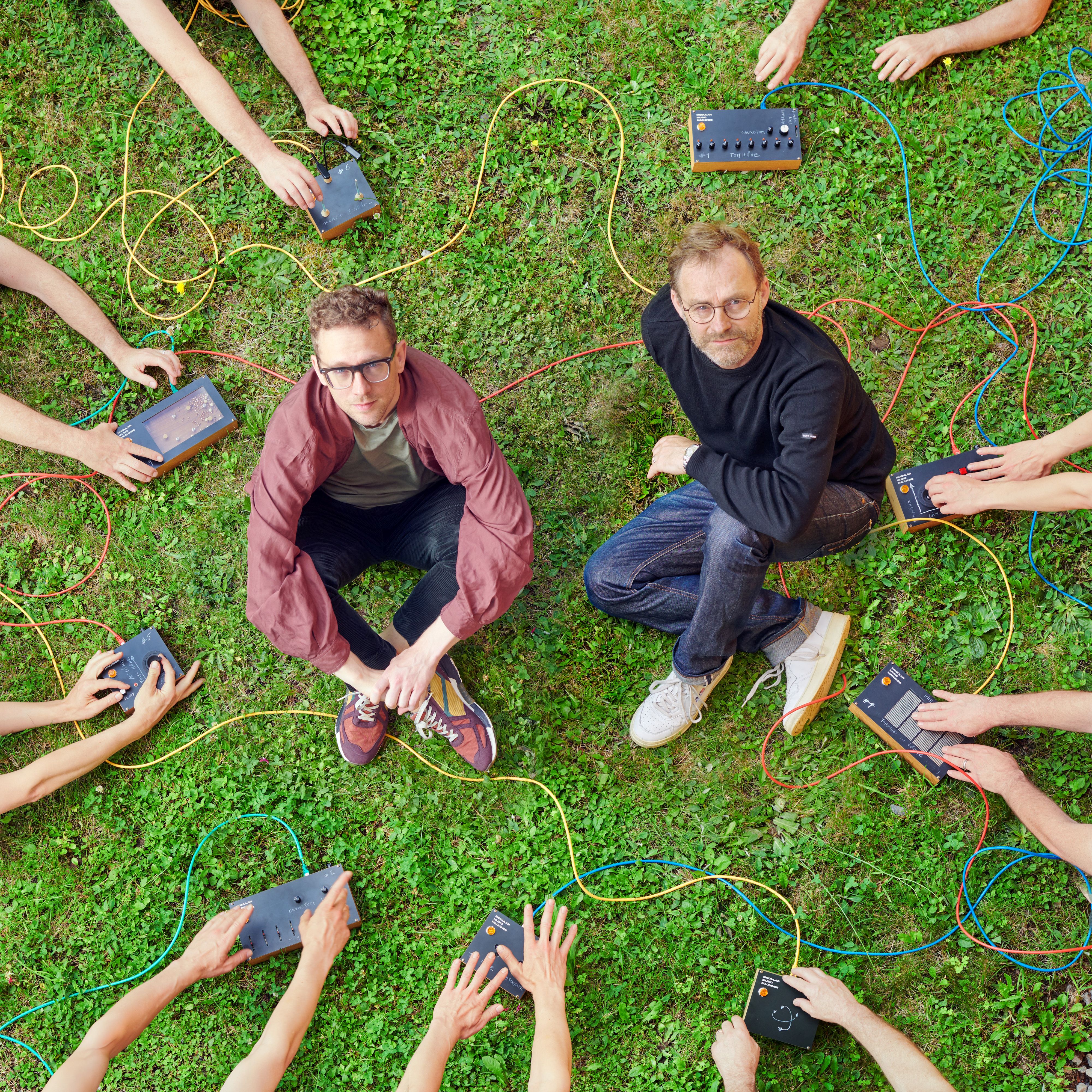
Members: Matthias Tschopp (woodwinds, modular synth, keys, electronics), Jürg Zimmermann (horns, modular synth, tape machines, electronics)
Interviewee: Matthias Tschopp
Nationality: Swiss
Current release: it's me?'s album Modular Music Machines is out via Unit.
If you enjoyed this Matthias Tschopp interview and would like to know more about his music, visit his official homepage. He is also on Instagram.
[Read our Jürg Zimmermann interview]
Many artists have told me that they're in discovery mode when working with the modular. What are some of the things you recently discovered while working with your own set-up?
In our duo it‘s me? We've been working on our Modular Music Machines for the past 3 years.
These machines are partly sound modules, partly controllers. After an initial phase of extensive research and try-outs, the last year we focussed on making things work, building routines and reducing gear where possible. So there were not that many discoveries recently, more in a sense “can we do this simpler?“
On the other hand, my personal goal with the modular is to process my woodwind instruments (baritone saxophone, bass clarinet and flute) through the modular rack and discover new sound possibilities. Actually I am experimenting a lot with different layers and how they can interact with my baritone saxophone: layers of noise, synthesizers, samples and granular delays.
On the interaction side I am experimenting with an envelope and a pitch follower for using the pitch and volume of my saxophone to control other stuff. And I’m checking out some ring modulation and joystick controllers as well.
You see, there is always something going on when you stand in front of a modular rack …
There are artists who can realise their ideas best with a traditional – or modified – piano interface, others with a keyboard and a mouse, yet others by turning knobs or touching screens. What's your preferred and most intuitive/natural way of making music and why?
It must be something we can put our hands on – our instruments, a piano, or the modular stuff.
It’s hard to be creative in front of a computer. It’s nice for recording, arranging, trying out things. But the magic happens when we can create music with any kind of instruments or modular knobs involved …
What did your first modular look like? Tell me about the first pieces you produced and performed on it, please.
I started with an Instrument Interface for connecting my saxophone and then first bought some delays and a mixer.
Then some modulation and randomness sources, and later some additional sound sources for the layering concept.
There is a worldwide community around modular synthesizers. How would you describe your involvement with it and its role for your creative development especially in the early days of your modular journey?
I relied heavily on videos of that community, namely loop-op, divkid, and Hainbach. Also there is a great book called Patch and Tweak.
These things and some friends like my fellow musician Jürg Zimmermann helped me a lot.
[Read our Hainbach interview]
Modular synthesizers allow for the most diverse and personal set-ups. What were some of the most surprising/inspiring configurations or ways of playing the modular that you've seen?
Some Videos with Suzanne Ciani, Hainbach or DivKid … their patches inspire me a lot. Live (watching other musicians perform the modular) there is usually too much going on for me to really understand what kind of patch could be used.
But musically I love a lot of the ambient and experimental stuff out there …
[Read our Suzanne Ciani interview]
Can you take me through the evolution of your modular system up to your current set-up? What are aspects you consider when buying a new module?
As I said, I started with saxophone and delays. Then I added modulation sources and randomness for interaction, and some utilities like sequencers and quantizers to make different ideas work. Last came sound sources like oscillators, samplers and noise.
I think the next step will be some drum modules to complete the panorama …
Which modules incisively changed your way of making music – and why?
I think it is more the possibilities of all the modules combined more than one specific module
Portability has been one of the main drivers for music production over the past years. What importance does mobility have for you when it comes to production – and what strategies for making the modular portable have you developed?
I built my modular stuff in an old tenor saxophone case. That’s the limitation for playing live: all the modules I use have to fit in there.
I have a second rack for it’s me? which we use when we play with our Modular Music Machines. And I have a third rack for music production at home …
With a keyboard and a traditional synth, I would instantly know what something would sound like if I pressed down the keys a certain way. Would you say the same is true for the modular and certain patches and modules? How does working with wires, cables, and plugs change your perspective on music?
For performing live, I need to arrive at the same point. I need to know what's going to happen to have the possibility to interact with other musicians in an immediate way. There is no time for patching and figuring out ideas – everything has to be ready at a knobs turn.
But when I am in my studio developing new ideas, it’s a completely different thing. Then any surprises are very welcome!
Modulars suggest a more immediate relationship with sound. In how far does this hold true from your point of view and what has working with them taught you about sound in general?
Absolutely. The modular opened up my sonic possibilities a lot.
Working with it also gave me a deeper understanding of many musical parameters like frequencies, arrangement, layering, beatmaking …
In which way does the modular influence musical results and what kind of compositions does it encourage / foster?
We found out with it’s me? that the modular genuinely works great in experimental, ambient or techno surroundings. But we aim for something in between, and it was kind of a journey to get there.
It’s not easy to create songs that you can replicate more or less accurately every time you play them. The more complex and sophisticated your patch is, the more changes with every knob you turn, the more difficult it becomes to recreate this.
So it was quite a process for us to find the best way to include all our ideas and still be able to fully enjoy and play our modular while staying on track with our songs and arrangements.
Describe the creative process for the album Modular Music Machines, please.
Apart from us combining our wind instruments with the modular system, the main development of it’s me? are our Modular Music Machines. These sound stations are given to the public, so they can interact with us during the concert.
Building these Machines and creating compositions that work musically, no matter who is using a particular Machine, was a major work that took us 3 years.
But we are very happy with the results. They combine songs and composition, interaction and experiments, improvisation and simply enjoying the making of music.
Many modular set-ups still do not support saving patches or quickly switching between them. What possible benefits or inspiring consequences does this quite severe limitation have for your own music and creative practise?
Well, you have to know your modules and patches pretty well to turn your knobs precisely. I think this is good, this way you have to learn your modular like an instrument.
I can’t save any presets on my saxophone either.
I am under the impression that choosing the modular is not just a musical decision, but somehow extends into other parts of one's life as well. Can you reflect on this a little bit?
That’s true. It opens up a lot of possibilities and this mindset is also helpful in other situations.
Wait, there has to be a solution to that … ☺
For you personally, is the goal to become as proficient and fluent on the modular as others might get at the piano – or to keep discovery mode on forever?
Both! Playing live, I have to master my patches first and really be fast and interactive in all I do.
Discovery mode is great for finding new ways when I am in my studio preparing the next project …