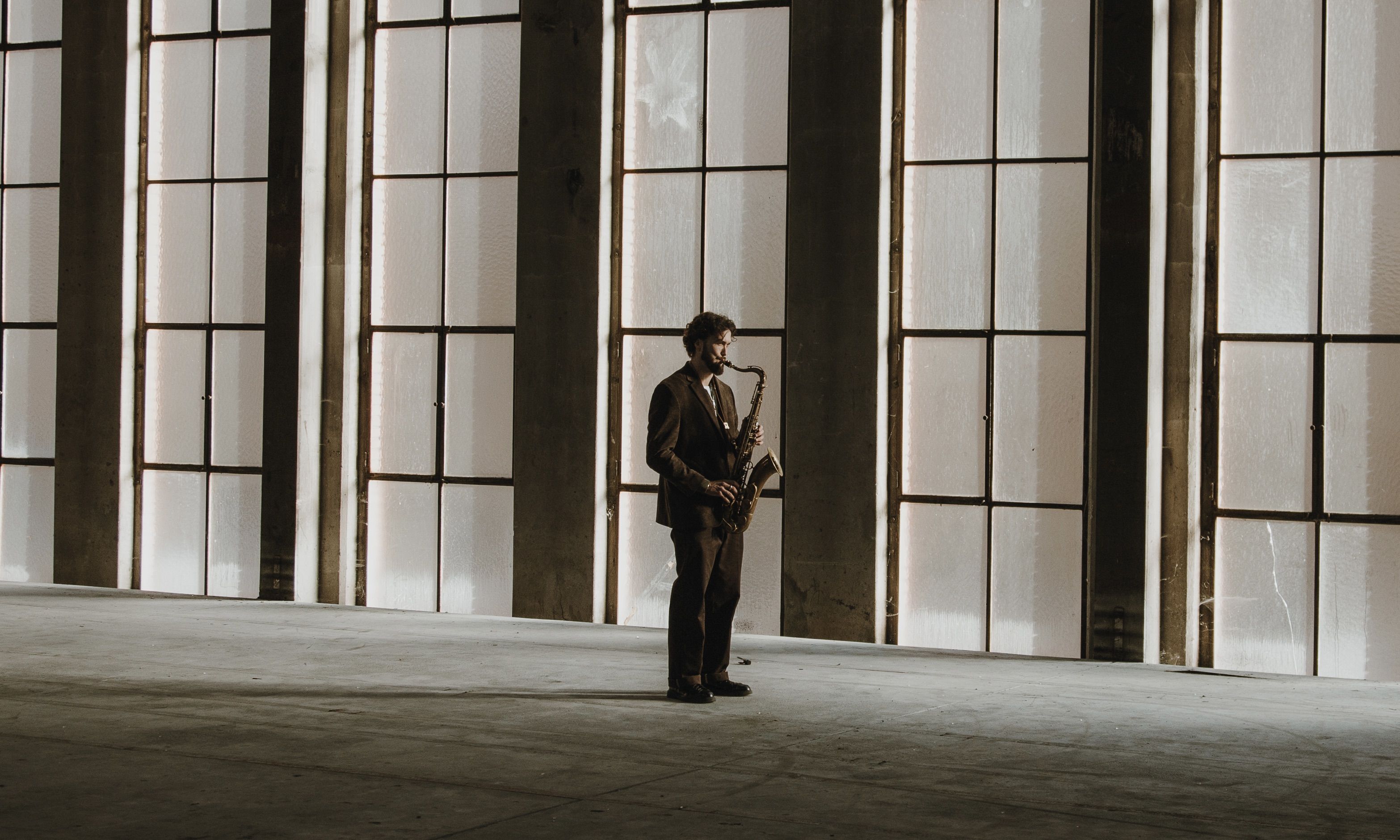
Published
Name: Maurice Storrer
Nationality: Swiss
Occupation: Saxophonist, composer, improviser
Current release: Maurice Storrer's debut album as a leader, Foureign Language, is out via unit. It features Jacob Sur (piano), Marius Sommer (double bass), and Aaron Leutenegger (drums, cymbals).
Recommendations for Schaffhausen, Switzerland: I definitely recommend going swimming in the Rhine. If you’re lucky enough to have access to a traditional wooden boat called a ‘Weidling,’ or know someone who does, you can row up the river to a beautiful spot, make a campfire, and cool off in the fresh water. It’s a special experience that really connects you with nature and the local culture.
Things I am passionate about but rarely get to talk about: One thing I’m really passionate about is hiking and wild camping. On my last long-distance hike, I crossed the Sarek National Park in Sweden. I loved being far away from civilization, completely self-sufficient, and relying only on what I carry with me.
For me, hiking in nature means disconnecting from everyday life, enjoying the silence, and feeling deeply connected to the environment around me. The freedom of moving through wild landscapes on my own terms is something very special.
And I’m a bit of a nerd when it comes to hiking gear … I could spend hours talking about the best tent, lightweight backpacking tips, or the perfect backpack.
If you enjoyed this Maurice Storrer interview and would like to know more about his music, visit his official homepage. He is also on Instagram, and bandcamp.
When it comes to experiencing the sensation of “energy” as as a listener, which albums, performances, and artists come to mind?
John Coltrane is an artist I always like to come back to. His music was my first real contact with jazz, and it had a huge impact on me.
The album A Love Supreme especially stands out – It’s one of the most powerful musical statements I’ve ever heard. The whole suite feels like a personal and spiritual journey – not just for Coltrane, but for everyone who listens.
You can hear how deeply connected he is to the music. It’s not about showing off, but about expressing something real. That album taught me that musical energy doesn’t have to come from volume or speed – it can come from meaning, depth, and trust in the moment.
There can be many different kinds of energy in art – soft, harsh, healing, aggressive, uplifting and many more. Which do you tend to feel drawn to most?
For me, energy in music is not always about being loud or fast. It can also be something quiet or emotional. Sometimes, just one honest note can feel more powerful than many notes. I really connect with music that feels open, honest, and present.
I’m also very interested in how a band creates energy together. When everyone listens and reacts to each other, something special happens – a kind of shared flow. That’s something I try to create with my quartet: a feeling that moves all of us, including the audience.
In the end, it doesn’t matter what style the music is. If a piece makes me feel something strong – especially during a live concert – and I feel connected with the band in that moment, then I would say I’m feeling energy.
In as far as it plays a role for the music you like listening to or making, what role do words and the voice of a vocalist play for the transmission of energy?
For me, the human voice is one of the purest and most direct forms of emotional expression.
Even though I mainly play instrumental music, I often try to shape my saxophone lines like a voice – with breath, phrasing, and emotional clarity, especially in the song “Orthoptera.”
Lyrics can help tell a story, but for me, they’re not always necessary. I’m often more touched by music without words, because it leaves space for my own feelings and imagination.
What matters most to me is honesty in the playing – whether it comes from a singer, a saxophonist, or a drummer.
When it comes to experiencing the sensation of “energy” as a creator, how would you describe the physical sensation of experiencing this energy? [Where do you feel it, do you have a visual sensation/representation, is there a sense of release or a build-up of tension etc …]
I don’t always feel energy as something physical in my body. More often, I notice a change in the atmosphere around me. The room feels different – like there’s more focus or tension in the air.
I become very aware of the space, the sound, and the people around me. It feels like the music fills the room and connects everyone. Even if I close my eyes, I can still feel the music in the space – almost like it has a shape or presence.
It’s a strong and clear feeling, even if it’s hard to describe. Everything else fades into the background, and I’m just focused on the music and the moment.
When it comes to composing / songwriting, are you finding that spontaneity and just a few takes tend to capture energy best? Or does honing a piece bring you closer to that goal?
Composing is something I’m still exploring more deeply. I believe it’s like a muscle – the more regularly I use it, the more responsive and stronger it becomes. Just like practicing on my instrument.
The Swiss saxophonist Christoph Irniger, once told me that composing is like fishing: you won’t catch a fish every time, but if you don’t keep showing up and casting your line, you’ll miss the chance to catch a really great one. That idea has helped me build patience and consistency in the process.
Sometimes an idea comes together right away in the first sketch. Other times, it needs more time and shaping. I've learned to be patient with the process and not to force it.
[Read our Christoph Irniger interview]
How much of the energy of your own music, would you say, is already part of the composition, how much of it is the result of the recording process?
I try to start every composition with an emotional idea or feeling. That’s what gives the piece its direction. But I’ve learned that for me the composition is just the beginning. The real development happens later – especially during rehearsals and in the studio.
In rehearsals, the band helps shape the piece. Everyone brings their own voice and perspective, and that often changes the way the music feels. We try things out, adjust details, and see what works best together. Sometimes the piece goes in a different direction than I expected – and that’s often a good thing.
In the recording process, we listen closely to each other and try to catch the right atmosphere. That can mean taking risks, reacting spontaneously, or leaving space open. Some of the songs really opened up during recording.
So even if I write the music alone at first, it’s the process of playing, listening, and trusting each other that makes the music become alive.
For Foureign Language, what kind of energy were you looking for?
I didn’t start this project with a fixed idea of what kind of energy I wanted to capture. It was more about following what felt natural at the time.
In the end, we chose the pieces that resonated most with us – the ones that carried something real and formed a coherent set. The result is a mix of different energies: some pieces are quiet and melancholic, like “Orthoptera,” while others are loud, intense and forward-moving, like "Aiming High."
How do you capture the energy you want in the studio?
In the studio, we played each song all the way through without stopping. We didn’t try to make everything perfect. For me, feeling and emotion are more important than playing without mistakes.
It’s important to catch the right feeling in the moment. Small mistakes can happen, but that makes the music feel more real and alive.
If you try too hard to fix everything, the music can lose its natural flow. So we focused on keeping the energy, even if the take wasn’t perfect. That’s what makes the music honest and exciting for me.
What role do factors like volume, effects like distortion, amplification, and production in general for in terms of creating the energy you want?
For this project, I wanted the sound to stay raw and natural. Since the music connects in some ways with the jazz aesthetic of the 60s, I chose to avoid effects and heavy production. We focused on capturing the acoustic energy of the instruments in the room.
I think it really depends on the style. In some musical contexts, effects and production are a key part of creating intensity. But in this case, less was more – the energy came from how we played, not from how it was processed.
How does the presence of the audience and your interaction with it change the energy of the music and how would you describe the creative interaction with listeners during a gig?
Playing live with an audience creates a special connection. When people listen closely, I can feel their attention and energy. This makes me want to play with more feeling, more focus, and more openness.
For me, the energy between the band and the audience moves like a circle. We give our music to the listeners, and they take it in. Their reaction, whether it’s clapping, silence, or just watching carefully, gives us feedback. This feedback helps us stay inspired and sometimes changes what we play in the moment.
Because of this exchange, every live show feels unique. It’s a shared experience that can’t be repeated exactly the same way twice.
Would you say that you prefer to stay in control to be able to shape the energy or do you surrender to it and allow the music to take over? Who, ultimately has control during a live performance?
I think control and surrender go hand in hand. You need some control to shape the music and keep things coherent, but you also have to give in to the energy that comes up naturally.
Once we start playing, I need to be open and let the music take over. During a live performance, it feels like the music itself has the most control, guided by everyone on stage together.
The energy that music is able to generate can be extremely powerful. How, do you think, can artists make use of this energy to bring about change in the world?
For me it’s all about creating a sense of community. Music has a unique power to connect people beyond language and culture.
The energy generated in a performance or recording can move listeners emotionally. In that way, music becomes a force for positive change.