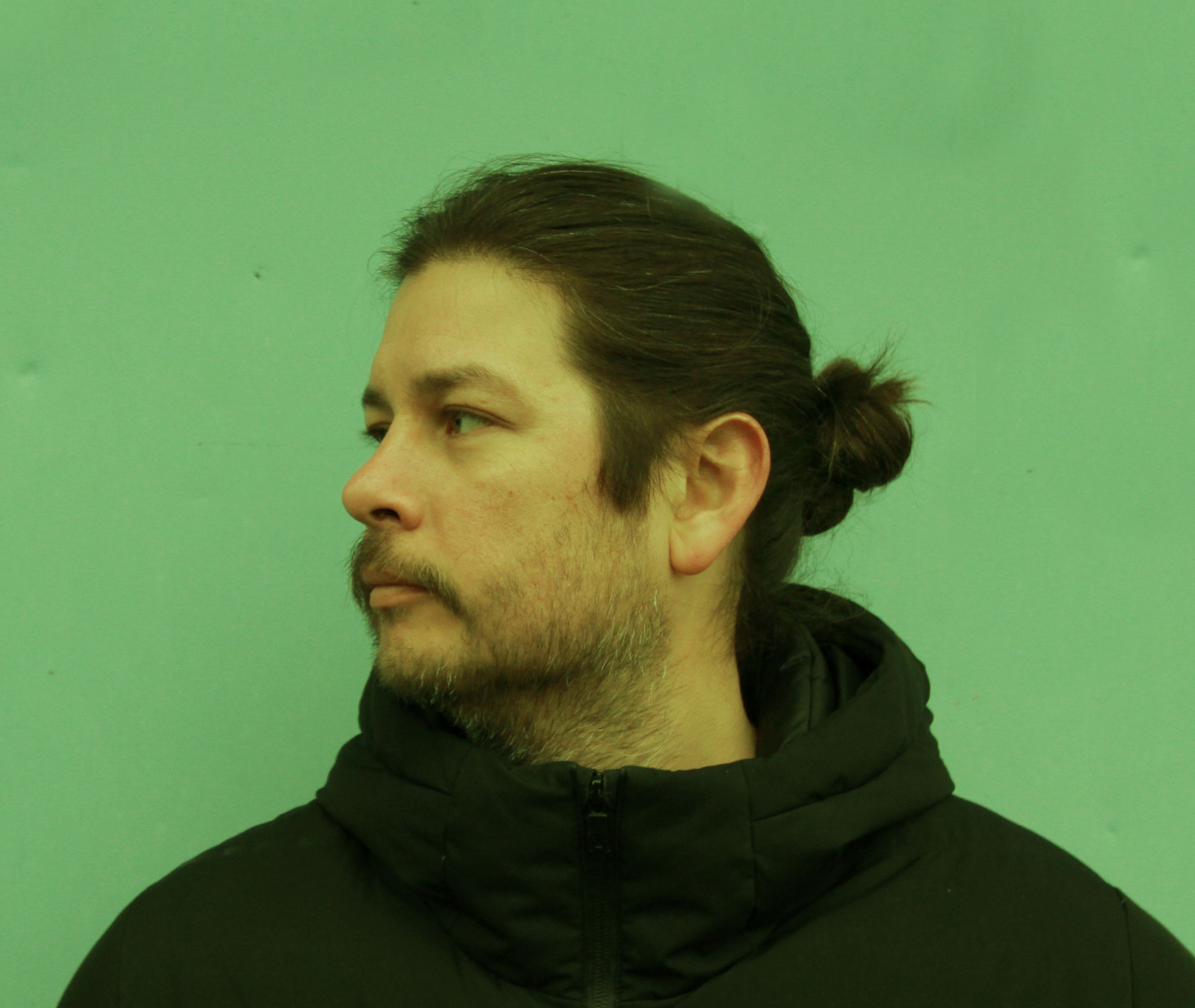
Published
Name: Ned Pegler aka Medlar
Occupation: Producer, DJ
Nationality: British
Current release: Medlar's new album Islands is out April 18th 2025 via Delusions of Grandeur.
Recommendation for London: Tayyabs
Thing I am passionate about but rarely get to talk about: I got really into playing chess in the last year, and have become obsessed. It's a cliche but it forces you to slow down for a moment and assess situations before reacting, and there's often a hidden move somewhere, which didn't seem like an option at first glance. Add me on the app at Npegz.
If you enjoyed this Medlar interview and would like to know more about his music, visit him on Instagram, bandcamp, Soundcloud, and Facebook.
What were some of the musical experiences which planted a seed for your interest in electronic music?
Playing around with tape recorders as a child, it seems, was an entry point for a whole generation of us. This sparked a curiosity in me and so many of my peers to further investigate how records are made.
Also, as a young teenager, my dad was living in Romford and when visiting him I'd take the earnings from my Saturday supermarket job to Boogie Times (the HQ of Suburban Base records and an employer of some famous d&b DJs) to buy drum and bass vinyl.
Entering a record shop and discovering this new mysterious world felt like another big fork-in-the-road moment.
Most genres of music make use of electronic production means. What does the term “electronic music” mean today, would you say?
Good question, and an answer that changes constantly. Bob Dylan got called Judas for plugging in a guitar which seems hilarious now.
It's harder to pinpoint what isn't electronic music these days, and I've found myself saying "guitar music" or "non electronic music" for lack of a better phrase in recent years. The language is catching up with the landscape that's for sure.
I still think of electronic music as music without any traditional instruments or microphones used. Detroit Electro, Kraftwerk or IDM type stuff still comes to mind.
The album I released as N Pegler last year was influenced by the sonics of 90s ambient techno (606/808 drums, digital reverbs, 12 bit samplers, filtered pads etc) and I'll continue exploring this more overtly electronic sound through that alias.
I think I conflate 'electronic' with techno aesthetics for some reason.
I grew up mainly listening to electronic music but have of lately, along with others I've spoken to, been somewhat disappointed by most new releases. I'd be curious about your own view on this, the “creative health” of the scene and potential reasons for the disappointment.
I feel part of that is just that we've just heard a lot of music at this point, and we are skipping through many tracks every day passively when scrolling. I remember when I first started DJing regularly in the 2010s I'd hear older people bemoan the 90s house revival, and I'm keen not to react the same way to anything comparable happening now.
People complaining "it used to be better" has been consistent for literally centuries. People complaining that art was dead when the printing press was invented isn't that different to the AI debates now. We are also witnessing the biggest democratisation of access to production, ever, which can only be a good thing.
I like to think that we'll all end up programming drum machines in old people's homes in the same way past generations have done with watercolour paintings and crochet; for the enjoyment of the process and with no desire to monetise it.
What were some of the recent releases, or performances of electronic music that left a deep impact on you?
I went to see A Guy Called Gerald and The Jungle Drummer at the Jazz Cafe with my friend Kris a few months back, which I loved.
These days, most of my favourite live performances are ones that explore something new, whether a genre combo or some kind of performance concept, and often feel like they're balancing on the edge of chaos in some way (the element of risk/chaos is something I've always loved in DJ sets too).
Even if no more technology was released, the hardware and software available these days give us incredible possibilities for experimentation and combining electronics into live setups in various ways, that we'll be figuring out for a good while.
What kind of musical/sonic materials, and ideas are particularly stimulating for your work right now?
'Islands' features a lot of 80s, early MIDI era sounds, with a bit of a naive/fun edge, so lots of marimbas & mallets, FM synthesized bass sounds (DX100 log drum bass, TX81Z "Lately Bass"), drums from TR-808, CR78, Linn Drum samples, and lots of guest instrumentalists.
Something I love is reinventing old equipment by using it in a modern context.
For instance, everyone remembers samplers being tedious to use, and they are a bit, but in combination with a modern DAW to trim samples, a USB drive instead of a floppy disk, and the sampling potential of the internet, they're pretty fast to use and still offer such a great sound, that will fit into a mix pretty seamlessly most of the time.
Where do most of your inspirations to create come from – rather from internal impulses or external ones? Which current social / political / ecological or other developments make you feel like you need to respond as an artist?
Outside of international politics, I feel AI is the big one, and will only become more relevant.
It is tempting to make a super deep, emotional record which uses only the most horrible AI-generated-major-key-ukelele-music-designed-for-influencer-backdrops as source material, and to mangle it into something unrecognisable, beautiful and most importantly, human-sounding.
I believe many people must be thinking of projects like this right now. James Ferraro is probably on it as I type this.
Music has become a lot more global, and incorporating elements from other parts of the world or the musical spectrum is commonplace. Do you still think there are city scenes with a distinct, unique sound? How does your local scene influence your work?
I wrote my dissertation in 2012 on how I believed dubstep was the last genre that would organically develop in a location before going global, and I've been proved wrong with scenes in South Africa, Brazil and South America in recent years.
I expect a lot of us in the UK are more partial to heavy bass from growing up here, with the influence of Jamaican sound system culture running through everything.
Today, electronic music has an interesting relationship between honouring its roots and exploring the unknown. What does the balance between these two poles look like in your music?
On 'Islands', this intersection with the unknown came from working with improvised performances, and the process of working an improvised take into a track. Demos were sent to musicians who recorded takes, and then I built the remainder of the track around their performance.
I'm also someone who is looking for that element that is surprising to me as the maker, whether it's a random LFO or a collaboration. I lecture in music production at Point Blank, and encourage my students to try embracing the unknown. Most of our best-loved records weren't informed from the point of conception; they usually used experimentation to get the initial ideas.
The workshopping of records in some ways feels like a luxury of the past. Albums like D'Angelo's Voodoo relied on years of consulting, prototyping and feedback sessions to reach the end result, and it paid off. Brian Eno's oblique strategy cards are another great example of the benefit of challenging instincts and embracing the unknown.
How much potential for something “new” is there still in electronic music? What could this “new” look like?
Brazil, Portugal and South Africa have been showing us some new rhythms for a while.
Hip hop always seems to lead the way on the production side of things, the vocal production on Lazer Dim 700's work is one thing I've heard recently that stood out to me as sounding very different/unexpected/new.
What were some of the recent tools you bought, used, or saw/read about which changed your perspective about production, performing, and making music?
I'm always up to date with the latest version of Ableton Live and Logic Pro and they are both incredibly powerful.
The AI stuff for me is equal parts interesting, scary and off-putting, though I have already used some stem separation technology for some DJ edits..
Do you think that there is a limit to what can be done in sound design – and what defines these limits?
Short answer: no.
The increasing potential for endless processing power in software (and the world of modular synths, and combining old & new technology etc.) will mean we have some way to go here.
In as far as it is applicable to your work, how would you describe the interaction between your music and DJing/DJ culture and clubs?
At points in the past I feel I over complicated things, but in recent years all of my tracks are very much informed by DJ/dance music culture.
The name of the new record, Islands, came from the idea that I think all the tracks work together, but also could exist as separate entities, in a DJ set.
How, would you say are your live performances and your recording projects connected at the moment? How do they mutually influence and feed off each other?
The live performances are fully embracing live looping whilst having a backup plan ready to go if necessary, and these will incorporate elements of releases (e.g. the drums from one track, bassline from another, but having the flexibility to choose).
For DJ sets I have 2 approaches, either moving around genres continuously, inspired by DJs like Tony Humphries - vocal house into disco into acid etc. and keeping things very fun. Or conversely, staying in a lane usually of more clubby/techy, less musically complex tracks.
Generally, it'll be the first option for an earlier set or big stage, the latter for later hours and smaller venues.
Even if AI will not entirely replace human composition, it looks set to have a significant impact on it. What does the terms composing/producing mean in the era of AI, do you feel?
I mean, I've tried out some of these generators at my lecturing job and they're quite insane really. It is definitely far more realistic, and less off-putting than the visual equivalents. Similar to visual design, it seems to be quite accepted that the less glamorous jobs will be replaced first; composing/designing for adverts of small businesses, where being generic is generally seen as a good thing.
One interesting point is that we can examine studies on chords and music theory forever (look at all the youtube content about learning chords), but there's no exact formula for creating great melodies. A great melody taps into something emotional and it's difficult to analyse how or why.
Another angle is; will people knowingly go out of their way to listen to AI generated music, or continue listening if they knew it was? So much music is consumed through passive listening via short form videos these days, and in this context I think we probably don't really care.
But music fans will rarely actively revisit music without caring at all about the creator, and often it's a story about the creator that leads to their discovery in the first place. Music is something that has, until now, always required more than one person to exist, and I believe that'll remain the case.
Are there approaches, artists, festivals, labels, spaces or anyone/-thing else out there who you feel deserve a shout out for taking electronic music into the future?
I'm lucky enough to meet many talented young musicians and producers at Point Blank and through my mentoring work with Arts Emergency. We are quick to moan about changes in technology and culture, but we are in safe hands.
Also, the world of professional and consumer music technology is developing so quickly, I feel like these software and hardware developers deserve some love.