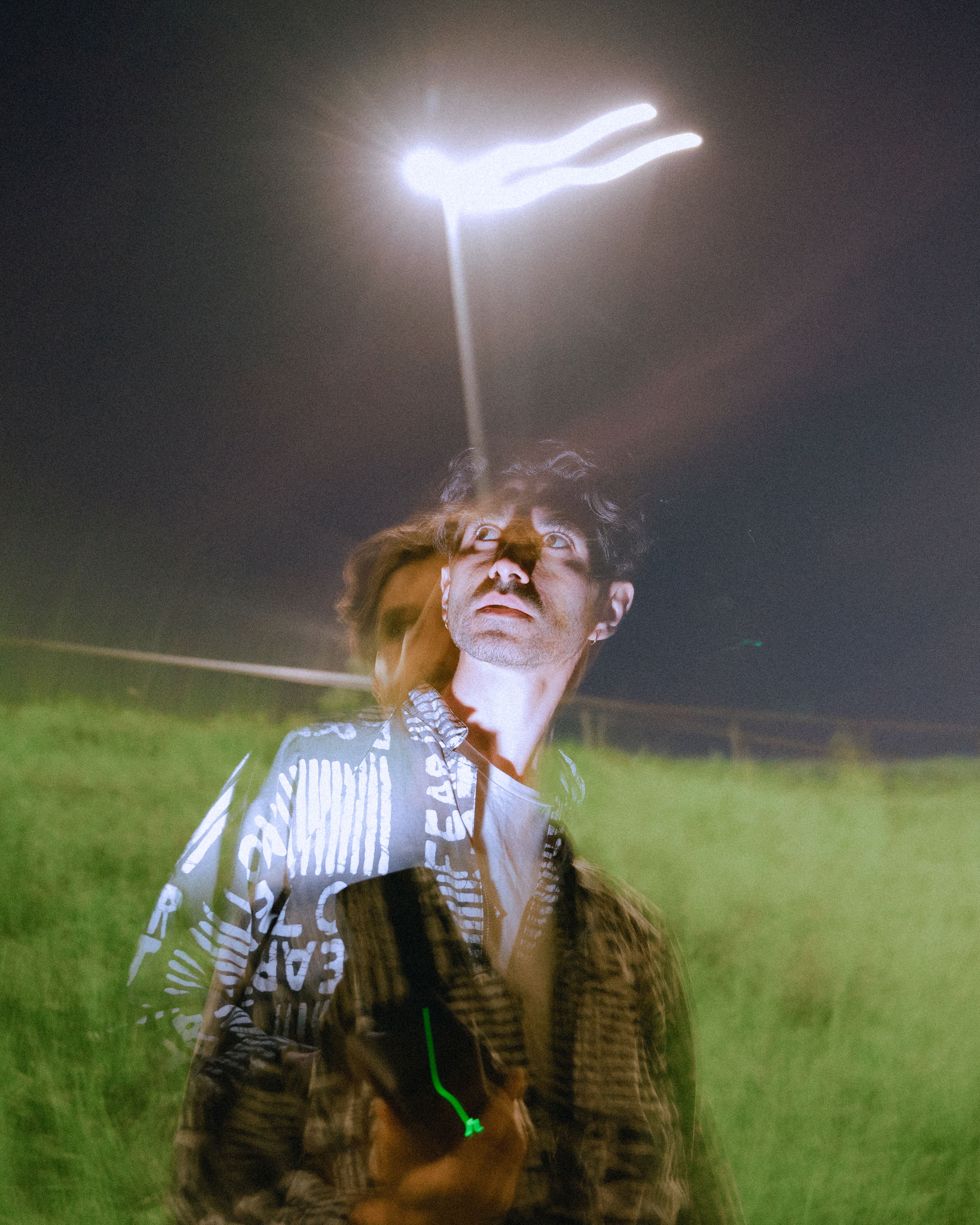
Published
Part 1
Name: Mehmet Aslan
Nationality: Swiss-Turkish
Occupation: Composer, producer, DJ
Current Release: Mehmet Aslan's new EP Auguri is out via Planisphere Editorial.
Recommendations on the topic of sound:
Merlin Bird ID: A big library of bird calls and sounds
General Theory of Rhythm: I can recommend everyone to read about Malcolm Braffs insights, if you want to deep dive into rhythm
James Bridle: Ways of Being: Simply great book about terrestrial intelligence across species
Sensing Earth - Cultural Quests Across a Globe
Listening Book by W. A. Mathieu: One of my favourite books still on the subject of Listening
Rhythmus (Music) - wikipedia
If you enjoyed this interview with Mehmet Aslan and would like to stay up to date with his work, visit his official homepage. He is also on Instagram, Facebook, and Soundcloud.
For a deeper dive, read our earler Mehmet Aslan interview.
Do you think that some of your earliest musical experiences planted a seed for your interest in sound?
Never thought of it actually. But I tried to remember the sounds from my childhood, which is in itself a nice exercise. Because we had an airport near where we lived I remember the airplanes and their deep rumbling noise when landing and taking off.
The quietness of the forest when I walked in it or the soft trickle of the village stream. The sounds of the soccer field, the shouting of the players and the light, dull sound when kicking the ball.
The rushing of the tram as it rattles along the tracks and approaches in the distance or the singing of birds in the backyard garden. Occasionally there was also a rooster crowing in the morning, which I never knew where the sound came from, as there where no visible farms anymore nearby.
Do you experience strong emotional responses towards certain sounds? If so, what kind of sounds are these and do you have an explanation about the reasons for these responses?
Listen to bird calls and hear how unique and fascinating they are. Human sounds like children laughing can trigger a kind of emotion; it's simply because it's human. Or the meowing of hungry cats that want something from you.
Every time I hear beautiful singing in a song, it can instantly change my mood, which fascinates me every time. The sound of a quiet forest can heal me completely; I could endure it for hours. Listening to a sea with its waves also calms me and always teaches me reverence.
Maybe it sounds a bit corny but all sounds of elemental origin have a calming effect on us because they connect us with nature. The soft patter of rain, the gentle flickering of fire, the rustling of the wind. Unfortunately these sounds are sometimes get forgotten in the city rumble.
Are there places, spaces, or everyday devices which intrigue you by the way they sound? Which are these?
For example, recently at a dinner, I accidentally cut too hard on my plate with my knife. You can imagine what kind of high-pitched sound that produces. My table neighbour flinched, and we talked about this phenomenon that certain high sounds are no longer audible at an older age. There are these strange test sounds where it's gradually shown by age that it's no longer audible. That somehow fascinated me always.
I was traveling the past weeks and realised that the sound of some public bathroom ventilations can be so different. Sometimes they almost produced a musical sound or rhythmic pulsations.
I love the sound of nice cafés, the clatter of cups, the pleasant sound of background noise, when there is a warm and nice atmosphere, which as its own quality.
Silence is great, but combined with darkness it can also intrigue us. When something is hidden, we suddenly start to have fear of the unknown.
For some, music equals sound, to others they are two distinct things. What is the relation between music and sound for you? Are there rules to working with sound, similar to working with harmony, for example?
I don't think they are two identical things. Sound encompasses all auditory experiences, from everyday noises to tones of music. Music is what humans make; it is something deeply emotional and it has structure, rhythm, melody and harmony. Sounds are rather monotonous and uniform, they have a tonal quality, one deals with what is there, what occupies the space. Music is about emotions, telling a story, a narrative, a beginning and an end.
Harmony and Melody have its rules, so maybe sound could also have it, like dynamics, texture and space. For sound you can use terms like design, sculpting etc. Showing sort of a difference how we deal with both differently.
I like also how culturally the perception of some sounds can be different, or also how emotionally certain music is perceived. In some cultures rhythm can be more in the foreground than in others. A Bach song can be perceived differently in African or Asian cultures than in European cultures.
What were your very first active steps in terms of working with sound and how would you rate the gains made through experience?
I would say that in all my works, I’ve always experimented with sound—using field recordings, everyday objects, and more—and tried to give the music its own texture through these methods.
There is a method called “Active listening“ from which I always learned a lot: You listen to a piece of music or sound, actively, and write down notes on melody, harmony, texture, structure, dynamics etc. and simply analyse what you hear. You can do multiple listening sessions and always concentrate on a different aspect. I think this simple technique can help you learn a lot about music. It is something like meditation on sound and music.
Simply doing field recordings and actively listening to my environment helped me getting more aware of my surroundings and how certain sounds are shaped.
I have a sampler paired with a very cheap small microphone, and I’ve let small, stone-like objects trickle onto it, which produced a scratchy sound. When you record something like that, the space is already inherent in the sound; it doesn’t need an artificial space added.
For your own creativity, what were some of the most important things you learned from teachers/tutorials, other sound artists, or personal experience?
Since I formed my live band with live musicians, I was forced to learn more about musical harmony and rules. I can safely say that before that I didn’t even know where certain notes where on the piano roll. This was a positive change and helped me understand better some rules and how songs are built. Also the differences between production and live music emerged, I realised these were like two different worlds.
Recently, I've learned a lot about how much you can actually work with just the tools from Ableton, finding different new ways to work modularly and create new sounds so that I deviate from my "usual" methods. I'm particularly interested in generative tools.
I'm often on the move and don't always have all my equipment at hand, so I also have to see how I can make music just out of the box. I like this limitation.
How and for what reasons has your music set-up evolved over the years and what are currently some of the most important pieces of gear and software for you?
I’m exploring again and again a synthesiser like SH-101 and still finding new ways of using it. Of course you can make much crazier and deeper sounds with a new synth, but it also has everything you need and I like that idea to work with what you have.
I am also still in love with my OP-1 and how it helps me using it as a sketch-book. The years have proved that there is no real replacement for it. But I used it so extensively that it is falling apart. Hopefully I can get a new one..
Software-wise, I've stayed with a very minimal setup and try to use few plug-ins for special purposes, concentrating on Ableton. Sound libraries have also become increasingly important for me to find suitable sounds.
Otherwise, my setup has remained as similar as possible, except that I also use more acoustic elements like guitar or spoken word.