Published
Name: M(h)aol
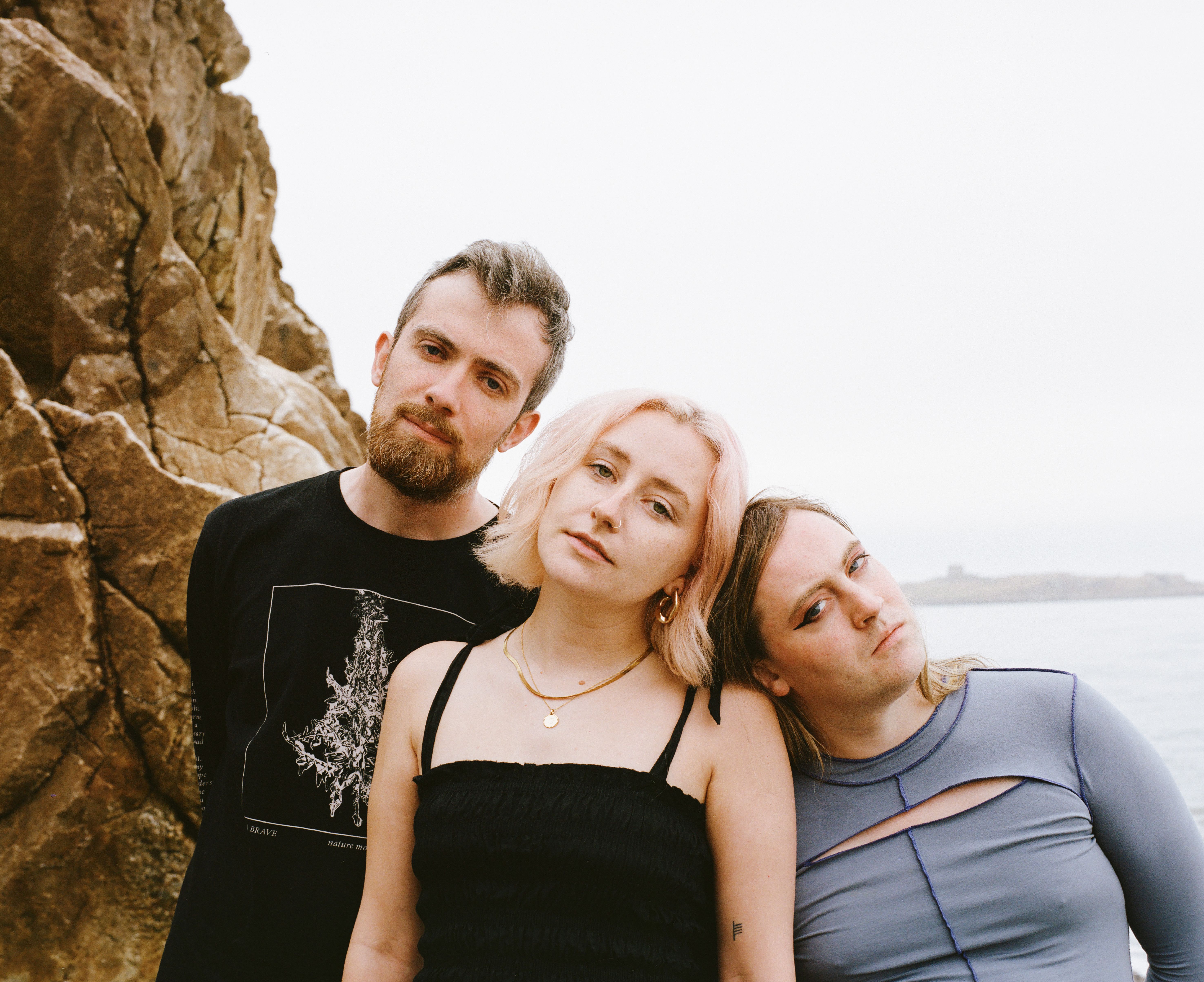
Members: Constance Keane (drums, vocals), Jamie Hyland (bass, vocals), Sean Nolan (guitar)
Nationality: Irish
Current release: M(h)aol's new full-length album Something Soft is out via Merge.
Global Recommendation:
Jamie: Absolutely anywhere you go, consider finding a botanical garden.
Topic that I am passionate about but rarely get to talk about:
Jamie: way too much stuff. Horticulture, cooking, geology, astronomy, metal-smithing …
If you enjoyed this M(h)aol interview and would like to know more, visit the band on Instagram, Facebook, and bandcamp.
Where does the impulse to create something come from for you? What role do often-quoted sources of inspiration like dreams, other forms of art, personal relationships, politics etc play?
Constance: For me, it’s generally things that have either happened to me personally, or topics that I read about that I feel a connection to, whether that’s in books or in the news, or an essay online.
Jamie: The impulse just is ... I have a very active auditory imagination and I do dream of sounds sometimes but I don't know if not having that would affect my drive to create.
There's just something so satisfying about the actual of creation, whether it's music or photos or something more physical.
For you to get started, do there need to be concrete ideas – or what some have called a 'visualisation' of the finished work? What does the balance between planning and chance look like for you?
Constance: Most of the time I write my lyrics while I am playing the drums, so a lot of it comes down to chance. I will have a topic in mind that I want to write about usually, but not a structure or specific wording.
Jamie: I was just listening to a TTRPG podcast where they were playing a cartography game which kinda reminds me of how we work as a band. You just roll a bunch of dice and jump in and start playing to find out where we are going together.
The semi-set rules help keep us on track so deciding what instruments are being used is almost like planning …
Is there a preparation phase for your process? Do you require your tools to be laid out in a particular way, for example, do you need to do 'research' or create 'early versions'?
Jamie: Deciding what guitars and pedals and amps we are going to use is sort of like getting the tools together ... but almost more like deciding what the pallet is comprised of in terms of sonic possibilities.
More practically, laying out pedals determines how many buttons can be pressed at one time.
Do you have certain rituals to get you into the right mindset for creating? What role do certain foods or stimulants like coffee, lighting, scents, exercise or reading poetry play?
Constance: I find lighting super important for my process. My favourite thing is asking the others whether I can turn off the big lights.
Unless you’re performing surgery, big lights shouldn’t exist.
For your latest album Something Soft, what did you start with? If there were conceptual considerations, what were they?
Jamie: As with all our releases, we started with a deadline and a dream.
The main concept at the very beginning was simply to make an album and have fun together doing it.
Tell me a bit about the way the new material developed and gradually took its final form, please.
Jamie: Quickly. We spent considerably more time than our previous album working out exactly what the parts should be and how they should sound.
But, that being said, the number of days we are talking about is still only in or around 10. It tended to be quite immediately obvious if something was working or not.
What makes lyrics good in your opinion? What are your own ambitions and challenges in this regard?
Constance: My favourite lyrics tend to be quite straightforward. I’m really interested in complicated ideas being expressed in a simple way. I find that thrilling.
I’m not sure if it’s an extension of my approach to drumming - where I find working with a stripped back kit and limitations pushes me forward creatively.
What are areas/themes/topics that you keep returning to in your lyrics?
Constance: Most of our songs are about feminism or dogs to be honest. I’m not sure if that will change.
Many writers have claimed that as soon as they enter into the process, certain aspects of the narrative are out of their hands. Do you like to keep strict control or is there a sense of following things where they lead you?
Jamie: I would tend to agree in part that an element of creativity is just letting go and seeing where you end up. But I would also say that it's more keeping a loose grip of the reigns than a fully “jesus take the wheel” situation.
Those moments can be fun and informative but I tend to think taking the fully untamed thing and refining it makes for more interesting, considered results.
There are many descriptions of the creative state. How would you describe it for you personally? Is there an element of spirituality to what you do?
Jamie: To be honest, I'm a deeply un-spiritual person. But I do sometimes find it helpful to imagine that there is some kind of otherworldly “muse” that I can just let do a bunch of the work.
I'm fairly sure that's just a way of cognitively engaging in the subconscious mind, not becoming some sort of spiritual medium though …
Once a piece is finished, how important is it for you to let it lie and evaluate it later on? How much improvement and refinement do you personally allow until you're satisfied with a piece?
Constance: Most of our music is recorded almost immediately after we write it, or something during the writing process.
There is not much refining that goes on, it kind of is what it is. I find that freeing.
How do you think the meaning, or effect of an individual piece is enhanced, clarified or possibly contrasted by the EPs, or albums it is part of? Does each piece, for example, need to be consistent with the larger whole?
Jamie: I personally think of the album/EP on a whole as a piece which is comprised of smaller parts. It's different in a live context but I think we are actually engaged in a couple of different art forms.
One is the album making which includes the entire holistic experience of the album, including the visual, physical, emotional experience, another closely linked is the song-writing. And then live performance is its own separate thing again.
Whether to consider the other releases in an artists catalogue in the same regard is for the listener to decide.
In terms of what they contribute to a song, what is the balance between the composition and the arrangement (including production, mixing and mastering)?
Jamie: In a sense, I would love to be able to say the song and arrangements are totally separate.
I'm also aware that, for the kind of music we are making, the sonic experience is just inherent to the songs. If I didn't make the “production decision” to make this particular beeping noise, then Connie wouldn't have had the impulse to play that drum beat and say those words. Without all that, Seán doesn't have any context to decide on what strange scratching sound to make.
If it's not then mixed in such a way as you, as a listener, can have that same experience we are trying to create in the playing, then what was the point. I very much see the studio as an extra instrument that I play for the band.
After finishing a piece or album and releasing something into the world, there can be a sense of emptiness. Can you relate to this – and how do you return to the state of creativity after experiencing it?
Constance: Yes, I have previously found it incredibly difficult to release music and it has taken quite a toll on my mental health. I have had to take extended breaks from projects.
I think with this band though, I feel much more at ease. I’m not sure if that’s because it’s more in your face, and less me asking people to care about my intimate feelings.
I would love to know a little about the feedback you've received from listeners or critics about what they thought some of your songs are about or the impact it had on them – have there been “misunderstandings” or did you perhaps even gain new “insights?”
Constance: One thing I do find confusing sometimes is when people tell me my lyrics are “brave.” I think that is the best example of someone viewing me through a lens I do not view myself.
Not to be completely selfish, but I am generally making this music for myself and my bandmates and it’s a bonus if others connect with it.
Creativity can reach many different corners of our lives. Do you personally feel as though writing a piece of music is inherently different from something like making a great cup of coffee? What do you express through music that you couldn't or wouldn't in more 'mundane' tasks?
Jamie: I would maybe say they are very different but also quite similar in ways ... where in music, it's really helpful to take a “there are no wrong answers” approach, with making a cup of coffee, you can definitely do it wrong quite easily.
That being said I would actually say there's a lot to be expressed in the mundane that might be hard to do through music. The feeling of just wanting a plate of roast potatoes is much easier to express by just throwing potatoes in the oven that making music.