

Name: Michael Stephen Brown
Nationality: American
Occupation: Pianist, composer
Current release: Michael Stephen Brown's new album Twelve Blocks is out via First Hand.
Recommendation for NYC, USA: Definitely The Met Cloisters. It’s part museum, part brilliant stitched-together architecture from another time with a beautiful garden. You can wander through medieval cloisters, view unicorn tapestries–who wouldn’t want to do that? You can just be quiet for a while, and maybe that’s a theme I’m getting at here with this interview.
Topic I am passionate about but rarely get to talk about: I’m oddly interested in the relationship between routine and repetition. Routine gives you the structure, and repetition is where things actually start to open up. Practicing the piano, playing the same passage again and again, walking the same route every day, and coming back to the same idea over time.
That way of thinking is all over my album Twelve Blocks. The title comes from a daily walk, and the music works the same way. Small gestures return, slightly changed. What shifts isn’t the material so much as you. In a culture that moves on quickly, staying with something long enough for it to speak back still feels quietly radical.
If you enjoyed this Michael Stephen Brown interview and would like to stay up to date with his music and upcoming live performances, visit his official homepage. He is also on Instagram, and Facebook.
The borders between producers, sound artists, and even songwriters are becoming increasingly blurry. What does being a composer mean today, would you say?
A composer is someone who has to defend their choices, almost like a court of law with performers, and translate whatever chaos is inside them into something intelligible — or at least listenable.
Many people perceive classical music and contemporary composition as having high barriers of entry, both for listeners and musicians. What have your own experiences been in this regard?
Classical music is a pretty small world compared to most other genres, and contemporary music is an even smaller corner of that. But from the inside, it doesn’t feel closed to me. I see a lot of energy. Enthusiastic audiences. Students are competing hard for the same few prizes. Composers are applying again and again for grants and residencies. There’s a lot going on.
From the listener’s side, I actually think there are more ways in than ever. Podcasts, Substacks, long conversations – people can engage at whatever level they’re comfortable with. A great example is my friend Evan Shinners, also known as WTF Bach. His podcast goes very deep into Bach. It’s not designed to please everyone, but that’s what I like about it. He treats the music as something alive and urgent, without dumbing it down. That idea really resonates with me.
I think classical music works best when it’s treated as a living thing, not a museum piece behind glass. That philosophy definitely carries into my own work. Evan also wrote the poetry for my song cycle Love’s Lives Lost, about two former lovers who meet again later in life, carrying memory, chemistry, and a lot of unfinished feelings.
As of today, what kind of materials, ideas, and technologies are particularly stimulating for you?
I’m probably pretty boring and old-school in this regard. I’m very happy with my piano, “Octavia,” an 1893 instrument I found on Craigslist. She’s a beautiful old concert grand and my daily artistic companion—also the only collaborator who never checks her phone.
Her sound is complex and a little unpredictable, which I love. I’ve written a lot of music sitting right next to her. I also am really enjoying composing with a pencil and paper these days – radical, right?
Where do most of your inspirations to create come from – rather from internal impulses or external ones? Which current social/political/ecological or other developments make you feel like you need to respond as an artist?
Most of my music starts from an emotional place, and I usually need a story or an image to get started.
On my album Twelve Blocks, the title piece was inspired by my mentor Jerome Lowenthal walking twelve blocks across Manhattan during the pandemic to visit his longtime partner, Ursula Oppens, quietly reciting poetry to himself along the way. I was moved by that image and ended up writing a piece they could play together.
Breakup Etude for the Right Hand Alone grew out of two breakups at once: a relationship ending and a finger injury.
Four Lakes for Children was inspired by the four children of Yaddo’s founders, each of whom passed away before the age of ten. So for me, inspiration is really about storytelling — music as narrative.
My latest piece, The Carnival of the Endangered Wonders, is inspired by Saint-Saëns’ Carnival of the Animals. It grew out of encounters with endangered species I’ve seen around the world, from Hong Kong to Florida.
I don’t really think of myself as an activist composer — I’m more interested in turning things like loss, love, and wonder into sound. It gives my imagination a place to run wild.
Tell me a bit about the sounds & creative directions, artists & communities, as well as the colleagues & creative hotspots of your current hometown, please. How do they influence your music?
I’ve been thinking less about a “scene” and more about environments that actually allow you to listen, focus, and connect.
A big reset for me came through time at Yaddo in the summer of 2024. Phone off. In the woods. Writing music in response to the people around me. I loved being surrounded by writers, filmmakers, poets, and visual artists. It expanded my world beyond just musicians in a really meaningful way.
I also spent time at MacDowell in 2025, and those residencies really fueled me creatively. They brought back a kind of childlike focus I’m always a little afraid of losing, and I felt like I reconnected with my inner child.
Yaddo is also where I met my partner, Angeline Gragasin, who’s been a huge influence. She’s a brilliant filmmaker, and you can hear her presence in Pour Angeline on the album. She’s not on social media. She listens deeply. She keeps her phone on airplane mode. I’m always impressed – and a little surprised – when she actually checks it.
We recently collaborated on a short film called Lake Alan, built around Four Lakes for Children. We dressed in period clothing to recreate a rediscovered home movie from the late 19th century. That was her idea. I loved it, and I’m excited to keep collaborating and writing music for her upcoming films.
For me, it all comes back to collaboration. That’s what pushes me inward — to understand who I am as an artist, and who I might still become.
The music is really for the people closest to me — the friends and collaborators on Twelve Blocks. I’m endlessly inspired by my friends.
Composing has always had an interesting relationship between honouring its roots and exploring the unknown. What does the balance between these two poles look like in your music?
I come from a very traditional musical background, and as both a pianist and a composer, I’m steeped in the classics. I love it that way and don’t see that as a limitation. Late Beethoven still feels wild and unfinished to me, and that sense of risk is something I’m always drawn to.
I’ve written a piano concerto that works with small musical fragments, inspired by that Beethoven idea of musical DNA being built into something larger, but filtered through my own musical language. That language comes from music I’ve lived with for years: pieces I’ve played and studied since childhood, touchstones like Aaron Copland and Maurice Ravel, and a lot of time spent studying orchestration and trying to understand why composers made the choices they did.
At the same time, I’m very aware that it’s 2026 and music isn’t frozen behind glass. Having a parallel life as a performer keeps me moving between older music and new work, between past and present, and that tension is where the music I write tends to live.
How much potential for something “new” is there still in composition? What could this “new” look like?
I’m not especially worried about music running out of ideas. I get more uneasy when newness becomes the goal rather than the result. Being radical just for the sake of it rarely feels convincing to me.
It would be like saying writers or filmmakers have finally run out of stories to tell. I don’t think that’s possible.
What role do electronic tools and instruments play in your creative process? What does your creative space/studio look like, and what tools does it contain?
At the moment it’s this: Octavia (my 19th century Steinway), a Yamaha keyboard, pencil and paper, random percussion instruments– bird whistles and two musical saws.
It is my impression that adding a conceptual, non-musical dimension to one's work is almost a prerequisite for commissions and grants. How do you view this tendency, and how “conceptual” is your own approach to writing?
I think it’s easy for certain tendencies to quietly become expectations. Conceptual elements can be great, but they can also turn into a kind of requirement. At this point, submitting a grant proposal for something called Violin Sonata No. 3 can feel like a fast track to the reject pile.
For me, a concept works best when it grows out of the music, not the other way around.
Working with long forms, complex concepts, or new vocabulary is potentially more challenging today because they require us to remember things that happened perhaps minutes ago, while most of us are finding it hard to focus even on what's happening right now. Both as a composer and as a listener yourself, how do you deal with this?
I feel this tension all the time, both as a composer and as a listener. Attention does feel more fragile than it used to, and I say that as someone who’s definitely caught himself thinking about emails during a slow movement. So I’m sympathetic.
I don’t think the answer is to abandon long forms or complexity. For me, it’s about invitation and pacing, about giving the listener something to recognize and return to if their mind wanders.
I’m not trying to demand total focus. The challenge isn’t length or complexity. It’s making the experience feel human enough to stay with.
For many artists, life-changing musical experiences take place live. Few works these days, however, are performed beyond their premiere. What, do you feel, does this mean for composers, and the music they write, and how does this reality influence your own work?
It’s true, and a bit strange, that so much music today is written with the quiet knowledge that it may only get one, or if lucky, a few performances. That can be discouraging, but it also sharpens the question for me: what kind of music do I actually want to put into the world?
I’ve stopped thinking of the premiere as a finish line and started thinking more about whether a piece feels like it wants to be returned to. Does it reward another listening? Does it invite performers back rather than wear them out?
At the same time, I don’t think a piece loses its value if it only has a brief public life. Some of the most powerful musical experiences are fleeting. So I try to write music that’s honest in the moment, but sturdy enough to be picked up again later. If it lasts, great. If it only gets one shot, I still have the experience of creating it and learning from that.
How, would you say, are live performances of your music and your recording projects connected at the moment? How do they mutually influence and feed off each other?
For me, live performance and recording are basically the same thing, just with different kinds of pressure. Most of the pieces I record have already been played live for a while, sometimes for years. Playing them in front of people teaches you very quickly where they work and where they don’t. By the time I record something, it’s usually been lived in.
Recording flips the pressure the other way. The microphone hears everything, including things you’d rather it didn’t. That kind of honesty feeds back into how I play live and how I write. I like that the two keep each other in check.
To some, the advent of AI and 'intelligent' composing tools offers potential for machines to contribute to the creative process. What are your hopes, fears, expectations, and possible concrete plans in this regard?
I’ll admit I’m a little wary of it, but I’m also curious. I don’t think it changes the core reason people make or listen to music, which is to connect with human experience.
At the end of the day, I think people still want art that comes from a person, with all the uncertainty and feeling that implies.
Are there approaches, artists, festivals, labels, spaces, or anyone/thing else out there that you feel deserve a shout-out for taking composition into the future?
I’m drawn to work that feels lived in and thoughtfully made — something that comes from a genuine place, not something rushed out just to chase the next trend.
Places like the Chamber Music Society of Lincoln Center have meant a lot to me because new music is a large part of their mission, commissioning composers and providing lots of opportunities. Residencies like Yaddo and MacDowell have also been crucial, especially because composers are surrounded by writers, filmmakers, and visual artists, not just other composers.
In terms of artists, I’m drawn to composers and performers who are deeply personal and unafraid of clarity – people like my mentor Samuel Adler, George Perle, Augusta Read Thomas, and Jennifer Higdon.
I’m equally inspired by performers who carve out their own paths and consistently bring new work back to life – groups like Sandbox Percussion, cellists like Nicholas Canellakis, and composer-performers such as Stephen Hough, Marc-André Hamelin, Roman Rabinovich, and Michelle Ross.
[Read our Sandbox Percussion interview]
The Montreux Festival intends to preserve its archive of recordings for future generations. Do you personally feel it's important that everything should remain available forever, or is there something to be said for letting beautiful moments pass and linger in the memories of those who experienced them?
I feel pretty strongly about this both ways. Archives like the Montreux Festival are incredibly valuable. They let future listeners hear history not as an idea, but as something lived — full of risk, imperfection, and surprise. I’m genuinely grateful those recordings exist.
At the same time, I don’t think everything needs to last forever to matter. Some of the most powerful musical experiences I’ve had live are the ones I can’t fully replay — moments that now only exist in memory. That’s part of the beauty.
Music is a time-based art, and live performance still carries a special meaning precisely because it’s fleeting.

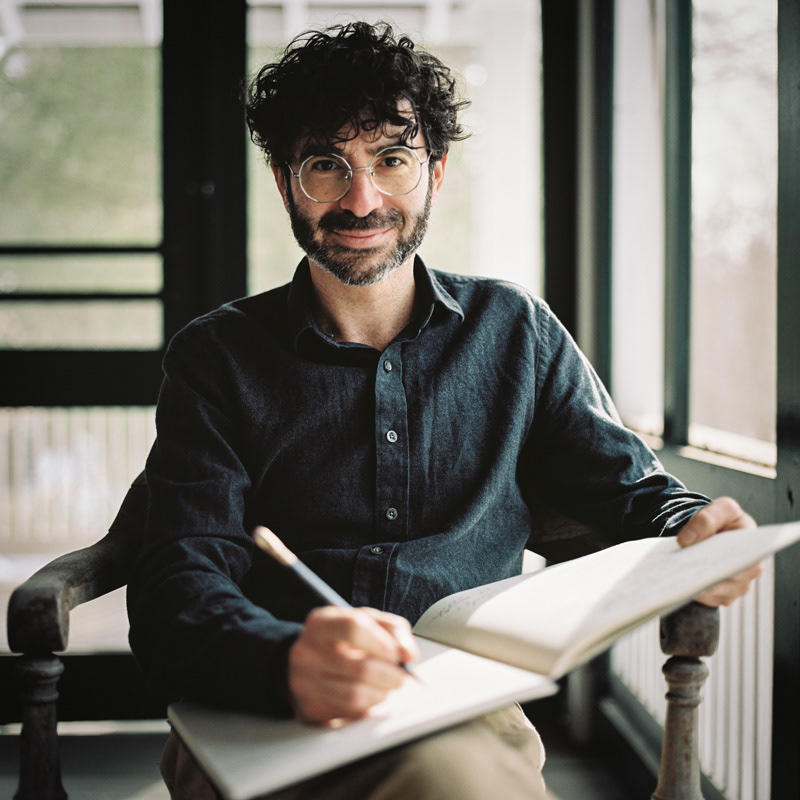 Michael Stephen Brown Interview Image by Sofian Khan
“I’m interested in turning things like loss, love, and wonder into sound. It gives my imagination a place to run wild.“
Video
