Published
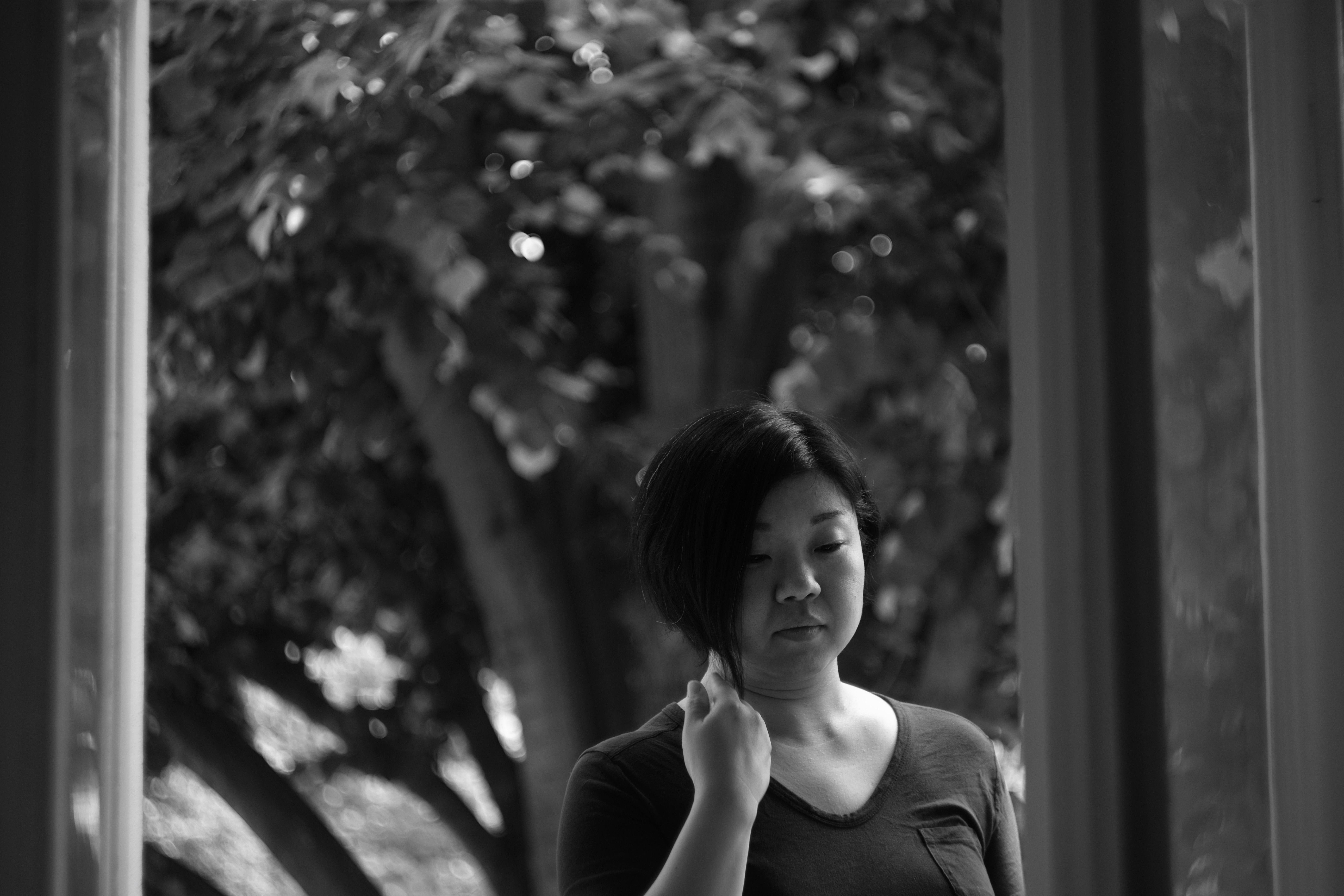
Name: Michiko Ogawa
Nationality: Japanese
Occupation: Performer, composer, researcher
Current Release: Michiko Ogawa's most recent release is Pancake Moon on Futura Resistenza.
If you enjoyed this Michiko Ogawa interview and would like to stay up to date with her music and live dates, visit her official homepage. She is also on Instagram, and bandcamp.
When I listen to music, I see shapes, objects and colours. What happens in your body when you're listening? Do you listen with your eyes open or closed?
It depends on the situation, but during concerts I often find myself closing my eyes. When I studied classical music, I used to do it in order to visualize the harmony and structure of what I was hearing. Now I close my eyes for a different reason — to let go of any theory, and to immerse myself completely.
When the eyes are closed, the visual world disappears, and the space of hearing expands outward. I feel as if my body becomes porous, almost transparent, allowing the sound to pass through.
There’s also a physical response I’ve had since I was young. When a piece of music deeply moves me, I feel the skin on the back of my head open up, as if tiny cells are blooming outward.
It’s strange, but that sensation has become my personal barometer of emotional truth.
How do listening with headphones and listening through a stereo system change your experience of sound and music?
For me, the main difference is whether the experience can be shared. Headphones invite you inward — they create an intimate, almost secret space.
Speakers, on the other hand, open a possibility for collective listening. When I listen with a friend and we suddenly recognize the same beauty at the same moment, it feels like a small but precious act of communion.
Those conversations that unfold after music ends — casual, meandering, unplanned — have always held a special place in my life.
Tell me about some of the albums or artists that you love specifically for their sound, please.
Taku Sugimoto – Opposite (1998)
A timeless masterpiece. It opened the door for me into the world of experimental music.
Jim O’Rourke – Eureka (1999)
A classic everyone knows, but one that remains deeply personal to me. His sonic world is something I’ve always admired.
[Read our Jim O’Rourke interview]
Charles Curtis – "Unfinished Song"
Simply, devastatingly beautiful.
Julia Holter – Aviary (2018)
Her voice works like a universal medicine for me.
[Read our Julia Holter interview]
Haruomi Hosono – "Nokto de la Galaksia Fervojo" (1985)
A record I’ve loved since my teenage years.
Do you experience strong emotional responses towards certain sounds? If so, what kind of sounds are these and do you have an explanation about the reasons for these responses?
I’m not drawn to sounds that directly reproduce someone’s personal emotions.
I don’t mean to reject emotions themselves — personal feelings, memories, and experiences naturally inform creative work. But in art, I believe the sound must be abstracted. Only then can each listener freely project their own experience onto it.
For me, music becomes meaningful when it allows this personal resonance, rather than imposing someone else’s feeling.
There can be sounds which feel highly irritating to us and then there are others we could gladly listen to for hours. Do you have examples for either one or both of these?
When I was younger, I would spend hours listening to music, trying to absorb everything I could. These days, even my favorite music rarely occupies that much time.
Making music myself has changed the way I listen. I try to stay neutral, to ear with clarity rather than indulgence. Listening has become an active choice rather than a passive habit.
Are there everyday places, spaces, or devices which intrigue you by the way they sound? Which are these?
I’ve always been drawn to subtle noises in household appliances — the soft whirring of a fan, the quiet hum of a refrigerator. These sounds announce themselves without demanding attention; they exist purely to perform a function. There is something honest and unadorned in that.
I also love natural sounds: the cicadas desperately singing in the summer sun, the delicate evening song of crickets. Even the sound of my eight-year-old daughter singing or mumbling to herself as she plays can catch me off guard — a fleeting, tender music of her own making.
Perhaps, in music, I am less drawn to direct speech or declaration than to this intimate, incidental presence.
Have you ever been in spaces with extreme sonic characteristics, such as anechoic chambers or caves? What was the experience like?
Before beginning graduate school in California, I worked at NTT ICC, a media gallery in Tokyo. They had an anechoic chamber, and I would occasionally enter under the pretence of maintenance, secretly wanting to test Cage’s ideas about silence.
With every external sound stripped away, my own bodily noises — my breath, swallowing, even my stomach — became grotesquely amplified. The silence was unnatural, almost suffocating. Yet in that extreme quiet, I became aware of sounds I normally ignore: the distant life of others, the hum of existence beyond myself.
In a way, it helped me understand why Cage treated all sound as music — because every sound, however incidental, carries life with it.
What are among your favorite spaces to record and play your music?
Last summer, I had the chance to record in a brand-new studio tucked into a friend’s house outside Berlin, deep in the forest. Everything was perfect, from the acoustics to the space itself. When heavy rain fell, I could faintly hear it seeping through the walls, adding a delicate layer to the music — a kind of ambient punctuation.
Berlin is densely populated and culturally diverse, full of people living close together. That richness brings vibrancy, but sometimes also a kind of “social noise” that can be exhausting. Even so, I realized that no matter how exquisite human-made music is, it cannot surpass the expansive, grounding presence of nature.
When working alone, I prefer my home studio. I love being at home so much that I could spend endless hours there, fully immersed in the process.
Do music and sound feel “material” to you? Does working with sound feel like you're sculpting or shaping something?
For me, sound is less like material and more like energy. It has presence, but it already exists — I don’t create it from nothing. Instead, I channel it, intuitively capturing fragments and weaving them together, much like assembling a collage.
In this way, my work feels less like producing sound and more like discovering and organizing energy as it flows through me.
How important is sound for our overall well-being and in how far do you feel the "acoustic health" of a society or environment is reflective of its overall health?
The effect of sound on well-being depends largely on how attuned each person is to it.
Sound itself is neutral and omnipresent. The choices we make — what we notice, what we listen to, what we let into our lives — reflect our internal state. A sound that lifts our mood can contribute to overall well-being, and conversely, unpleasant sounds can detract from it.
Acoustic health is tricky to define. But there’s a difference between a rich, natural soundscape and a bustling urban environment full of traffic and crowds. Being immersed in natural surroundings allows me to focus and feel at ease. When living in Berlin, I sometimes treated music as a substitute for the expansive calm of nature — a personal sanctuary within the city.
The environment shapes the music I make, and there’s no right or wrong in that; each place offers different inspiration.
Sound, song, and rhythm are all around us, from animal noises to the waves of the ocean. What, if any, are some of the most moving experiences you've had with these non-human-made sounds?
One vivid memory comes from Joshua Tree National Park, about ten years ago.
It was midnight, cold, and utterly silent, the stars blazing above. Occasionally, the wind whispered through the bushes, insects sang faintly, and night animals scuttled across the desert floor. The world felt simultaneously alien and familiar, like stepping onto another planet. Part of that experience was visual, of course — the vast desert, the sharp contrast of cold and dark — but much of it was purely sonic.
Another moment was last summer in Poland. During an outdoor rehearsal, a sudden, torrential rain washed over us. It was dramatic, sacred even — a sense of everything superfluous being cleared away. That rain inspired a piece I completed with my collaborator, the dancer Karol Tyminski.
Even manufactured sounds can captivate: once, while fiddling with an AM car radio, a fleeting pattern of static caught my attention. I recorded it immediately, thrilled by its unexpected beauty.
Many animals communicate through sound. Based either on experience or intuition, do you feel as though interspecies communication is possible and important? Is there a creative element to it, would you say?
Absolutely. I believe it is both possible and important.
Recently, I read about Japanese animal linguist Toshiaki Suzuki, who showed that birds combine “words” to communicate in ways similar to humans. That research excited me.
Humans have prioritized ourselves for too long, creating many environmental problems. If we could communicate more clearly with animals, it could help address these challenges. And I think it would also open up new creative possibilities, ways of listening and responding that go beyond human conventions.
Tinnitus and developing hyperacusis are very real risks for anyone working with sound. Do you take precautions in this regard and if you're suffering from these or similar issues – how do you cope with them?
Thankfully, I haven’t experienced serious hearing problems so far. I do try not to overuse headphones.
I know that as I get older, my audible range will likely narrow, and my preferred sound qualities may change. That’s fine with me — it’s just part of the process.
We can surround us with sound every second of the day. The great pianist Glenn Gould even considered this the ultimate delight. How do you see that yourself and what importance does silence hold?
When thinking about silence, Cage is unavoidable. He defined silence as music freed from the intention to listen, while Gould saw it as a separation from the world, something shaped by control and construction. In a way, their ideas are two sides of the same coin.
My experience in an anechoic chamber felt closer to Gould’s sense of isolation, probably because I was fixated on “listening to silence.” As with deep concentration, sounds can seem to disappear, and what we hear always exists within our own perception.
As a musician, I do use silence in this Gouldian sense, improvisationally, and I welcome moments when it happens spontaneously. Making sound is always a choice, and our intention inevitably plays a part.
At the same time, I completely agree with Cage that any sound, free of value judgment, can become music. This also reminds me of Eno’s idea of “sounds that function like silence.” I don’t set out to create that deliberately, but in Pancake Moon, the result ended up feeling like a vacuum of cosmic silence.
Silence is essential, both in daily life and in creative work. Engaging with music is always a journey into the depths of one’s own inner world, so being in a physically quiet environment is crucial.
Seth S. Horowitz called hearing the “universal sense” and emphasised that it was more precise and faster than any of our other senses, including vision. How would our world be different if we paid less attention to looks and listened more instead?
Olaf Stapledon’s Star Maker came to mind. In one chapter, the protagonist experiences a civilization built around hearing rather than sight. Their lives are shaped by sound in ways we can barely imagine.
For me, early childhood vision problems may have played a role in developing my auditory focus. I wore thick glasses and could only see dimly. The world looked dull, but music was vivid. Later, as my vision improved, I gained new clarity — yet I still value the way sound structures my experience.
Sound has always been a lens through which I perceive the world, guiding my attention and shaping my understanding of it.