Published
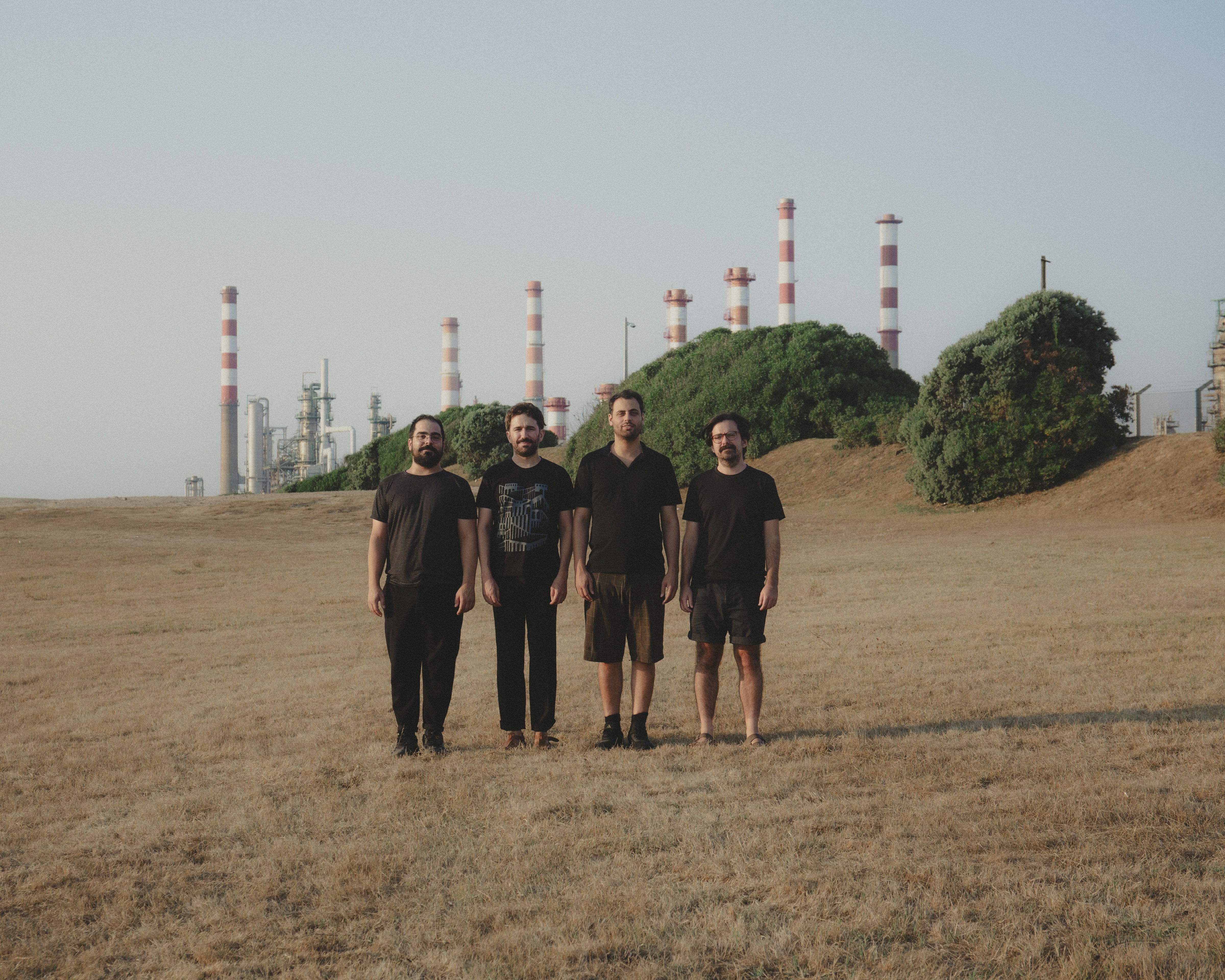
Name: Montanha
Members: André Azevedo (bass, electric guitar, organelle), João Sarnadas (electric guitar, bass, acoustic guitar, Volca Keys), Nuno Oliveira (Volca Beats, organelle), Tito Silva (PSR-38, Volca Keys, bass, organelle)
Nationality: Portuguese
Current release: Montanha's new album Alvorada is out via Favela Discos.
Recommendations on the topic of sound: Juhanni Pallasma’s Eyes of the Skin touches this topic in a broader way, and is good for opening possible worlds of other senses. Musicophilia by Oliver Sacks is a good book on already existing worlds, but they are too personal and out of reach, and can be used only as reference. David Byrne’s How Music Works is great for living in this world of visionand enjoying more what it has to offer in the acoustic realm.
If you enjoyed this Montanha interview and would like to know more about the band and their music, visit them on Instagram, Facebook, and bandcamp.
When I listen to music, I see shapes, objects and colours. What happens in your body when you're listening? Do you listen with your eyes open or closed?
It depends on the music. Some music is intended to be listened to with the body, some with the mind, some with violence, some with movement, some with peace or quiet.
It’s not good to shut your eyes in a mosh pit for safety's sake, but this sensory deprivation would definitely make you feel the music (and the pain) differently. Sometimes hairs tingle, there’s calmness or stress, sometimes with eyes closed, weird scenes appear.
In this record we worked a lot on dreams. It was not on purpose, eyes just tended to close. While mixing, it was hard to make it till the end without drifting in between worlds, so we found this to work on.
Tito once fell asleep playing keys, and we all took a nice picture with him.
How do listening with headphones and listening through a stereo system change your experience of sound and music?
Sometimes the body and the music are out of phase, like dub on a phone speaker or in headphones. There’s stuff you can only listen to with the body, and stuff that you can only listen to with headphones.
Then there’s the whole context and aesthetic, there’s music that should be listened to with phones, music that needs 4 22” subs, music that needs an elevator, sometimes you can’t have any of those and need an orchestra. Sometimes you need a mountain. Sometimes you need a band called Montanha.
All music has its own space and medium, and combining these sometimes brings up new listening experiences.
Tell me about some of the albums or artists that you love specifically for their sound, please.
Love is not the correct word for this but early Metallica, especially Kill em All, sounds like beer, and this is an amazing feat.
The Disintegration Loops by Basinski, where you can hear decay, are nice sound essays.
[Read our William Basinski interview]
The cotton balls of Zimoun are a very intense contrast.
[Read our Zimoun interview]
Reptilian Expo and the rest of the soniti people have an incredible sound. Breath of the Wild’s soundtrack and sound design is beautiful, and on the other side of the spectrum, playing Half Life Alyx, even on Quest2 speakers is an intense experience.
These are some of the sound references we have, of course they keep changing as one finds new interesting things.
Do you experience strong emotional responses towards certain sounds? If so, what kind of sounds are these and do you have an explanation about the reasons for these responses?
Sailor Moon intro hits hard in the childhood nostalgia. It’s that weird pan flute with tape decay and modulation.
Microwaves are instant happiness, for some reason. The plim of an elevator, there’s definitely an end to waiting. A weird laugh can make one laugh more or make one immune to humour, and a laughing track transports us to a Seinfeld episode. Loud barking can transform ordinary warm people into complete nazis, there is probably torture involving this kind of thing (after a google search there is a book about this).
We have also made some tracks that could fall on this torture spectrum, but we chose dreams for Alvorada, not nightmares.
There can be sounds which feel highly irritating to us and then there are others we could gladly listen to for hours. Do you have examples for either one or both of these?
Water. Passing by in a river or sea is one thing, leaking from a faucet at night is another.
A car engine riding for hours at night is dangerously smooth, when one wants to work it is unbearable, it’s designed to be pleasant on the inside.
Sometimes that snare can loop for hours until we get it right, but our yoga neighbours lose their minds. Sometimes someone forgets to pause the drum machine and when you figure it out it’s already too late for your brain.
Are there everyday places, spaces, or devices which intrigue you by the way they sound? Which are these?
We’re often fascinated by everyday spaces that weren’t designed with sound in mind, but still end up having really unique acoustic identities.
Like the sounds of everyday machines, printers, fridges, fans, even old appliances that rattle or hum in irregular rhythms. There’s something oddly alive about them. They feel like accidental instruments, producing rhythms and textures that often go unnoticed but still shape our environments.
Because the cover of the Alvorada vinyl is so out of the ordinary, we had to visit the printing factory and fell in the synchronic trance of a 1965 Heidelberger.
Have you ever been in spaces with extreme sonic characteristics, such as anechoic chambers or caves? What was the experience like?
One of the most interesting spaces we’ve been to, sonically speaking, is the Therme Vals, designed by Peter Zumthor.
There is a small concrete chamber hidden between the bathing spaces, with a very high and narrow ceiling and with crazy reverberation. If you just make a continuous low sound and it keeps reverberating forever, kind of makes you enter into a drowsiness state, while being inside the water.
In our studio, if you open the windows, sound appears on the ceiling corner, like a sonic review mirror.
What are among your favourite spaces to record and play your music?
We like to record in our studio Spoiler Room, in Porto. It’s a space we’ve poured a lot of care into, shaping it just the way we like - and it also serves as the headquarters of our collective, Favela Discos. Also, all our instruments and material are just there and it’s very easy to get lost in music.
There’s also Barca do Lago, in Gemeses, a place by a river curve where we recorded all the old Montanha material, and where we also worked for this record.
The big room is open to the river with big windows and we play all night for ourselves until this scenery of nature just fades in slowly and takes our attention.
Do music and sound feel “material” to you? Does working with sound feel like you're sculpting or shaping something?
In a practical sense, when I use EQs or compressors I’m literally sculpting sound, and changing connections between the elements. I envision a scene, or a painting, mostly static, with multiple layers from background to foreground where various elements play their role.
Even in composition, if I imagine a delay, there is a visualization of these repeats. Sometimes I wish I had the time and knowledge to actually paint every song like I see it, like a reverse Mussorgsky.
But to answer your question, although I know it is material, and feel it in my bones, I also feel it as an invisible energy flow, an immense spirit capable of underpinning any sense of being.
How important is sound for our overall well-being and in how far do you feel the "acoustic health" of a society or environment is reflective of its overall health?
One of us lives at a square that became the food corner for tourists.
One night, some friends were over discussing music, and one of them asked what record this was. It was two air conditioning systems from nearby restaurants. Beauty is in the ear of the beholder. It slowly got louder month by month and one day it malfunctioned and whole the building burnt down. The noise can reveal unhealthyness.
The studio where we recorded and composed our music is located in a very busy street, with lots of noise pollution, cars stomping on manhole covers, ambulances going to the hospital. But at night it gets a lot quieter, and that’s when our album was recorded, when the street, the city went to sleep and all the anxiety and rush of daytime went away.
We used field recordings of this street to connect the tracks on the album, so we could pass to the listener a bit of our experience recording and composing our music.
Sound, song, and rhythm are all around us, from animal noises to the waves of the ocean. What, if any, are some of the most moving experiences you've had with these non-human-made sounds?
Birds are a very good source of entertainment. We spent maybe one hour listening to a sci-fi gun sound at night in the Ariège. There is a nice app called BirdNET that identifies bird calls, and turns out it was a tiny owl. We never stole anything from them deliberately (for now).
The most intense thing I ever heard was the Salkantay glacier crack. The sound came from all around me, outside and inside. I was camped at the foot of a hill and was reminded that if there is an earthquake I’m dead. Didn’t sleep that night.
There is no way this can be reproduced in any mechanical way.
Many animals communicate through sound. Based either on experience or intuition, do you feel as though interspecies communication is possible and important? Is there a creative element to it, would you
say?
It exists already to some degree. Dogs understand a cadence of two syllables and can be taught what it means. Sometimes the “song” they hear is a specific taught sequence of movements.
On the other end you can also understand what dogs want. Sometimes. I guess everything that depends on pattern recognition will be solved by AI one day or another, we’ll be talking to dolphins in a few years.
The act, or the technology itself is not really creative, but the possibilities of what one can do with this are endless.
Tinnitus and developing hyperacusis are very real risks for anyone working with sound. Do you take precautions in this regard and if you're suffering from these or similar issues – how do you cope with them?
I recently found out via a friend who had a lot of troubles that there are two origins of tinnitus, one through physical deterioration of the little ear hairs, and another related to extreme stress.
For the first one we usually use earplugs, for the second one the best way is to not take anything too serious, like the grid of the DAW. Just break the grid, record asynchronously. The soundtrack from the first Terminator was synced by ear. We all have a bit of both.
As for hyperacusis, it’s very important to have a quiet place to retire to every once in a while.
We can surround us with sound every second of the day. The great pianist Glenn Gould even considered this the ultimate delight. How do you see that yourself and what importance does silence hold?
There’s mandatory silence on Sundays.
Once, after an intense 4 day sprint of touring in extreme heat completely drained and needing rest, I was unable to hear music. Some guy started playing and singing Pearl Jam in the square. People don’t need technique or good sound when there's soul. This guy had none of the three, and his ego pierced through the walls of the square. Thank god there’s mandatory silence on Sundays.
The only time I’ve ever needed silence like this was on a Goa Gil 24h set. It was his last and the man just didn’t stop. I thought I was going to a party, but it was a marathon. All one could do for silence was to try running away into the desert. And I grew up in a conservatoire listening to people failing scales all the time.
You can only appreciate music if you can have silence.
Seth S. Horowitz called hearing the “universal sense” and emphasised that it was more precise and faster than any of our other senses, including vision. How would our world be different if we paid less attention to looks and listened more instead?
Seeing is a choice and hearing is not, naturally speaking. A world of listening must also be a world of silence, or a world where elements can be heard.
This era is not interested in this. The best we have are noise cancelling earphones, but they bring us as close to a world of listening as a noise show.