

Name: Morning Stars
Members: Barbara Morgenstern, Alex Paulick, Sebastian Vogel, Felix Müller-Wrobel
Nationality: German
Current release: Morning Stars's new album A Hymn Without a Sound is out via Starling Darlings.
Recommendations for Berlin, Germany:
BM: I love the Tegeler Forst, a forest in the north of Berlin. Although it´s part of the city it is never crowded and has very peaceful and lovely parts.
FMW: If you're into good times, nice people, a vast variety of music and reasonable prices (as we are) you should give Schokoladen in Berlin Mitte a visit! We're really happy to play our release concert there on January 13th!
Things I am passionate about but rarely get to talk about:
BM: I love walking, I love to hike, go for walks or just cruise through the city without a specific goal.
FMW: I recently rediscovered my love for heavy metal and am happy I finally found some folks in my Indie bubble who share that passion and started a band with me called “Fevering”!
If you enjoyed this Morning Stars interview and would like to stay up to date with the band and their music, visit their official homepage. They are also on Instagram, and bandcamp.
What were some of your earliest collaborations? How do you look back on them with hindsight?
BM: I started in a collective called "Nautic United" in 1991 and played in a band called “Oof" from 1994 until 1998. I enjoy being part of a collective, it can push your ideas in directions, you would not have found alone.
But I also like the independence as a solo artist, full freedom and no compromises. I am the kind of person who needs both.
FMW: As a teenager in a small town in the 80s I joined a hardcore punk band which shaped my idea of “being in a band“ as having a project together with like-minded people, making music or just hanging out together a lot.
AP: I think all of us have been playing music with other people since we were children. For me, it was with my younger brother. We used to make up our own songs on toy guitars and record them to cassette. We would sticky-tape a cheap microphone to one of those 1970s upright vacuum cleaners to use as a mic stand. For me, creating music and recording music have always gone hand in hand.
There are many potential models for collaboration, from live performances and jamming/producing in the same room together up to file sharing. Which of these do you prefer – and why?
AP: We like all of them! And we all do all of them in other constellations. But the main point of The Morning Stars is to get together in a room and create songs together – in situ.
BM: It generally depends on the social and musical aspect of the collab. I have a slight preference for improvisation, ´cause the collaboration arises in the moment without too much brainwork. I love to improvise with The Morning Stars!
How did this particular collaboration come about?
AP: It was Sebastian’s 50th birthday.
Felix had the idea to give him the present of a new band. He called Barbara and then me and we both immediately said yes.
What did you know about each other before working together? Describe your creative partner in a few words, please.
AP: We have all known each other for over 25 years now. We have even worked together in different constellations.
The key is that we like each other and respect each other. We are friends and our music is a manifestation of our friendship.
What do you generally look for in a collaborator and what made you want to collaborate with each other specifically?
AP: Here it was initially motivated by camaraderie. I always want to collaborate with people whom I trust, yet who challenge me. That’s again true in this case.
BM: Playing and composing in a group is very different to solo activities. I love when something evolves you did not expect. This is what I look for.
I had the feeling that we as a group can do something really great but did not know what it would be like and so our sound was a wonderful surprise to me. The dynamics and the harmony singing are great.
FMW: I've been playing together with Sebastian and Alex for a long time now so I kind of knew what to expect. I've known Barbara and her music for a long time as well but never played with her.
I always loved how she came up with harmony changes that surprised me, and I'm really happy she brought that to the table with The Morning Stars as well!
Tell me a bit about your current instruments and tools, please. In which way do they support creative exchange and collaborations with others?
AP: In this group, it’s just our fairly standard instruments: a drum kit, a fretless bass guitar, an electric guitar with some pedals and an amp, a keyboard with the Prophet rev2 Barbara bought especially for this band. We used a DAW and some plugins to produce the record that was recorded with microphones and preamps in a nice room.
FMW: I'm curious if we will stick to the means we used so far or will some day think about what might happen if we try different instrumentations, ideas or concepts.
Before you started making music together, did you in any form exchange concrete ideas, goals, or strategies? Generally speaking, what are your preferences when it comes to planning vs spontaneity in a collaboration?
AP: Not especially. We all do that in other collaborations. The strategy here was just to make music together in a room again, rather than in that “production zone” that has become normal to us in other situations.
BM: We just discussed a little about what we want, but the real magic happens when we play together. And that's the trick: We do not plan or think much, we just play. We record our sessions and later on grab the best parts and work them out in detail, write lyrics and come up with the song structure.
Describe the process of working on A Hymn Without a Sound, please. What was different from your expectations and what did the other add to the music?
BM: I had no expectations, I just mainly wanted it to be fun. As we compose all the songs together everyone is constantly adding something to the music. When we come to the more concrete parts of our songs, of course we all share our ideas.
After we had our first shows we decided to go to the studio. Luckily we could record with Guy Sternberg in Berlin @lowswing studio. Alex did the mixes and Norman Nitzsche did the mastering.
AP: For me, it was harder to stay motivated to work on finishing the recordings. For my other projects, a lot of creativity happens in the production process and that keeps me feeling curious and eager. Here it was more about polishing a studio documentation of what we had already done together in a room, or in various rooms.
I thought it would be easy. But I missed the group energy that we have when we play together, which does not translate well when it comes to editing and mixing.
FMW: Maybe that's the challenge for our next steps: to find a way to keep up the collective band energy for the mixing/post-production process.
Is there a piece which shows the different aspects you each contributed to the process particularly clearly?
AP: Somehow all of the songs came together collectively – with one main exception – though our song lyrics often emerge when one person takes the initiative.
BM: My favourite piece is "The Everything."
The beginning is groovy, instrumental, a bit tricky. Then after 2 verses and middle parts the first vocal verse starts, Alex and Felix sing in super beautiful harmonies and we end in a hymn-like 3-part vocal end which leads to a noise improvisation.
Felix wrote heartbreaking lyrics which touch me every time we play the part.In this song all of our qualities come together beautifully: beat, an unusual song structure, killing harmonies and a noisy end.
What tend to be the best collaborations in your opinion – those with artists you have a lot in common with or those where you have more differences? What happens when another musician take you outside of your comfort zone?
AP: I think you need to have enough common denominators to find a basis, yet enough separate ideas to bring to the table without insisting they be used. I have been in collaborative situations that were based more on exchange rather than commonalities. It’s very different.
BM: Both are beautiful, of course. Being taken out of the comfort zone hurts from time to time but it's very important for your musical development. Playing with musical soulmates is great but I think it needs both: understanding and challenge.
Decisions between creatives often work without words. How did this process work in this case?
AP: The initial ideas always develop without discussion. We just start playing. If it sounds good we keep playing! Even key moments of the arrangements come from that. But we do discuss the arrangements once a good handful of ideas are in play.
BM: When we play, it is like a conversation, one plays, the other one answers, you join one of the band members, after a while another one comes in. For me it's a process of really focused listening and playing at the same time.
What are your thoughts on the need for compromise vs standing by one's convictions? How did you resolve potential disagreements in this collaboration?
AP: This collaboration isn’t about pursuing our own artistic dogmas. Frankly, the most difficult aspect of this collaboration is the scheduling.
BM: My best experience in the last year was the insight that "talking helps!". When we have disagreements we talk and talk until we find a compromise that works for all of us.
Was/Is this collaboration fun – does it need to be?
BM: Both points: yes!
AP: This collaboration is fun and that is one of the core principles. Well, maybe “fun” isn’t the right word – though it is often fun or funny. It’s enjoyable. It’s not hard work. It’s quality time.
Do you find that thanks to this collaboration, you changed certain parts of your process or your outlook on certain creative aspects?
AP: I don’t think so. My other collaborations still work as they did before.
BM: I lately realised while playing with others that it feels like playing with "The Morning Stars" which was a great feeling. Our speciality from my perspective is to develop first drafts in a very open process and then strip them down and really work on the material. This is new to me in a group process.
Collaborating with one's heroes can be a thrill or a cause for panic. Do you have any practical experience with this and what was it like?
AP: Not really. Along the way I have met a few of my “heroes” – though there wasn’t an opportunity to collaborate. I am always pleased to find that those people have been very encouraging. They have just been doing their thing a little longer and started a little earlier.
Barbara? I think you have the best legend collaboration story.
BM: I once collaborated with Robert Wyatt who is one of my major major heroes. I was sending him my records and he replied via postcard which was incredibly fantastic! And he agreed on singing on one of my ideas - a dream come true.
As part of my role as a conductor/head of a choir in Berlin I had the great chance to work with a lot of people as there are: Matthew Herbert's Brexit Big Band, Arto Lindsay, Van Dyke Parks, Harmonia, Fatima Al Qadiri, Roedelius, The Meridian Brothers, Ari Benjamin Meyers, Hauschka etc.
But these were more projects which is very different from really playing and composing together.
[Read our Matthew Herbert interview]
[Read our Arto Lindsay interview]
[Read our Roedelius interview]
[Read our Hauschka interview]
Lately, I played with a drummer who is studied and can sight read scores, he is a fantastic musician. I realized: Okay, I need more playing skills, I have to practise because I am not able to play what I hear and what I want to play. It was a huge push to practise more which helps a lot!

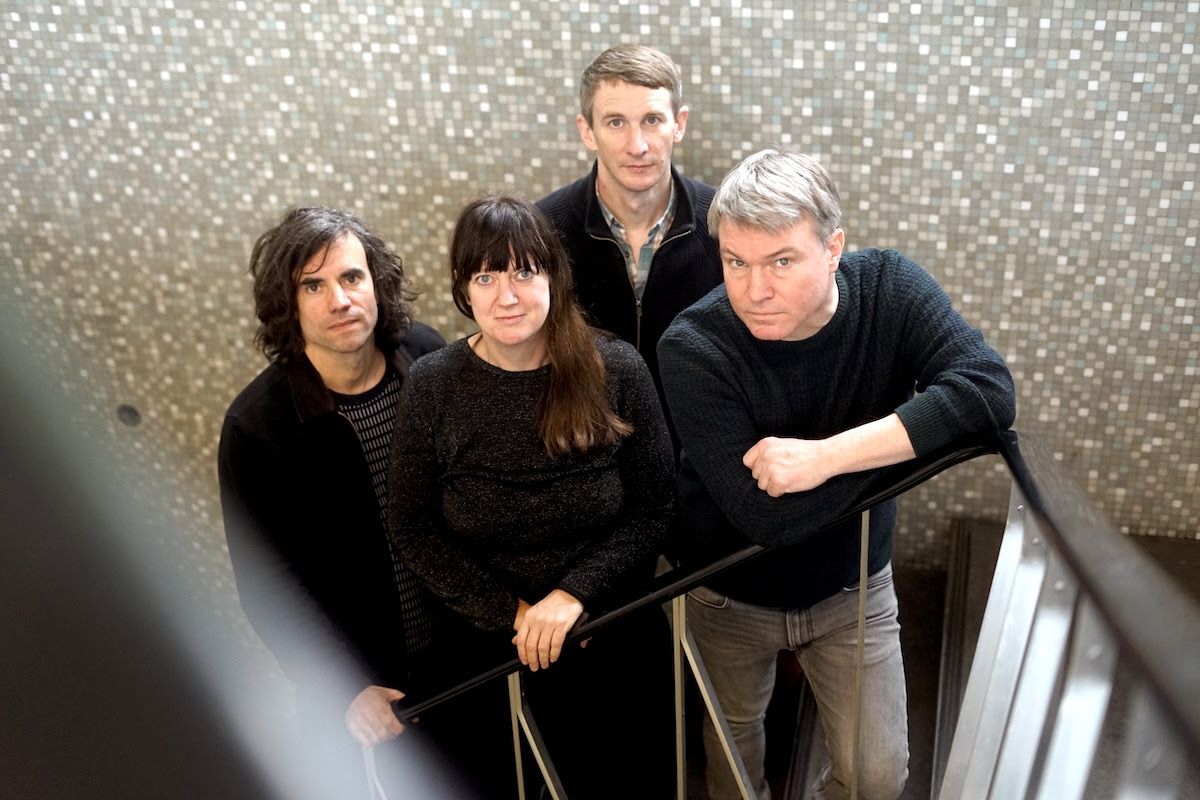 Morning Stars Interview Image by Marta Ricci
Barbara Morgenstern: “When we have disagreements we talk and talk until we find a compromise that works for all of us.”
Video
