Published
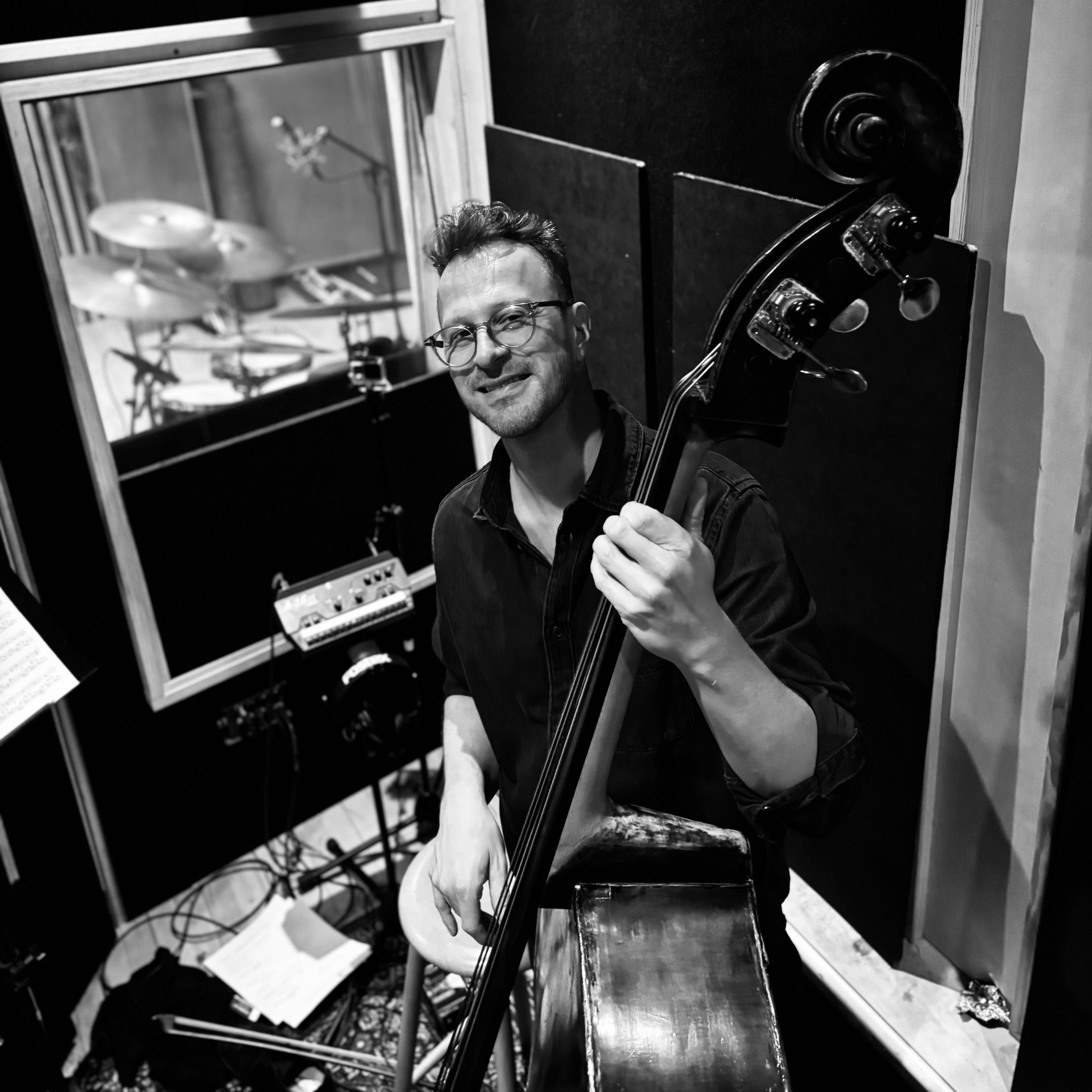
Name: Morten Haxholm
Nationality: Australian
Occupation: Doublebassist, band leader, composer, improviser
Current Release: Morten Haxholm's new album Aether II is out via Zack's.
Recommendations for Copenhagen, Denmark: Musicwise I love visiting the older jazz clubs; Christiania Jazz club and La Fontaine are some favorites. It is a lovely city, with a burgeoning cultural, historic, and gastronomic scene, and I'd recommend it to all.
If you enjoyed this Morten Haxholm interview and would like to find out more about his music, visit his official homepage. He is also on Instagram.
When it comes to experiencing strong emotions as as a listener, which albums, performances, and artists come to mind?
Jazz / instrumental:
Coltrane always get me, almost no matter which album.
Vocal:
Scott Walker: The Drift
Radiohead: In Rainbows (I'm a big Radiohead fan)
There can be many different kinds of emotions in art – soft, harsh, healing, aggressive, uplifting and many more. Which do you tend to feel drawn to most?
Some words that describe the emotions, qualities, and values I appreciate in music could be: Wistful, powerful, dynamic, musical interaction, sense of longing – and belonging.
An example of the sense of “longing / belonging” can be a track from my 2023 album: Aether - the song “Vesper”.
It is written as a search for the wistful, searching, and longing feelings. And finding a place, a home, where you belong.
I have had a hard time explaining that listening to death metal calms me down. When you listen to a song or composition, does it tend to fill you with the same emotions – or are there “paradoxical” effects?
I'm pretty open and encompassing in my musical tastes. I love being surprised by any kind of music!
However it might sound slightly paradoxical that an instrumental jazz composer like myself, enjoys a good amount of dark EDM, especially when writing emails, it can be quite flow-inducing!
In as far as it plays a role for the music you like listening to or making, what role do words and the voice of a vocalist play for the transmission of emotions?
For me, there is an easier ”specific” connection to the music when there are lyrics. A faster, direct path to a certain feeling. Then again I'm also intrigued when there are ambivalent / cryptic / poetic lyrics, that leave room for my interpretation and feelings.
Thom Yorke of Radiohead comes to mind, in terms of emotionally inducing vocal timbre and matching lyrics. Sufian Stevens and Elliot Smith also are a couple of favorites!
However, as a jazz musician, composer, and listener I do enjoy the openness of instrumental music a lot!
When it comes to experiencing emotions as as a creator, how would you describe the physical sensation of experiencing them? [Where do you feel them, do you have a visual sensation/representation, is there a sense of release or a build-up of tension etc …]
When a tune finally succeeds, the band finds its own interpretation, and the band embodies the composition, it feels like you are flying!
A sort of dreamscape where you fly on a blanket of perfect sound ... surrounded by a love and dedication to music, a place where you feel all, hear all elements of the music and the musicians creating it. It is absolutely fantastic!
When it comes to composing / songwriting, are you finding that spontaneity and just a few takes tend to capture emotions best? Or does honing a piece bring you closer to that goal?
A few times a composition comes as a fully formed, perfect composition. Written or envisioned in all parts within a few minutes.
However, the norm for me is a longer compositional process ... Sometimes I compare it to being an archeologist / paleontologist; digging out a dinosaur. First, you do a rough excavation clearing the ground soil, and then have a long process where you brush away tiny patches of sand – showing small pieces of a bigger end product. Finally, you assemble the pieces, trying different bones in different places – like a jigsaw.
Works the same for me when I'm composing. First I find a bigger plan: ”What story do I want to tell”. Then I find the little parts of the composition: some chords, a groove, a melody - I continue until I have quite a few parts. Then I reassemble and do edits until I feel like I've come somewhat close to the story I wanted to tell.
How do you capture the emotions you want to get across in the studio?
Even though I write instrumental music, we talk about what the song is about when we rehearse it – or before we record in the studio.
My song ”HILDA” from my first Aether album is dedicated to and named after my grandmother ”Hilda”.
I had composed the song for her when she was alive, but she didn't get to hear it before she died. I did play the song at her funeral in a minimalist duo version, and I told that story before we recorded it half a year later.
I think we ended up encompassing some of my loss, but also celebrating and remembering her life, with this recording of the tune.
What role do factors like volume, effects like distortion, amplification, and production in general for in terms of creating the emotions, energies or impressions you want?
On this album I worked with more additional production elements than before – and more than you usually hear on an “acoustic” jazz album. However, I feel we still encompass a recognizable “Acoustic Jazz” sound – embellished by some extra production elements.
I worked with extra FX on the acoustic instruments, and cut up / edited some parts to better fit a stronger electronic ambiance – an example could be the intro to “Silveon” – the opening track of the full album.
On the same (main) track of “Silveon,” we have additional production elements: the piano is prepared with pieces of wool and other soft materials.
Afterwards, the complete piano track was run through a Chase Bliss “Onward” pedal, and then the FX tracked was mixed as an extra ghost-like synth layer – as heard on the C part of Silveon around the 1.08 mark and forward. This effect, and others, give the music a special ethereal, spacious, dreamlike quality that I love!
We have a later single coming – with some heavily processed piano, that makes it sound like a dream-like ghost choir.
In terms of emotions, what changes when you're performing live on stage, with an audience present, compared to the recording stage?
It is a different kind of focus; in the studio, the emotions are more inward-directed, whereas in a live concert situation, it is more outward-directed.
What kind of feedback have you received from listeners or concert audiences in terms of the experience that your music and/or performances have had on them? Would you say that you prefer to stay in control to be able to shape the emotions or do you surrender to them and allow the music to take over? Who, ultimately has control during a live performance?
It is the perfect mix for me! Being able to know the music so well, by heart, that I sometimes can let go, and just watch my fingers play!
Just see my hands move, and listen to the full sound of the band – all details presented clearly – but also as a collective and communal “whole” of sound.