Published
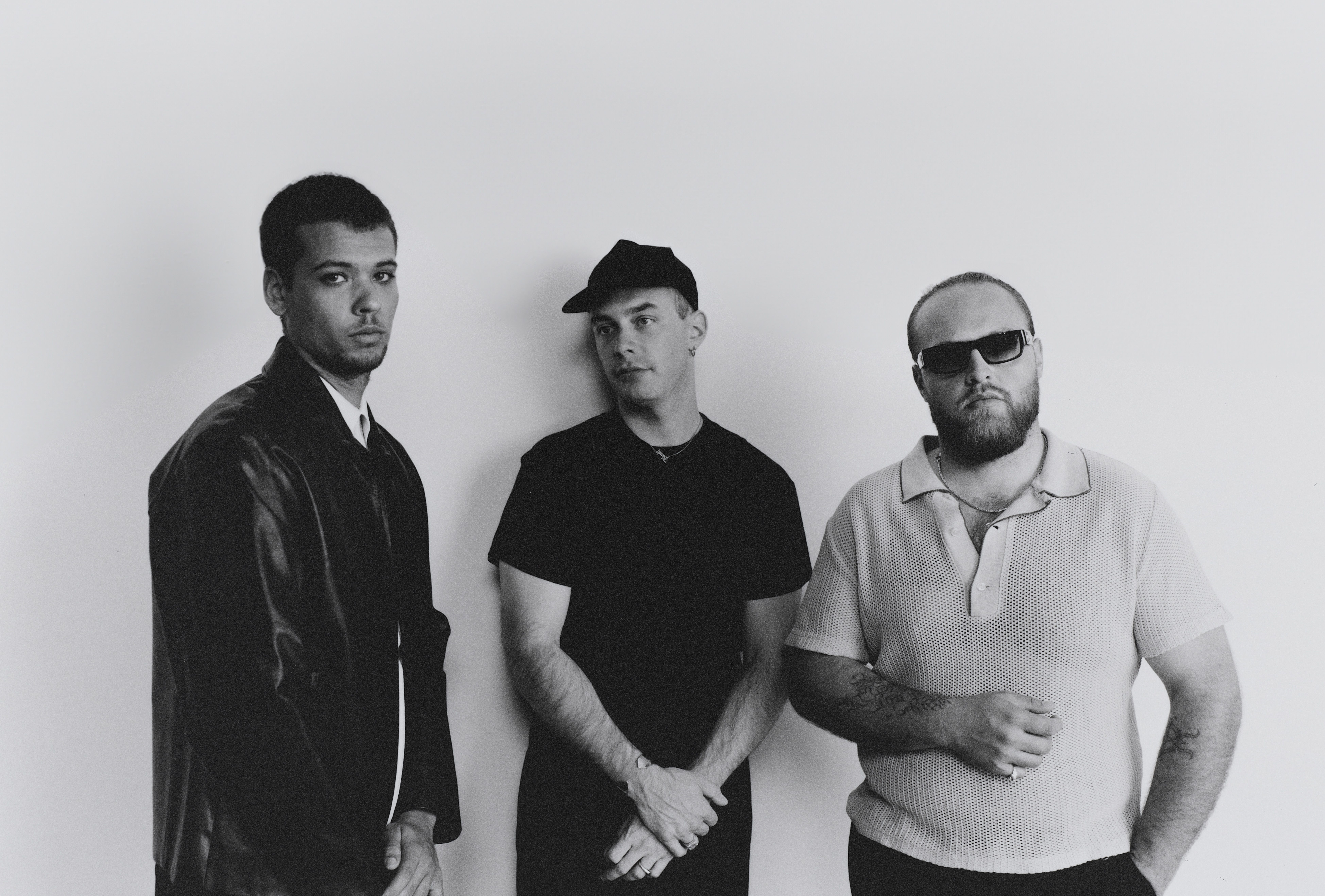
Name: Moses Yoofee Trio
Members: Moses Yoofee Vester (bass), Roman Klobe (keys), Noah Fürbringer (drums)
Nationality: German
Current release: Moses Yoofee Trio's debut album MYT, featuring ENNY, Wanja Slavin, and EVIN, is out via Nils Frahm's Leiter.
Global Recommendation:
Moses: A place you should visit when you’re in Berlin, our hometown, is ‘Gretchen’. It’s a really cool club where we played our first show and the owner/promoter of the club always helped us a lot with our career. Shout out to Lars! He also books all the good people to Berlin that give us the inspiration we need, so we’re really thankful for that. And if you want to have a nice beer in Neukölln, then check out “Bierbaum 2”!
Roman: Haha I don’t know if “Bierbaum 2” is a really good spot, but you should check out Albaik on “Sonnenallee”, it’s the best Shawarma place!
[Read our Nils Frahm interview]
[Read our Wanja Slavin interview]
If you enjoyed this Moses Yoofee Trio interview and would like to know more about the band and their music, visit their official homepage. They are also on Instagram,.
Tell me about your instrument and/or tools, please. What made you seek it out, what makes it “your” instrument, and what are some of the most important aspects of playing it?
Roman: I chose the bass because I studied guitar. After I finished studying, I got sick of the guitar and I wanted to play something more simple. That's why I switched to bass. But now I'm back to guitar.
Moses: When I was a kid, me and my mom lived together. A friend of her gave us a piano because she moved places to a different city, I think I was three. From there on it was in our living room. Then I quickly just sat there and found interest in the instrument.
I got my first piano lesson with four or five. From there on, I'm playing only piano and I'm super happy that I chose this instrument or that the occasions chose the instrument for me, because I feel like it has so many opportunities and – compared to other instruments – even the most opportunities.
I sometimes imagine how it would be to play an instrument where you can just play one note, like a saxophone or something else … I think harmonies are it for me. That's why I'm happy to be able to play piano.
Noah: I was very lucky that my dad was already playing the drums a little bit. He's also a film maker, and he made a lot of scores, so there was always music in the house.
I grew up in the countryside, and he had a little drum kit where I could sit on his knees and go crazy with it ... I think I started, I don't know, with two or three.
It was somehow a privilege for me because I had a passion really early and I never stopped playing drums. It was a safe space for me because I could play drums whenever I felt sad or whatever. My parents gave me money for some lessons, and I studied in Mannheim when I was older, and that's it. I'm thankful to my parents.
How would you describe your own relationship with your instrument – is it an extension of your self/body, a partner and companion, a creative catalyst, a challenge to be overcome, something else entirely?
Moses: So for me, my instrument feels like a friend and a safe space, maybe my best friend and maybe the most reliable friend, but not like an extension of myself.
It's more like it's just always there, doesn't need anything and is always a blank page kind of. You just need to play it.
Roman: For me, my instrument is really just a thing that I learned to play and try to master – probably will never be able to really master it, but it's really nothing more or less than that. It's a thing that allows me to create.
Noah: I wouldn’t say it’s an extension, but since it was always in my life, it's hard to imagine that it could not there anymore. The drums are my entire life so I couldn't imagine it without them.
What I really like about the drums is that it’s kind of an honest instrument because they're acoustic. I remember times I had like a hate-and-love-relationship with it because it's really hard to get better. But I like the honesty of an acoustic instrument because the harder you hit, the louder it is – you can't fake it.
When you're improvising, does it actually feel like you're inventing something on the spot – or are you inventively re-arranging patterns from preparations, practise or previous performances? What balance is there between forgetting and remembering in your work?
Moses: I think there's definitely a pattern and repertoire of stuff I practise, obviously. I think part of jazz school and part of practising our instrument is patterns, licks and scales and all of that, so I guess you manifest certain patterns.
Still, I think over the last years I'm actually trying to step away from them as far as I can, cause sometimes they do the exact opposite of what I want them to do. I try to be super creative on the spot, so in every solo I try to get inspiration from something or take a deep breath and just listen to the other people playing in order to ‘go places’ I didn’t go before and which are new to me.
I guess it's more about surprising myself.
Noah: For me it's pretty similar. I would break it up in two things: the technical approach, which is being able to play what I'm thinking. So basically, I'm trying to practice and to be able to reproduce what I practiced – then it gets to muscle memory and you can just play it.
But on the other hand it's also about spirituality: to be able to listen to others, to leave breaks and space. It's really about listening to each other and trying to find a magic moment together. You're playing together and you're searching to reproduce a magic moment.
Roman: I agree with both answers and I would also place focus on actually listening more to what the others are playing.
I mean, everybody's always improvising, but if you have a solo spot and you actually lead the improvisation, I guess it's super important to keep my ears open to what everybody else is doing. Like this, I can also take stuff and, you know, kind of ‘steal’ it or like response to it and develop it.
But then there are also certain moments where I want to go kinda ‘hard’, like to a climax, and then I know there's some stuff that I need to do to get us there, since this is maybe something I always play. This way, the improvisation or solo becomes what you imagined.
Moses Yoofee Trio Interview Image by Aysan Lamby
Taking your recent projects, releases, and performances as examples, what, would you say, are the key ideas behind your approach to improvisation?
Moses: Based on releases and music we played, I would say it definitely is about the people you’re playing with and the situation you’re playing in. I think we all had jams or sessions where we just collectively improvised and we learned it the hard and the soft way to play jazz tunes through forms and to improvise as you ‘should’ improvise. So I don't know if it's really improvisation or just like recreating.
But overall, I think we just found the mixture we want from open parts and open improvisation on top of written-out stuff. Each of us has spots in his head where we improvise and where we express ourselves independently as we want to. I think it's about the time you play together and the time you spend together to be able to create together and to go places.
Noah: As an add-on, for me the nice thing is that it's pretty balanced with the trio (between improvisation and written out composed music).
In your best improvisations, do you feel a strong sense of personal presence or do you (or your ego) “disappear”?
Noah: For me it's just about the music. If I hear something after the concert, like a recording or a video in a story, and it’s really dope – this gives me confidence, but in a good way.
But in the spot, I would say it's really just about the music and playing together.
Roman: I would also say the goal is for sure to let your ego disappear while playing. Because like I said in the other question, I think it's important to focus on listening to the others while you are playing in order to fit in and to find the space.
If everybody thinks like this then everybody finds each other’s space, which is very nice at the end.
Moses: For me, ego is a big thing actually. I think it is super important to have big ego – not an ego in the sense of compared to the people you play with, but more compared to the whole situation.
When my ego grew, I just felt much more safe and much more able to do what I really want to do. The band and the people I'm playing with are more like friends to this ego. It's not about being the best, it just gives me a lot of self-awareness and self-confidence to be able to express myself.
If I’m having a good improvisation moment, then my ego – or let’s rather call it my self-confidence – was usually pretty strong in that moment.
Stewart Copeland said: “Listening is where the cool stuff comes from. And that listening thing, magically, turns all of your chops into gold.” What do you listen for?
Roman: I always try to listen to the others or to all of us and to the space in between. Also, I try to listen to myself from a very objective outside perspective – even though it's not 100% possible – in order to see the whole picture.
Moses: I agree, it’s super important to be able to zoom out to hear all elements and to see the whole picture.
Noah: I also totally agree, but zooming out is pretty hard. It's part of practicing for me because it’s hard to play and at the same time zoom out and listen to the whole music as a bigger picture.
Also, I think – and this sounds really cheesy, but anyway – in drum nerd talk, groove is about the break and the air between the strokes, if that makes sense. It's like listening to each other to create something with less.
In a way, we improvise all the time. In which way is your creative work feeding back and possibly supporting other areas of your life?
Moses: I don’t know if improvisation in music has a lot to do with other stuff in life, but I think being able to be spontaneous and creative on the spot is important. When you have sessions or you want to write and compose music, then it's really helpful to be able to improvise.
For our work process it also helps a lot, cause most of the good stuff we do is the first thing we play when we go into a room. After that we often ‘try hard’ too much and then it’s not good. The first idea is always super nice and I think it's about the room and us three together for the first time on a day.
Roman: I also don’t know if it does anything in an everyday situation, but it probably helps with being flexible. As a musician you don't have a routine, because every day or every week looks very different. That's something that I really like.
So I guess improvisation in a piece of music is like improvisation in a piece of life.
Noah: It is, actually. Every day is different, especially compared to a ‘normal’ job. You don't know if you'll have gigs, you don't know if you can survive money-wise. Every year is different and I also get it when some musicians are not able to continue their paths because of that and because they're scared to not make it or to survive from just making art.
Moses: What is also really helpful in improvisation but also in real life is emotions. Being honest to your emotions and to look into yourself.
Expressing emotions through music and through improvisation is something that people who don't play instruments can't really do. I think that’s something improvisation can really help with, too.