Published
Name: Mother Tongue
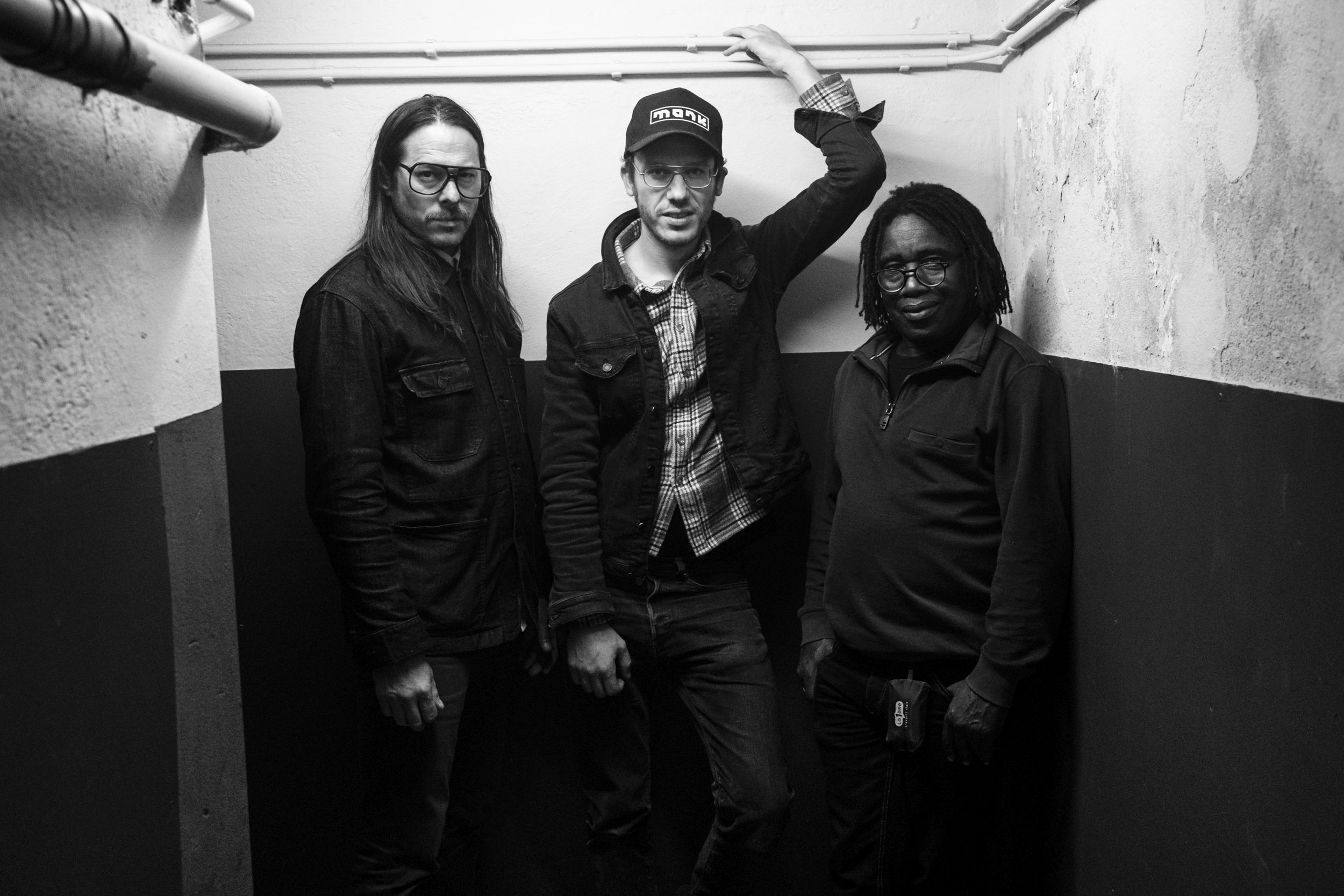
Members: Mola Sylla (vocals, percussion), Frank Rosaly (drums), Oscar Jan Hoogland (electric clavichord)
Interviewee: Oscar Jan Hoogland
Nationalities: Dutch (Oscar Jan Hoogland), Puerto Rican (Frank Rosaly), Senegalese (Mola Sylla)
Current Release: Mother Tongue's self-titled album is out October 3rd 2025 via Makkum/De Platenbakkerij/Astral Spirits.
Recommendation for Amsterdam, the Netherlands: OCCII - Onafhankelijk Cultureel Centrum In it. An independent venue for live music. Great community of volunteers running it. It’s one of the view underground venues that is here to stay for sure. We recently moved a piano to the second floor. So for those who know OCCII - for a long time. Now there is this new face to place. Acoustic music and YES: sunlight!
Further online agenda’s: jazzin.amsterdam, amsterdamalternative.nl, radar.squat.net
And some great record stores: Platypus Records, Flesh Records, Black Gold, Distortion Records, and for improvised music especially City Records.
When did you first consciously start getting interested in musical improvisation? What was your first improvisation on stage or in the studio and what was the experience like?
This was in Zaal 100 around the change of the century, where, still going strong, there is an ad-hoc improv series on Tuesday evenings. If you want to play there with your band you get a kind of sorry-no-reply: this stage is for new combinations. An artist coming through town meeting up with the local scene on stage. Fantastic gigs and terrible mismatches. You learn a lot going to these concerts more often. I loved it and still do. To hear musicians think.
At that time it reminded me of the rethoric debating games at high school. Now I like it more for it’s realness. There is not much music more live than this type. REAL time. REAL people. REAL situation. REAL music.
The Mother Tongue record was also recorded in a live improvised music context. Very different since we are a band that plays together more often. The Mother Tongue record doesn’t really sound like improv, mainly because Mola brings in so much song. But it was completely improvised. And it does sound very real because of that.
It really happened this way that day. The first song on the record is the first thing we played. DJANGALOMA DARA! You taught me nothing!
Tell me about your instrument and/or tools, please. What made you seek it out, what makes it “your” instrument, and what are some of the most important aspects of playing it?
With Mother Tongue I play my electric clavichord that a developed myself by adding pick-ups and a tupe amplifier to an old pre-piano-times keyboard. (this piano player was just toooo jealous of all the electric guitarist, specially the punk improvisers from The Ex: Terrie and Andy)
[Read our Andy Moor interview]
Without the amplification it would be very, very soft. A bit like playing an electric guitar without an amp. All clavichords have a special feature. You can ‘bend’ a note on it like you can on a guitar when playing a bluesy line. If you press harder on one of the keys the tone goes up.
One day I heard a record of music by C.P.E. Bach played on clavichord. (It’s very hard to record a clavichord well and this was an early attempt) The notes bended ridiculously and the noise pitch ratio was leaning over to the noise side a lot. I thought that’s it! Ridiculous. Fantastic! I set off and after 3 clavichords and ripping of guitar pick ups from too many guitars and failing and failing I got there.
Now I do a lot more with it then just playing and bending the keys. During a gig I play a lot directly on the strings, I use small propellers or cassette tapes, an e-bow and a crackle box. It sometimes really is the mad scientist in his noise atelier.
What attracts me in playing the clavichord with Mother Tongue is two things. One being the complementary roles we can play. There is a rough solid base of Oscar sound, Mola voice, Frank percussion that just works. We can set out our independent paths along those three roads. S V P sound voice percussion. And of course we switch roles and suddenly, all of us are involved in a noise improv or Mola and I play harmonies together or we are a percussion trio.
The other thing is it’s lack of a place and time history. I play piano in many of my bands. But I feel the piano can colour Mola’s Dakar griot art in a limiting way. It brings the listener to ‘the west,’ it’s terribly well tempered and limiting in its flat continuity of timbre; from lowest to the highest note it all sounds the same: piano. And you see the thing in front of your eyes even if you would listen in the complete dark.
The clavichord doesn’t give you that image. You don’t know what you are listening to. And not when. And not where. It blends much better with Mola’s voice and instruments and with the way Frank plays percussion.
Derek Bailey defined improvising as the search for material which is endlessly transformable. What kind of materials have turned to be particularly transformable and stimulating for you?
Haha good old Derek. Yes indeed with him improvising can be endless. Luckily it at least transforms (although not that much sometimes either back in the days in England).
I come from a very different improv family. My Derek is Misha Mengelberg (good friends with mister Bailey by the way). He called his improvised music Instant Composing. When I’m improvising it is always towards composition. Counterpoint is a key compass towards the relation with the other artists. And the piece and even the set is full of intention (which is a little different then ‘search’) and consequence.
On this record the rough pieces give urgency for the beautiful quiet ones and visa versa. Take the last piece of the album.
It was the last piece performed that day. It could not have been the first one I think. The second part contrasts highly (counterpoint) with the first one. It becomes more and more inevitable as we continue improvising the composition.
And in the end it doesn’t just stop because the record is finished, it really ends. Its transformation is final.
Do you feel as though there are at least elements of composition and improvisation which are entirely unique to each? Based on your own work or maybe performances or recordings by other artists, do you feel that there are results which could only have happened through one of them?
There are of course technical things that set improvising and composing as methods to make art apart.
There is the numbers game. The more people involved, the harder it gets to improvise towards composition. There is the relation of speed and complexity: If you want to improvise very fast, it is likely that your music will become more complex; especially with regards to pitch. It is very hard to improvise fast changing, yet transparent harmonies with more people. So if you want to make a pop song together with fast changing harmonies you might not succeed trying to improvise it. But those technical things can be so different per culture. The issues can even become absurd non issues.
It’s nice to realise that composing and improvising are both things not reserved for music alone. Making a band is composing. Scene building is composing. Making a meal is composing. Dressing up. Making a record of improvised music is composing. It is all also improvising.
I make music. And I love the intersection of improvisation and composition. It’s where time becomes alive.
When you're improvising, does it actually feel like you're inventing something on the spot – or are you inventively re-arranging patterns from preparations, practise or previous performances? What balance is there between forgetting and remembering in your work?
We learned to walk. We need that to go new places to do things we have never done before. We are not afraid of repetition. We are not afraid of repetition.
Artists from all corner of the musical spectrum, not just “free jazz” have emphasised the importance of freedom in their creativity. What defines freedom for your improvisations?
At the moment we lack freedom, both with most geopolitical situations and in the scene building. We are an Amsterdam based band but we are from all over the world. This music is a conversation between different musical mother tongues.
The walls are growing. Crossing borders is getting harder and harder. On a smaller level, when making scene based art, the music depends a lot on whether there are good schools underground venues that are not constantly at the risk of closure, places to live for artist and means to get the art of the ground.
If there are no places to live and venues are under constant pressure, your scene soon starts to loose its power. The best artist move out. The new artist can’t find their way in. The international students move back after their studies.
Improvised music is a scene based music. We become better together and in conversation with other scenes. It is hard to talk to Chicago where Frank has spent many years of his live at the moment and it has always been almost impossible to start a real conversation with many of the African scenes.
Taking your recent projects, releases, and performances as examples, what, would you say, are the key ideas behind your approach to improvisation?
Sometimes, when people ask me what kind of music I make, I answer that I make music with people that are so unique that, if you would take them out of the band, the band compleeeetely changes.
I like improvisation at the moment mostly because of the realness it brings. Like I sad before: It’s the most live music there is.
In your best improvisations, do you feel a strong sense of personal presence or do you (or your ego) “disappear”?
That is question that would be nice to ask to Frank Rosaly and Mola.
I feel Frank is very much interested in what the instrument and the sounds do without him intervening. And there is a transcendent element to his playing. I have seen him bring a room to a different place. You could say that, even being very charismatic, he then disappears.
Mola brings more than his own ego. With him, I feel his ancestors also speak. The circular time of Africa and his Griot wisdom bring a big ‘nos’ (we).
What are some of your favourite collaborators and how do they enrich your improvisations?
Playing together with Han Bennink is a key experience to me. The musical language I speak is developed for a big part by musicians in dialogue with Han.
My musical grandparents and papas and mamas have all played with Han. Had to solve the problems he confronted them with. Relate to the interdisciplinary attitude, the fantastic presence and the love. If I play with him it’s like time traveling. It feels like we have played together longer than I live.
Which is actually true with this music and its oral tradition, of course. Not only standing on the shoulders of giants but actually playing with them is, well, everything.
There can be surprising moments during improvisations – from one of the performers not playing a single note to another shaking up a quiet section with an outburst of noise. Can you tell me about such situations from your own performances and how they impacted the performance?
Being on the look-out for magic and chance it what improvisers can be scarily good at.
Again on the last track of the album, Mola and me suddenly stop playing at the same time. (This wasn’t a visual cue. It’s one of these super fast reflective decisions that happen so often with good improvisers and that can leave an audience perplexed) Leaving Frank alone on the drums as if the electricity suddenly stopped due to a power cut.
We have built trust with this group so nobody tries to ‘save’ the situation by coming back in, and Frank is totally cool with being alone. He doesn’t blink an ear and continues baring full responsibility for the music also when left alone like this. Independent YES.
As a listener, do you also have a preference for improvised music? If so, what is it about this music that you appreciate as part of the audience?
I like it because it’s real. I dislike it when it becomes generic, like an another genre of music next to dubstep or tango. Yes, even free improvised can be very generic. Especially when it is very successful and good.
In that case I like to quote Misha Mengelberg once more: “Niet om het een of ander maar ik ga even buiten voetballen” (“Not for any particular reason, but I’m going outside to play a bit of soccer”).