Published
Name: Nate Wooley
Nationality: American
Occupation: Composer, improviser, trumpet player
Current release: Nate Wooley's new album new album Henry House is out via Ideologic Organ.
Recommendations: The Living Mountain by Nan Shepherd; Any essay by Wendell Berry
If you enjoyed these thoughts by Nate Wooley and would like to know more about his music, visit his official homepage. He is also on Instagram, and Facebook. For a deeper dive, we recommend our earlier Nate Wooley interview.
Over the course of his career, Nate Wooley has collaborated, performed the music of and appeared on recordings with a wide range of artists, including Trevor Dunn, Bruno Duplant, Gerald Cleaver, Ingebrigt Håker Flaten, Mark Sanders, Mette Rasmussen, Mats Gustafsson, Ches Smith, Tomas Fujiwara, Michael Pisaro, and Wadada Leo Smith.
[Read our Trevor Dunn interview]
[Read our Bruno Duplant interview]
[Read our Gerald Cleaver interview]
[Read our Gerald Cleaver feature "about Griots, Ghost Orbits and Modular Synthesis"]
[Read our Ingebrigt Håker Flaten interview]
[Read our Mark Sanders interview]
[Read our Mette Rasmussen interview]
[Read our Mats Gustafsson interview]
[Read our Ches Smith interview]
[Read our Tomas Fujiwara interview]
[Read our Michael Pisaro interview]
[Read our Wadada Leo Smith interview]
Where does the impulse to create something come from for you? What role do often-quoted sources of inspiration like dreams, other forms of art, personal relationships, politics etc play?
That impulse has evolved, and it continues to evolve. Ideas used to arrive relatively well-formed in the middle of walks from the train to my office when I had a day job. Seven Storey Mountain 6 was like that. The sound of it was just suddenly in my head as I was crossing the street entrance to the Manhattan Bridge. Once I got to my desk, I wrote it all down. And I think I started writing musicians that morning.
That kind of inspiration is rare these days, but I do get similar flashes of complete work or, more often, answers to problems I have with ongoing work, when I’m sitting in a concert that I find especially inspiring or riding in the car on the way to some family dinner or gig.
Lately, I find myself wondering about the life behind what I see or hear. If it’s a movie, I start wondering about the quotidian hidden actions of the characters or the actors or the grip or the craft services person. What was Virginia Woolf’s emotional state when she was writing The Waves? Was she fighting with her husband or flirting with someone at the Oxford library? When she killed off the narrators’ mutual friend, was that a displaced act of rage or sorrow? That opens up something new in my mind, and often some new inspiration.
The result is usually not narrative; I’m not thinking of trying to write a story about that imagined hidden life. The messiness of that imagined humanity, though, often leads me to something I want to deal with or play with or fuck with.
For you to get started, do there need to be concrete ideas – or what some have called a 'visualisation' of the finished work? What does the balance between planning and chance look like for you?
It would be disingenuous to say that I don’t have some period where visualization of the final project isn’t necessary, but most of my work is based on some initial question. And often that question is something related to the limits of an idea: “How far can these people go with this set of parameters? How long can we sustain the freshness of this concept?”
I enjoy the rush of being surprised by my own compositions. It’s just the best feeling to not know what’s going to happen, and I believe that eight thoughtful people in a room with instruments can, given a path or set of directions, create something far more complex and unique than is possible from me imposing the will of my visualized end result.
Mutual Aid Music is my usual example of that: the compositional method involves writing hundreds of micro-pieces that the musicians can spindle and mutate in whatever way their improvisational minds want to, within the constraints of Kropotkin’s original philosophical/social idea of mutual aid.
The result is always something that surprises me, and it is music I would never think to make, but I always wish I could.
Is there a preparation phase for your process? Do you require your tools to be laid out in a particular way, for example, do you need to do 'research' or create 'early versions'?
No. I’m not that orderly. I don’t know that I’d want to be. I think it would create a division between that part of my life and the part that makes breakfast and answers emails.
I want it to all be one big bloody mess.
Do you have certain rituals to get you into the right mindset for creating? What role do certain foods or stimulants like coffee, lighting, scents, exercise or reading poetry play?
Similar to the above answer, I guess, but an opportunity to add some context.
I grew up in a timber and fishing town where the primary life philosophy is to shut up and get down to work. I don’t, therefore, have a lot of patience for the surface trappings of “Process.” I’m not sure that’s totally fair of me, but I know myself well enough now to accept it.
I get up in the morning, go for a run, drink coffee, and that’s about as far as the ritual goes. I work until I can’t work anymore; until the work is suffering from lack of energy or concentration; until the work might suffer.
Sometimes I can rest and do some more, but typically, when I’m done, I’m done. Usually that’s ten hours, and I feel good about that. Sometimes it’s less, and I feel bad about that.
What do you start with? And, to quote a question by the great Bruce Duffie: When you come up with a musical idea, have you created the idea or have you discovered the idea?
Creating and discovering are two ways of saying the same thing. And I’m not sure that I would feel comfortable talking in either of those terms.
I work, and that work means dealing with music and text, and it involves a lot of revision and manipulation, so the initial “idea” is not something I would put in the elevated position of creation or discovery. It’s the beginning of a process that will ultimately involve a lot of difficulty, and the initial impetus or material is rarely present in the final version.
Like Jacqueline Rose said, “If you want to read Hegel, you have to start by reading Hegel.” The real impetus isn’t creating or discovering. It’s just having the will to start.
Many writers have claimed that as soon as they enter into the process, certain aspects of the narrative are out of their hands. Do you like to keep strict control or is there a sense of following things where they lead you?
Oh, things definitely take over. I’ve never made anything exactly as I originally planned. 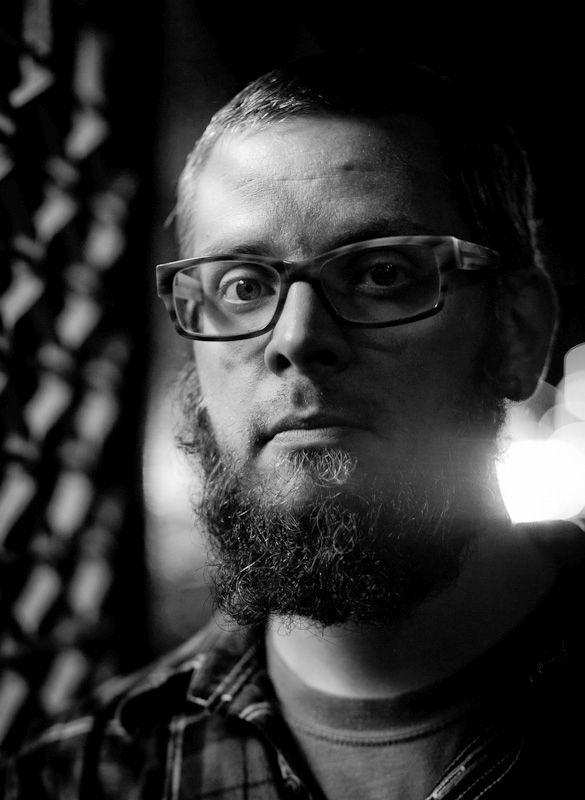
Nate Wooley Interview Image (c) the artist
There are many descriptions of the creative state. How would you describe it for you personally? Is there an element of spirituality to what you do?
It definitely isn’t spiritual, and I’m always wary of people who say it is. (That’s me being crotchety, though, and I have nothing against anyone that sincerely can access that feeling.) My problem with that idea is that is projects this notion that art is the product of an arcane magic that a select few can “tap into.”
The creative state is the result of a lot of rigorous study, repetition, and obsession rather than the visitation of an entity, and pretending that it is the latter actually cheapens the work that goes into being a musician or composer or poet or painter or dot dot dot.
At the same time, viewing the artist as a spiritual conduit erects a barrier to entry and understanding of the work. If a viewer comes to a painting for the first time with the preconception that it was produced through the channeling of divine inspiration, then it negates the hours put in to master the ability to paint light and shadow. That takes the human aspect out of what has been made and what they are viewing.
To me, I want the viewer or listener to think about the work for a long time, because it somehow touches something they know or makes them feel like another human has shared an experience with them. And the idea of spirituality in creativity creates a hierarchy rather than a shared humanity.
Once a piece is finished, how important is it for you to let it lie and evaluate it later on? How much improvement and refinement do you personally allow until you're satisfied with a piece? What does this process look like in practise?
I’m never satisfied with a piece. That’s why I like doing what I do.
It’s never right. It’s never mastered. There’s always somewhere further to go..
When you're in the studio to record a piece, how important is the actual performance and the moment of performing the song still in an age where so much can be “done and fixed in post?“
It really depends on the work. Some things naturally require a fragmentary approach in order to protect the health of the musicians. But other things are dependent on the probability of failure.
A lot of my pieces play with failure—see Syllables or Four Experiments—as a major theme in their performance.
In these cases, I wouldn’t say the performance is important, but the willingness to fail is. That’s different in a way. It’s not a “let’s nail it on the first take” attitude. More like “let’s see what happens.”
What's your take on the role and importance of production, including mixing and mastering for you personally? In terms of what they contribute to a song, what is the balance between the composition and the arrangement (performance)?
It’s part of the process, for sure. The great producer and engineer is the one that knows what you’re trying to do and seeing where it falls short.
And especially with a piece like Henry House that is so dependent on coaxing out certain overtones and beating patterns in a mess of sine tones and acoustic signal, the recording, mixing, and mastering is essential for getting it as close as it can to its full expression.
After finishing a piece or album and releasing something into the world, there can be a sense of emptiness. Can you relate to this – and how do you return to the state of creativity after experiencing it?
The emptiness doesn’t need a reason to exist; it just comes and goes in waves.
Years ago, I was wrestling with a horrible bout of aridness and depression, and John Zorn of all people helped me get through it. He told me it was just a natural thing, and to just relax and use the non-refundable hours of my life to do something else rather than worrying about it.
And that’s kind of what I live by. When things are slow or empty, I just concentrate on refining my trumpet technique or doing the writing, editing, teaching, or hustling work necessary to pay rent and stay alive.
That stuff has to get done anyway, so I can settle into it while keeping my mind off the chill.
Music is a language, but like any language, it can lead to misunderstandings. In which way has your own work – or perhaps the work of artists you like or admire - been misunderstood? How do you deal with this?
People get what they want from my work, and I can’t control that. As long as they’re not Wagnerizing it to fuel some sort of rancid hatred, I don’t really care what they think. That’s probably a protective measure for my ego at its core, but it is also a way of stay free to make what I want without its reception coloring the work itself.
The real goal for me as it pertains to my work, is to put something in the world that inspires someone to think and act. If it inspires someone to think and act (above caveat around hatred very much in play here) in a way I didn’t intend, then that’s great.
If they just enjoy it or use it to escape for an hour from their lives, then that might count as a misunderstanding of my work as your question proposes, but it wouldn’t upset me.
The artists I admire mostly share that quality, and maybe that’s why I admire them.
Creativity can reach many different corners of our lives. Do you personally feel as though writing a piece of music is inherently different from something like making a great cup of coffee? What do you express through music that you couldn't or wouldn't in more 'mundane' tasks?
I don’t like the hierarchy of artistic and mundane tasks. There are things that we pay attention to and things that we do mindlessly; that’s where the delineation occurs. Here’s my hobby horse. Too often we think that revolutionary acts have to be massive, shocking, and broadcast for public confirmation.
Being fully invested in the reading of a poem is a revolutionary act. Making sure your front gate is latched, so it doesn’t swing open into the sidewalk is a revolutionary act. Putting your shoes away because you know it makes your partner happy is a revolutionary act. All of these things are small, but consistently practicing attention, empathy, and rigor informs the person we want to be and the culture we want to live in.
I am not denigrating the production of an opera or a mass-scale protest—both things I would take part in and applaud the organization of—but their effect is so much more ephemeral than we think they are.
Making a great cup of coffee can be an act that spreads joy multiple times a day, and that spreading of joy can be a powerful and perpetual act of creativity and defiance. So can writing a piece of music, but I would argue that anyone that only does that, and isn’t settling into a practice of these other smaller daily revolutionary acts, is letting society down a little.