Published
Name: Nathaniel Eras
Nationality: American
Occupation: Multi-disciplinary artist, electronic music composer, sound designer
Current release: Nathaniel Eras's Omniaglyph EP1 is out via Track Number.
Recommendations: "From Here to Ear" by Céleste Boursier-Mougenot; 1979-1981 Recuerdo Espectral De Un Viejo Decorado Eléctrico by Xeerox
If you enjoyed this Nathaniel Eras interview and would like to stay up to date with his music, visit his official homepage. He is also on Instagram, and Soundcloud.
What was the first time you were consciously impressed by technology – in and outside of music?
As a teenager, I remember attending a performance by the A/V group Emergency Broadcast Network live in San Francisco in the late nineties.
I was intrigued by the way technology could be used for musical and visual performance.
Tell me about one or two of your early pieces that you're still proud of (or satisfied with) in terms of production – and why you're content with them.
I guess without thinking too deeply, I would go with “Abeo” from Portals.
I don't think I'm ever completely content with many works yet I’m grateful for all of them, However “Abeo” was and is a meaningful piece.
It had a balance between synths, organic field recordings and samples culminating to a rhythmic collage and pushing along a simplistic yet emotionally charged melody.
When it comes to arranging, sound design, performing, composing, etc – what are currently concrete topics and aspects that interest you and where you want to improve or simply challenge yourself?
Nothing really matters except for tapping into flow state or the creative sphere where time bends and the technical stuff comes secondary. To be honest it is hard to find that sometimes.
I'm trying to create sonic worlds. Textured palettes, and sounds that can also be imagined as symbols. It's instrumental music mostly so there is that option where the listener inserts their own subjective experiences into the music. There are themes throughout any given collection that perhaps gives us a framework but more importantly allows for interpretation.
With the recent release Omniaglyph EP1, I wanted to challenge myself to capture a more wider spectrum of emotions than previous works.
Do you keep up with recent developments in terms of gear and software? If not, why not? If so, what are you looking for?
To a degree, I try to keep up with whatever is new but Ableton live, and semi-modular synths have been a solid foundation to start. I'm always trying new combinations of gear for performance, looking for the perfect minimalist set up with maximal potential is key for me for now.
It just depends on the situation. Either music for live performance, film, contemporary art installations or interactive works with collaborators all require a unique lens which to approach tool selection.
How and for what reasons has your music set-up evolved over the years and what are currently some of the most important pieces of gear and software for you?
It evolved as needed, gradually and organically.
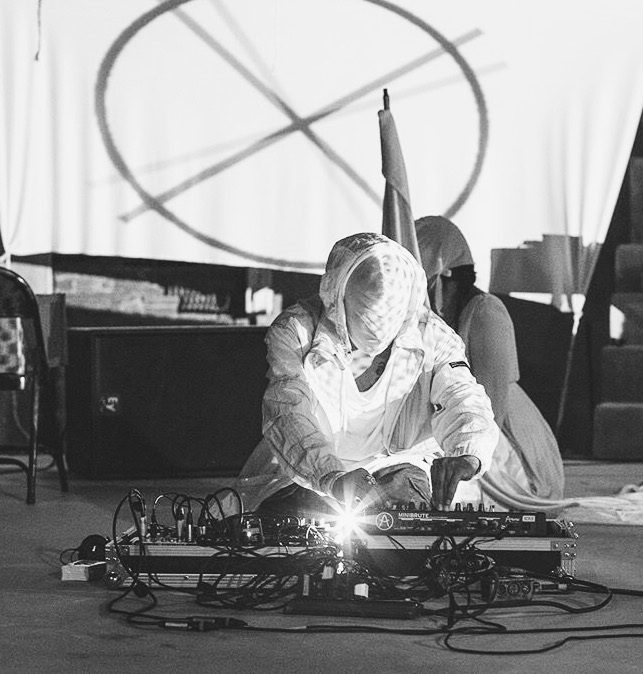
Currently for live sets, I use some combination of Ableton Push 2, Make Noise Music Easel, EP–133 K.O. II, Zoom H6 and maybe some contact mics.
Jean-Michel Jarre maintained that, despite the advances in virtual technology, we are still "analogue animals made out of blood and bones who need buttons and knobs to touch.” In how far is this statement true or false for your own music?
Ok true, but perhaps on the other hand, if the music is a generative work, then the control input mechanism is only in the initial stage of the process, or in the conceptual phase, the physical knob button question is voided in that case.
As for my music, yes I like having something to grab on to if it's needed during a recording or performances. There's a bit of recorded automation on the midi programming side as well and I like using the knobs on Push 2.
So I guess it simply depends.
What are examples of production tools/instruments that you bought for a specific purpose?
I bought a few string and orchestral plugins for my previous film score work and also used it in “Materiel Complex,” from my latest release Omniaglyph 1.
Other sounds came from field recordings of noises and sounds I collected from Fort Stevens, a decommissioned military base in Oregon, other sounds collected came from an abandoned oil rig near the Utah Spiral Jetty.
I built a stringed pickup instrument with a metal fire pit and a wire framed kitsch ornamental yard piece that I found in the trash. I bent the metal a bit and shaped it into the fire pit. I made recordings with it using a bow while bending the wire frame to adjust pitch.
Late producer SOPHIE said: “You have the possibility with electronic music to generate any texture, and any sound. So why would any musician want to limit themselves?” What's your take on that?
I love that quote, and Rest In Peace SOPHIE.
From the earliest sketches to the finished piece, tell me about the production process for your current release, please.
It's like throwing globs of clay at a log until something takes shape. They become a pile of things that starts to resemble something holistically new, then you begin to carve away until the piece begins to look at you and say what they need. There may be a plan of where we need to go and then again maybe not.
I like to mix organic and synthetic sounds as well. Sometimes arranging sounds and notes like a collage of shredded photos, and sometimes composing music like a slithering serpent where every scale is a potential sonic data point. Sometimes notes and textures get attention first, to provide mood and atmosphere. That allows for more creative decisions around instrumentation / sounds and compositional moments to emerge.
The pieces of music from the Omniaglyph 0,1,2 triptych were created or completed between 2017-2024. The earlier stuff was like a new page for me in that chapter of my life and I was hosting a lot of Los Angeles underground raves in those days.
There was eventually a Mexico tour, set for March 2020. News of the pandemic started to build and as the tour pressed on eventually everything shut down and all the shows were cancelled. We were left hanging in Mexico City with the world on high alert, and I felt a little defeated but it was a moment to reflect.
Then relocating to Baja California and Berlin for a few years, I spent time finishing this body of work that eventually became divided into a 3 part EP series.
Richie Hawtin, speaking about semi-modular equipment, has stated that a deeper understanding of sound synthesis can lead to “life lessons that go beyond what we can hear.” Can you relate to that statement?
Absolutely, I loved using my Strega and 0-coast on “Chimera Ovum” this project. There was a lot of discovery in the creative process.
What were some of your most positive collaboration experiences? How did this "human element" enhance your solo approach? Did you record via file sharing or in the same room and if so, what did the recording process look like?
With “Quantum Clouds and The Sea” we recorded that in Ensenada during one summer evening at Ana Reptiliana’s house in her living room.
We were not far from the beach and just up the hill off of a small uncompleted road. I set up a laptop with Ableton, Komplete Audio 1 and a LPD8, she had a few portable tape players from the 1980s with her lo-fi cassette cut-up edits and a collection of wind up music boxes.
Kathia came by and brought her electric viola and with only a tiny bit of direction we improvised on the spot without any practice really and recorded the sessions. Later on in my studio, I processed the recordings and arranged things a bit in order to define the structure.
To some, the advent of AI and 'intelligent' composing tools offers potential for machines to contribute to the creative process. What are your hopes, fears, expectations and possible concrete plans in this regard?
Learn to build fire, learn to contain fire, harness the mysteries of the fire. In other words, with regards to machine learning and music, I think it's fine and as technology continues to advance, so will our options for composing tools.
So the best thing to do is make good music the best way you can with whatever tools you have access to.
Have you used AI or generative music tools for your own productions? If so, in which way and what did they add?
Yes but more to experiment and play with.