

Name: Nduduzo Makhathini
Occupation: Pianist, improviser, composer
Nationality: South African
Current release: Nduduzo Makhathini's third album via Blue Note Records, uNomkhubulwane, is slated for release June 7th 2024. He is also one of the artists appearing at the XJAZZ! 2024 festival in Berlin. For tickets, go here.
Other acts at the festival include Nala Sinephro, Shabaka, Bill Frisell, Bex Burch of Vula Viel, Portico Quartet, Sasha Berliner, Nubiyan Twist, Orchestra Baobab, Muriel Grossmann, Sebastian Studnitzky and many more.
[Read our Bex Burch interview]
[Read our Vula Viel interview]
[Read our Portico Quartet interview]
[Read our Nubiyan Twist interview]
[Read our Sebastian Studnitzky interview]
[Read our Muriel Grossmann interview]
If you enjoyed this Nduduzo Makhathini interview and would like to know more about his music and upcoming live performances, visit his official artist page on the website of his label, Blue Note. He is also on Instagram, and Facebook.
How, would you say are your live performances and your recording projects connected at the moment? How do they mutually influence and feed off each other?
I guess they connect from the perspective of ‘time’, that is to say, they both demand a type of presence from me. By extension, this means I submit myself fully to each musical moment with no fear of the unknown. This opens up the possibilities to improvise in each moment.
The only unique aspect between the two is that a live performance includes an audience which definitely contributes to the vibrational depth of the work.
In as far as you have any experience or insights, what's your view of the Berlin jazz scene?
Berlin is one of my favourite cities, I sense an openness and that there is a willingness to conceive of the ‘world’ beyond its own borders. In my view, that is a significantly artistic sensibility that spread over in the way that people absorb the music.
This understanding of sharing space definitely plays into the jazz scene here, I love it.
Music has become a lot more global and incoporating elements from other parts of the world or the musical spectrum is commonplace. Do you still think there are city scenes with a distinct, unique sound? What holds these communities together?
This has always been there, especially with jazz, the innovators of this music have always been in one place while contemplating the music of another.
There is a huge scholarly discourse surrounding (black) music(s) and the Atlantic. While this is true, there are musical nuances that are unique to each place, this has to do with convergence between musics, histories, cultures and even religiosities. All these factors impact on the musicalities of place.
What does the term jazz mean today, would you say?
This term ‘jazz’ is problematic when we think of its semantic applicabilities.
But personally for me, it means protest music. It is the ability to refuse to be completely stripped off who you are in the moment of geographical and cultural displacement.
Derek Bailey defined improvising as the search for material which is endlessly transformable. As of 2024, what kind of materials are particularly transformable and stimulating for you?
The concept of improvisation for me has to do with liminality, a kind of unfolding and realising the beyond.
There is a huge insurgence globally to consider ‘indigenous knowledge systems’ as a way of liberating the future. In 2024, I’m thinking about how to understand improvisation within indigenous Zulu prophetic and healing practices.
Thanks to technological advances, collaboration has become a lot easier. What's your view on collaboration and its ongoing role for the music you make?
In African traditions the music is always based on communal sensibilities. I think the cyber world is slowly trying to catch up with what has always been there in Africa since ancient Kemetic civilisations.
The view of collaboration is ontological in my understanding, the concept of ‘ubuntu’ is already an invitation to expanding being beyond individualism but collectivism. This is a huge consideration in music making in Africa.
In terms of the results, the process, and the satisfaction, how do making music in the same room together versus filesharing compare to you, real concerts vs live streams?
I prefer playing in the same room, I think there is magic in being in the same space.
But of course, we have just seen, through lockdown, that there all these other alternatives and so if they are available, we definitely should utilise them.
The XJAZZ! Festival is closely connected to the Analogue Foundation, which emphasises the role of analogue gear and music-making. Do you have any thoughts on this and the role of “mistakes” (as opposed to the “cleanness” and “perfection” of digital) in music?
Well I’m huge believer in acoustic sounds, real time and spontaneity.
As an improvisor, I’m not thinking of the binaries of ‘mistakes’ and ‘cleanness’ but more concerned with possibilities in each moment.
Ímprovisation is obviously an essential element of jazz, but I would assume that just like composition, it is transforming. How do you feel has the role of improvisation changed in jazz?
Improvisation as a field is ‘fugitive’ — it refuses everything that is already known about it.
In the jazz context, it is about a constant production of new thoughts and ideas. Improvisation is evolution.
What, would you say, are the key ideas behind your approach to improvisation?
‘Ingoma’ is the fundamental idea for me, the bringing of prophetic practice into music with an idea of expounding into healing potency. This is where it’s at.
How would you describe your own relationship with your instrument – is it an extension of your self/body, a partner and companion, a creative catalyst, a challenge to be overcome, something else entirely?
My instrument is my companion and we are walking this journey together.
The term identity is an important aspect of many communities. Are you acting out parts of your identity in your improvisations which you couldn't or wouldn't through other musical approaches? If so, which are these?
Great question, I see myself as departing from a place of identity, history and culture with an idea to drop everything once I am inside the state of improvisation.
It is much like ‘know yourself so deep in order to surrender into something much greater than you’ — a complete mode of being that collapses a singularity of the self towards a communal one.
I have always been fascinated by the many facets of improvisation but sometimes found it hard to follow them as a listener. Do you have some recommendations for “how to listen” in this regard?
In my language the word ‘ukuzwa’ means listening, hearing and sensing. I think listening to improvised musics requires all three faculties to function as a whole.
In other words, we have to surrender.
In a way, improvisations remind us of the transitory nature of life. When an improvisation ends, is it really gone, just like a cup of coffee? Or does it live on in some form?
I feel that improvisation within what I call ‘ritual strategy’ becomes an eternal practice. When we enunciate the sound, we tap into an ongoing rejoicing of musics that are at a metaphysical sphere.
This type of music does not end even when the musicians stop playing.

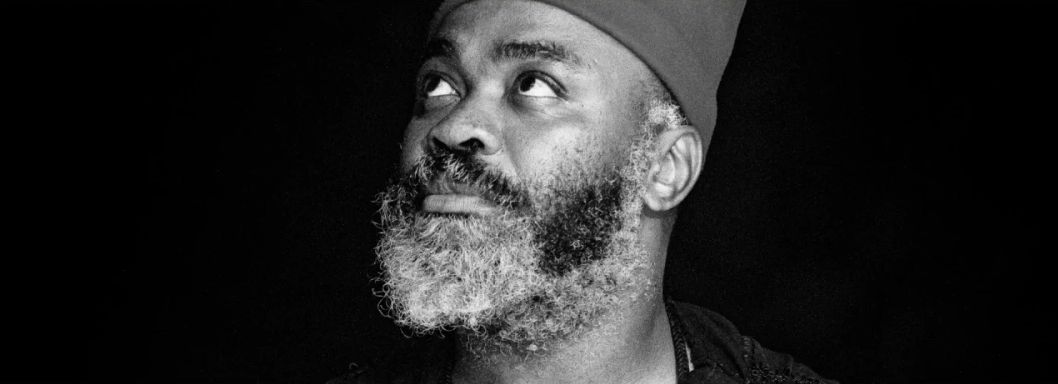 Nduduzo Makhathini Interview Image (c) the artist
"This type of music does not end even when the musicians stop playing."
Video
