

Name: Jess Weiss aka New German Cinema
Nationality: British
Occupation: Singer, songwriter
Current release: New German Cinema's debut album Pain Will Polish Me is out via felte.
Recommendation for London, UK: Whenever I visit a new city I like to visit graves of artists or writers who mean something to me. London has some beautiful graveyards – Nunhead Cemetery, near where I live, has a dripping Victorian crypt that is open from time to time, and inspired a poem by Charlotte Mew. Highgate Cemetery is very beautiful, and hosts Karl Marx, Christina Rossetti and George Eliot. Or you could make a pilgrimage to St Pancras Old Church, where New German Cinema has played before, the original burial place of feminist philosopher Mary Wollstonecraft, and allegedly where her daughter, Mary Shelley, author of Frankenstein, lost her virginity.
If you enjoyed this New German Cinema interview and would like to stay up to date with her music, visit her on Instagram, and bandcamp.
When it comes to experiencing strong emotions as a listener, which albums, performances, and artists come to mind?
I tend to connect with and return to music where emotion feels contained rather than overtly expressed.
Broadcast are very important to me in that sense, there is something so restrained and interior in Trish Keenan’s voice that makes it more affecting. Tender Buttons is an incredible record and a big influence on me as a vocalist and lyricist, particularly on songs like “Swirling Pain.”
Crying my eyes out watching Neutral Milk Hotel at the Union Chapel was like releasing the floodgates – a band I never thought I’d get the chance to see, and in such beautiful surroundings that complement the organic nature of their instrumentation perfectly. A very special night.
I have also always been drawn to Scott Walker, especially the later records, where the emotional weight is in the atmosphere as much as in the lyrics/vocal performance.
And Nico, where the voice creates a kind of landscape.
Making Pain Will Polish Me, I was thinking a lot about negative space, about what is withheld, and these touchpoints gave me some direction.
There can be many different kinds of emotions in art – soft, harsh, healing, aggressive, uplifting and many more. Which do you tend to feel drawn to most?
I love work that holds conflicting or seemingly contradictory emotional states at once – it might feel controlled and muted on the surface, but has a current of something much darker or more unstable underneath.
This could be a JG Ballard novel like High Rise, that starts with a rigid mundanity that descends into chaos, or could be a classic Smiths song, where the chiming guitars and upbeat pacing belie the despair of the lyrics. Or even a Rothko painting, which can feel so calming and meditative in some ways, or like a hanging bloodstain in others.
When writing, it is definitely a place to process extreme emotions, the shadow self: despair, desire, shame. But I am more interested in containing them, shaping them into something that can be held and looked at, and kept at a certain remove, rather than using them for catharsis.
In “Eyes” there is a line that surfaces quite abruptly, “If my brother tells me another time that I’m a failure in my father’s eyes …”, and the delivery is quite flat, almost withheld.
That felt important, letting something quite dark emerge without heightening it too much.
In as far as it plays a role for the music you like listening to or making, what role do words and the voice of a vocalist play for the transmission of emotions?
I am very led by lyrics and vocal performance. This is always the entry point for me. The voice carries so much information beyond the words themselves, rhythm, breath, hesitation.
I am quite obsessed with lyrics - poetry in so many extra dimensions - and keep endless notebooks of phrases and ideas, so they’re a collage of experiences and influences.
When it comes to composing / songwriting, are you finding that spontaneity and just a few takes tend to capture emotions best? Or does honing a piece bring you closer to that goal?
Both are necessary. The initial idea usually arrives quite quickly, there can be a sense of recognising something, or I’ve even had songs come to me fully formed in dreams. The process of refining is where the emotional tone and the images that you choose to paint become more precise and the emotional range expands.
Sometimes very raw takes are hard to surpass – like the piano on “Hera’s Themes” on the record – they were one-take improvisations that I didn’t know my partner was recording.
When I went back to record them for the album, I missed the tentative, vulnerable feeling of that initial performance, as I was feeling out the tune in real time. It felt very right to use that imperfect take with minimal processing as an expression of something quite tender.
How much of the emotions of your own music, would you say, are already part of the composition, how much is the result of the recording process?
The emotional landscape is definitely set from the outset. The recording process is about trying to faithfully translate that initial intention, or sometimes to reveal something that was only implicit in the writing.
Small decisions in arrangement or production can shift the emotional emphasis quite significantly, and making sure that is understood and communicates that first intention is very important to me.
Writing is a very solitary process, and feels ‘pure’. It’s the initial idea that I’m always trying to do justice to.
For Pain Will Polish Me, what kind of emotions were you looking to get across?
With Pain Will Polish Me I was interested in restraint, in holding difficult emotions in a controlled space, and darker undercurrents that aren’t quite graspable.
There is a lot of tension that is not often allowed to surface, though songs like “I Become Heavy” have some of this release.
Themes of transformation and endurance run through the record, the idea that something difficult can be slowly reshaped into something else.
How do you capture the emotions you want to get across in the studio?
A general rule would be that it’s often about reduction – removing elements rather than adding them.
I’m always trying to resist layering things up too much – my natural inclination is towards a wall of reverb and many, many harmonies, but compositions can feel much bolder and more affecting when I’m conscious about leaving space around the voice and for smaller details to come through.

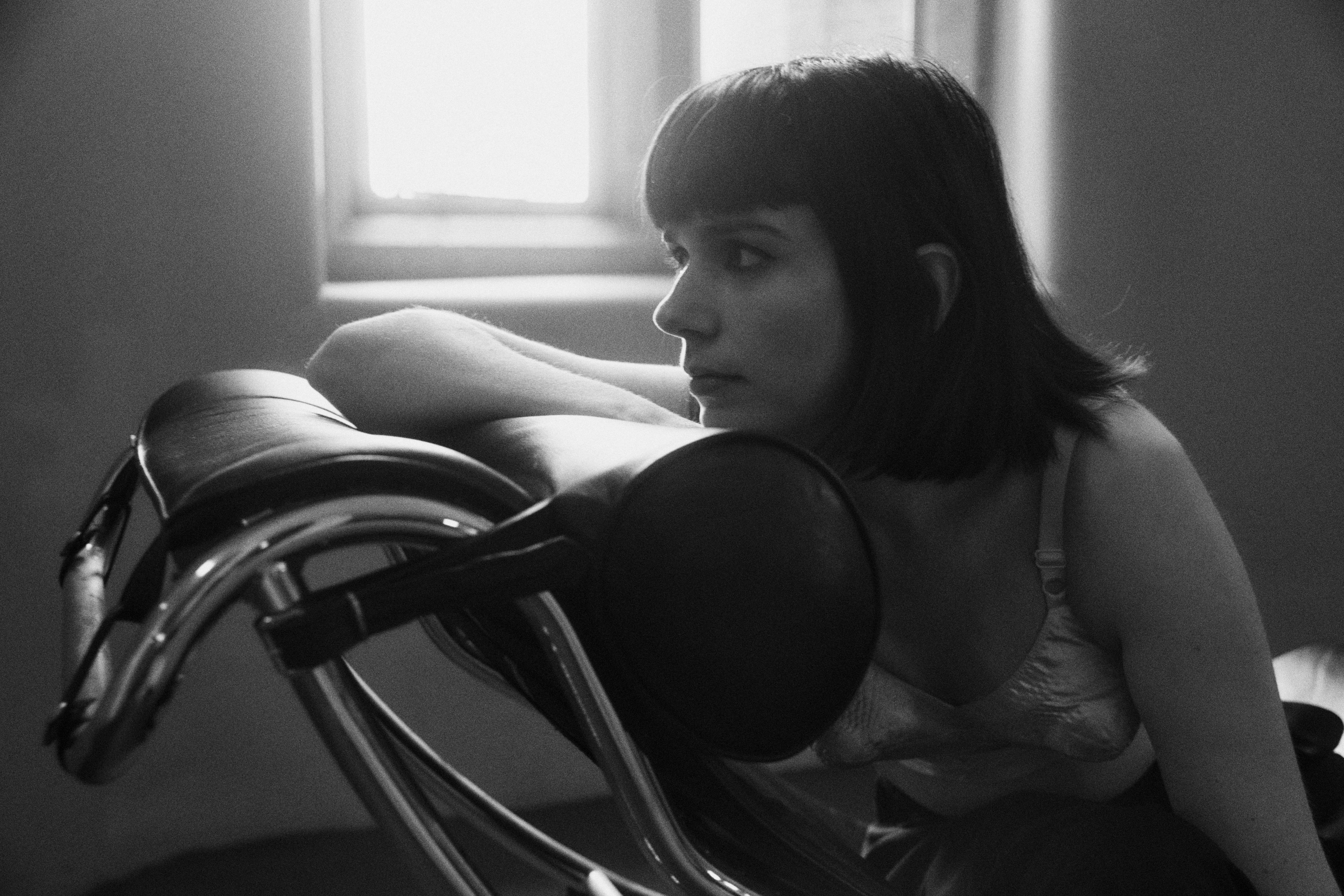 New German Cinema Interview Image by Conor J Clarke
“I tend to connect with and return to music where emotion feels contained rather than overtly expressed.“
Video
