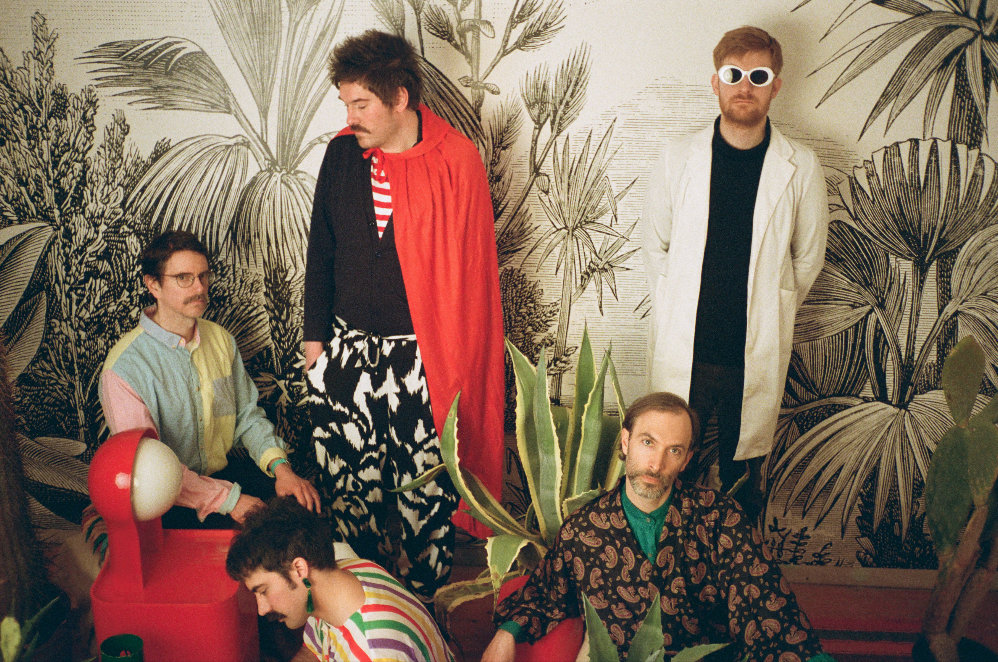
Published
Name: Newmen
Members: Joel Ameloot, Timm Kroner, Jörg Schmidt, Martin Heimman, Simon Rauland
Current Release: Newmen's new album Terminal Beach is out via FerryHouse.
Nationality: German
Krautrock recommendations: Timm: Manuel Göttsching - Dream & Desire (1977); Dzyan - Electric Silence (1974)
Hometown recommendations:
Joerg: At saasfee*pavillon in Frankfurt there are really good and interesting events when it comes to music. If you just want to have a nice coffee in the afternoon or want to go to a bar at night, the Plank! at Bahnhofsviertel is cool. Of course its named after Conny Plank and there is also the original drum set from his studio built up behind the bar.
Timm: Sameheads in Berlin – it's always worth a visit! :)
If you enjoyed this Newmen interview and would like to know more about the band and their music, visit their official website. They are also on Instagram, Soundcloud, bandcamp, and Facebook.
How would you describe your personal relationship with Krautrock? When and how did it start?
Joerg: Not too early, to be honest. In a way, not even when I was a teenager.
My first real Krautrock record was Neu! 75, which I picked up on CD from a secondhand record store when I was 18. That’s when it all started — one thing led to another.
A school friend of mine knew that Murray Street by Sonic Youth was my absolute favorite album at the time, and he suggested I check out Neu!, thinking I might like it.
[Read our Michael Rother of Neu! interview]
Timm: I actually came into contact with Krautrock very early on through my father, at least with the Rhineland or North German type. As a small child, he told me about how he was a guest on a music studio at a farm in the early 1970s, where there were lots of synthesizers and sequencers that kept playing even when you were sitting on the toilet. That's how he put it - the image fascinated me as a small child.
Unfortunately, I can no longer find out where and with whom his experience took place. Perhaps at Conny Plank's in Wolperath or at Harmonia in Forst? But these are guesses ...
Tell me about one or two of your favourite Krautrock records please.
Timm: It’s hard to say, because every style and every direction has its own appeal to me.
At the moment I'm listening a lot to the Mannheim jazz-kraut band Dzyan, who made two very interesting records in the early 1970s.
But if I had to choose my two favorites, I would probably say the crystalline elegance of Ashra or the conceptual radicalism of Neu!
[Read our Ashra's Manuel Göttsching interview]
Krautrock always seemed like a phenomenon connected to a very specific era in German history. What about this music and its time do you connect with?
Joerg: The possibility that real utopias still existed — at least the kind I find interesting
Timm: Even though Krautrock is not a homogeneous style, it at least forms a coherent form of technique and attitude in a certain way. For me, this is where the openness of 1950s jazz intersects with the upcoming laconic incompleteness of 1970s punk.
And the catalyst for this was the New Left, i.e. the countercultures with their probably most radical re-evaluation of all values in western art and culture in the 20th century.
Many of the original Kraut musicians loved blues, rock, and psychedelia; they were intrigued by electronics and improvisation; they rebelled against virtuosity, classical education and the superficiality of Schlager on German radio. How much of that do you recognise in your own creative preferences and interests?
Joerg: So this courage for structural openness, combined with a rejection of (male/ego/rockstar-pose codified) virtuosity, is a very important influence for us, even if it is only subtly audible at times.
Timm: In practice, this manifests itself, for example, in the fact that the respective parts are often composed by the person who has the least command of the instrument, in the sense of a scholastic way of playing.
Joerg, for example, is a professional guitar player, but plays relatively little guitar, as other band members without his skills sometimes find more reduced or conceptual structures, which then actually fit better into the sum than his playing, which is technically perfect.
Both in the music and the way it was made, Krautrock was about imagining different worlds. What is the experience of listening to this music like for you and what kinds of worlds is it taking you to? What is your preferred way of listening to it?
Timm: Well, it transports me to a world of the 1970s that seems more utopian, more humanistic and less optimized in many ways. A period in which the relationship between social enlightenment and technological progress found a unique equivalent.
Of course, then, the best way to listen to music from this period is on analog recordings. Cluster on a tape recorder, for example - awesome. Or Kraftwerk on LP - when the dust on the record repeats rhythmically and forms a symbiosis with Trans Europe Express, these are moments of great joy.
[Read our Cluster's Roedelius interview]
[Read our The Routes interview about Kraftwerk and the Twang Machine]
[Read our Denis Blackham interview about Mastering Kraftwerk]
[Read our Kid Loco and Soul Sugar interview about Dubbing Kraftwerk]
A lot of the Kraut spirit came to life through musicians living in communities, playing and recording together every single day. Have you ever tried working and creating in such a constellation? Is it possible to emulate this process from a home studio?
Joerg: During the pandemic, we actually set up our own band-run "tik tak studio" in a holiday house in the Rhön region. It’s a beautiful place with a big garden in the forests. Even for our earlier albums and EPs, we would go there and brought all our recording gear with us.
For the past three years, we've also been hosting a small annual garden festival there with live acts and DJs, in which we try to newly define the krautrock atmosphere into the present. The whole vibe comes pretty close to a sense of community — almost like Conny Plank’s studio.
So we’re in the fortunate position of not needing to emulate that process.
What, to you, are the main elements that make something “Kraut?” What are the practises of the musicians from the 70s that inspire your own practise today?
Timm: For me, Krautrock is associated with refusal in a general way, without the music sounding like refusal in the sense of protest. Instead, the negativity is sublimated into the music in an incredibly elegant or interesting way.
This can concern both the radicality of the form, such as the sequential mode of the synthesizer, or the equally important attitude such as self-irony (for example, the tendency towards Schlager in La Düsseldorf!).
I think all of this is a very appealing consequence of the countercultures of the 1960s/70s.
Tell me about one or two of your own early Kraut pieces that you're still proud of (or satisfied with) – and why you're content with them.
Joerg: I still really like our song “Kool Killer” from 2017.
I also think the remix of that track by Die Orangen is excellent.
Another one I never get tired of is “Fordissimo” from our latest album Futur 2 — which is kind of rare when it comes to your own work.
I believe those songs definitely have a timeless quality.
What instruments or equipment are you using to create your music? Are there any vintage instruments that you find essential to get your sound right?
Joerg: Oh yes — we use quite a bit of vintage gear. When it comes to synths, we mainly use a Korg PolySix, a Roland Juno-106, a Korg MS-10, and a Model D.
[Read our feature on the Juno 106]
And of course, there's a whole bunch of other fun toys as well. Almost all the guitar parts were recorded using a ’71 Fender Mustang through an old Dynacord Twen amp from 1968.
For the new album, we’ve also been working more extensively with a modular synthesizer system. Even though the modules are all based on the old originals, ours are newly built. If you tried to buy the actual vintage originals today, it would be completely unaffordable.
Could you describe your creative process for Terminal Beach, please?
Joerg: These days, most of our songs come together while we’re sitting at the mixing desk. In the past, the tracks would more often grow out of live jams. With Terminal Beach, once the first few tracks were “finished,” the direction for the rest of the record naturally revealed itself.
We also wouldn’t describe our music as pure Krautrock. We actually find the term “Kraut-Pop” quite charming, since we definitely enjoy working with pop structures as well.
Tell me a bit about the role that improvisation and inventive arrangement techniques (like cut-up) play for your work?
Joerg: Ah, that’s a lovely question!
The track “Swim” on our new album was actually mostly improvised.
Especially nowadays, when working in the studio often revolves around loops — which we definitely do — the idea of “cut-up” almost emerges naturally. We often move blocks around and just see what happens.
Personally, I’m very interested in the idea of “translation errors” in music and art in general. Kind’ of entropy that comes into the system. I constantly try to allow things to slip out of my control, just to see what might come out of it in the end.
I got into Kraut via Tangerine Dream and early Ash Ra and to me, the motoric beat was never quite as important. Today, it seems as though it's the defining element. Are you interested in it? Are you making use if it? What makes it special to you?
Timm: Haha yes, I understand what you mean. The motoric beat is just one stylistic feature of many, but it was received incredibly intensively because it really is a unique selling point.
The glittering and warm synthesizers of the Berlin School can also be found elsewhere at the same time, e.g. a lot in French early electronic music, without me wanting to deny that Manuel Göttsching is not the greatest god on the music planet. :)
Did you ever visit one of the birthplaces of the genre – Berlin, Düsseldorf, Munich – or any spaces related to the history of Kraut? Do you own any paraphernalia from the era?
Joerg: We’re actually quite good friends with Wolfgang Flür, the former drummer of Kraftwerk, and we've visited him in Düsseldorf.
He also came as a guest when we played at Salon des Amateurs — which, in a broader sense, is a place that grew out of the city’s avant-garde music tradition. We’ve also collaborated with Wolfgang musically.
Timm: Funnily enough, our studio is close to a place where a great Krautrock band was formed, namely Supersempfft from Wächtersbach. Rusty [Egan] drew our attention to it in a conversation.
Without him, we would never have realized that Supersempfft happened to come from the same nowhere area west of Frankfurt where we set up our studio.
Are there approaches, artists, festivals, labels, spaces or anyone/-thing else out there who you feel deserve a shout out for exploring interesting directions for Krautrock?
Joerg: There are so many! We like excolorado, a project originally from Buenos Aires but also living in Frankfurt.
Several of the original Kraut pioneers recently passed away or withdrawn from making new music. If some of your personal favourite artists were affected as well – can you share a little what did their music meant and means to you?
Timm: As mentioned above, I particularly love Manuel Göttsching, who unfortunately passed away far too young a few years ago.
For me, both his style and his productions have such elegance, beauty and sophistication that they still sound futuristic today.