Published
Names: Nick Jozwiak
Nationality: American
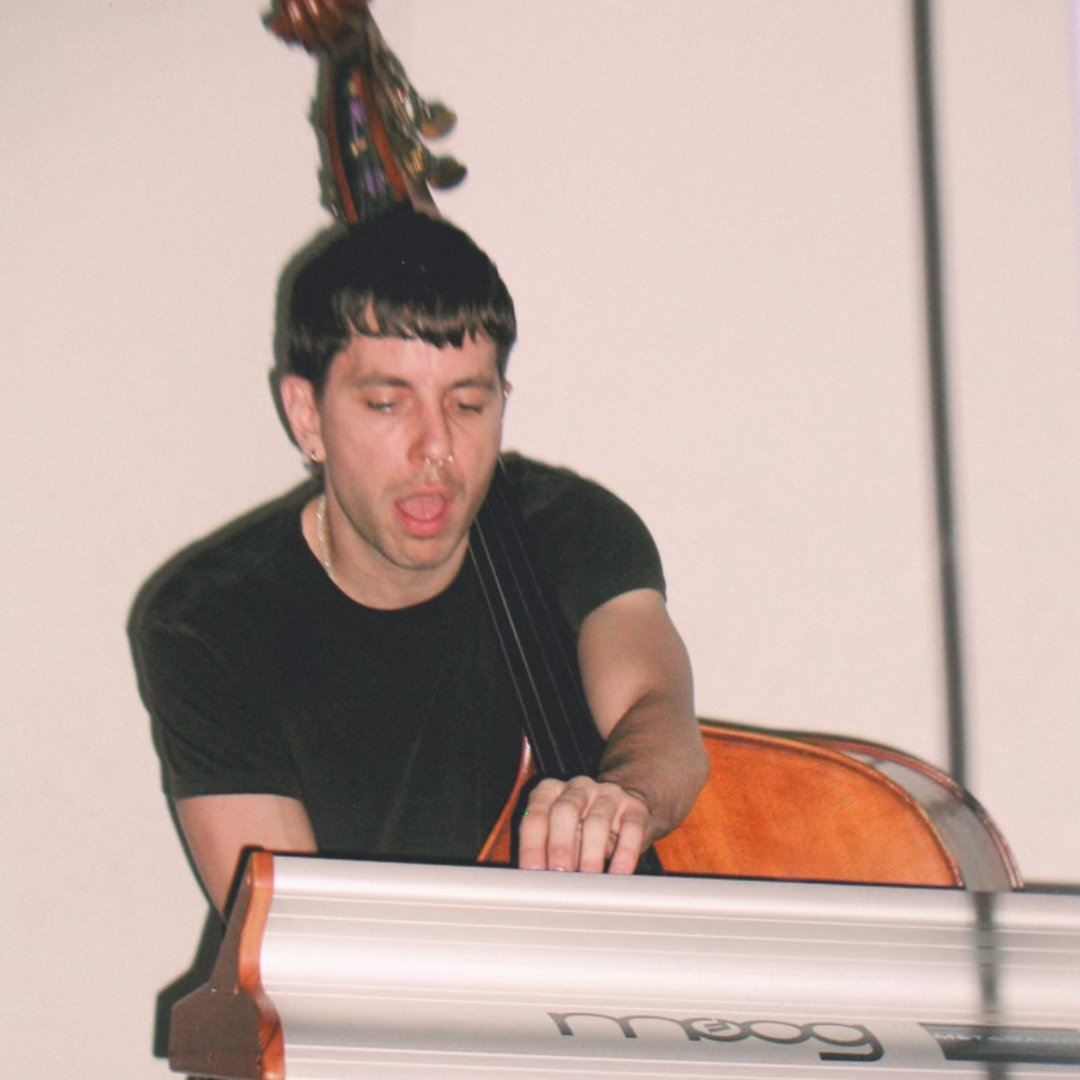
Occupation: Bassist, composer, sound artist (Nick Joz)
Current release: Nick Joz's new album Hieroglyph & Stuttering, featuring Joanna Mattrey (viola, preparations), John McCowen (Bb clarinet, contrabass clarinet, recorder), Peter Evans (Bb trumpet, piccolo trumpet), and Mark Gardner (modular electronics) is out via Endectomorph. Stream it here.
If you enjoyed this Nick Joz interview and would like to stay up to date with his music and current live dates, visit him on Instagram, and bandcamp.
The press release for Ars Ludicra with Being and Becoming mentions your interest in balancing the anxieties and rewards of experimentation. How does that inform your daily practise?
This balance is how I think of experimental music in general. I divide music very broadly into two categories - popular and experimental. In my personal definitions, popular music fulfils our expectations and one will immediately form an opinion on it.
Take for example, Chappell Roan’s song “The Subway” - it is mostly made up of the chorus/hook repeated many times over with variations that linearly increase the intensity with added vocals in higher registers.
This is a great feeling! Every time the hook hits again, one is emotionally fulfilled, and the song is so short that if one likes it one can listen over and over again, hitting on those moments of fulfilment and even singing along.
On the other hand, experimental music gives us no inherent sense of where it is going - it could become anything!
I think of the best experimental work as an adventure that keeps one on the edge of one’s seat, excited to follow and see where it goes. The anxiety comes in not knowing whether one will like it, or how long it will be, what’s coming next etc.
Of course on repeated viewings of an experimental film, for example, you will remember certain things and expectations can be fulfilled. This can be played with in different levels of abstraction by the artist.
In my view, the world is more fun because both popular music and experimental music exist.
The way I understood it, an important aspect for Hieroglyph & Stuttering was to use dedicated, original music for the editing process. What changes when you’re basing your collage on free improvisations rather than sampling the outside world?
In this method there is some amount of form (based on how and what the ensemble improvised) to work with in the material.
It is akin to collaging full paragraphs of text from different sources, redacting and altering internal elements, as opposed to collecting or generating individual words or phrases.
You’ve described the result as “a collage piece of concrete music, like a concrete poem.” I can see the concrete music part, but what is a concrete poem?
A concrete poem is a poem with a fixed visual form that must be seen to be fully appreciated. Often the visual form makes it so that one particular reading is impossible.
I believe this is where concrete music gets its name - as concrete music has one fixed form, as opposed to a traditional piece of music that has a score which is interpreted differently in any given performance.
You mentioned there were minimal instructions for the improvisers. What were they?
Studio 8, where the album was recorded, is small but offers enough spaces to isolate each member of the ensemble, which was necessary for the individual electronic processing of each instrument.
The instructions I gave the improvisers were basically to us as many different types of sounds as possible, as well as very general directions as to the length of each improvisation.
I thought it really interesting that you recorded the different parts of the musicians in isolation - what was the session like? Did you actually perform yourself?
Yes, I performed with the ensemble, in traditional free improvisation.
Before each improvisation we determined whether it would be short, medium or long. I would choose either the cello or the double bass for each. The whole session was only a few hours long.
I’d really love to know how much of the original takes survived on the finished album and how heavily you transformed the recordings.
It’s hard to say how much of the original takes survived - on the longer pieces I kept the overall form more or less intact but for example redacted a whole instrument during a section, or only included the processed version.
Some of the shorter pieces were essentially solos of one instrument at a time that were artificial constructions.
The press release mentions that you see a challenge”working within and beyond modernist conventions.“ Can you briefly expand on this?
I strive to make music that is not anachronistic - a challenge as I am someone highly trained in old music and old instruments.
We are of course haunted by our influences and what has come before us, and yet we can try our best to push things forward and meet the contemporary moment. I ask myself - what is the state of art music? Why make art at all in 2025? What is the function of art and artists in this time period?
I don’t have clear answers to these questions but I know that I don’t want to just make another record of improvised music that could have been made fifty years ago. I want to make music that exists in relation to ideas and feelings of the present time period.
I’m not exactly sure I’ve accomplished that here - but that doesn’t necessarily mean its not a successful work of art. I believe this record is fun to listen to!