

Name: Nicolás Melmann
Nationality: Argentinian
Occupation: Composer, sound artist, producer
Current Release: Nicolás Melmann's new album Música Aperta, mastered by Rafael Anton Irisarri, is out via Umor-Rex.
Global Recommendation: Cami de ronda, a footpath that goes from the north of Catalonia to France.
Topic that I am passionate about but rarely get to talk about: Seinfeld.
[Read our Rafael Anton Irisarri interview]
If you enjoyed this Nicolás Melmann interview and would like to know more about his music, visit his official homepage. He is also on Instagram, Facebook, Soundcloud, and bandcamp.
When it comes to experiencing strong emotions as as a listener, which albums, performances, and artists come to mind?
Silvio Rodriguez (nostalgia, depth, reflection), Ellen Fullman (contemplation, stoicism), Los Crudos (violence, discharge, energy) Frank Zappa (humor), Kazuya Matsumoto (meditation, connection with nature).
[Read our Ellen Fullman interview]
There can be many different kinds of emotions in art – soft, harsh, healing, aggressive, uplifting, and many more. Which do you tend to feel drawn to most?
I think it depends a bit on the context, whether I'm “consuming” art or producing. As a spectator or listener, I'm open to all kinds of experiences, although some I avoid completely.
For example, I can't stand horror movies - tension and stress in art are something I avoid. When I compose music, I tend to go towards places of contemplation, calm, healing, to put it that way.
Art and music helped me to overcome a complex personal story; my beloved sister was murdered by the police at the very young age of 15 years. I was 18, and this was a public fact that reached the media around the world, given the gravity of the crime. This episode changed my life completely, and music and art were a means of resilience and overcoming, where I channel the pain, uncertainty, and transform those feelings into something different, positive, or connected with life.
That's probably why most of my compositions have that imprint of healing, tension, and a search for a sense of beauty, a bit romantic and old-fashioned.
I have had a hard time explaining that listening to death metal calms me down. When you listen to a song or composition, does it tend to fill you with the same emotions – or are there “paradoxical” effects?
Generally it transmits to me the “same emotions,” although it is surely always very subjective, the interpretation and perception of each person. I use Black Metal, Crust punk, Screamo to do physical activity, for example, it fills me with energy and motivation.
From my personal experience, there is no such thing as “sad music”; for me, every sonorous act is pulsional, a vital manifestation. I use (I think like most people) sound as a psychological stimulus, and I generally accompany most of my activities with music and sound, from going to the supermarket, cooking, washing dishes, cleaning, drawing, reading, exercising ...
I tend to choose different music for different moments.
In as far as it plays a role for the music you like listening to or making, what role do words and the voice of a vocalist play for the transmission of emotions?
Undoubtedly, the voice is one of the instruments that transmits more emotions, and although music is highly expressive in itself, it is always mediated by the object-instrument; the voice is the emotion emitted directly from the body.
Perhaps in written music it is more controlled and logically reproduces what the notation of expression indicates, it can be understood as an emotion “patterned by the composer.” But in popular music it is the body vibrating by its own flow.
And of course, there is the “weight of the word”.
When it comes to experiencing emotions as a creator, how would you describe the physical sensation of experiencing them? [Where do you feel them, do you have a visual sensation/representation, is there a sense of release or a build-up of tension etc …]
Composing is one of the things I enjoy the most. I feel a certain well-being and sense of relaxation and high dopamine, similar to the feeling you get after you leave the gym.
It's probably also linked to the fact that the brain generates a certain addiction to new things, and a new composition certainly is. It's one of the most pleasurable things in music.
When it comes to composing / songwriting, are you finding that spontaneity and just a few takes tend to capture emotions best? Or does honing a piece bring you closer to that goal?
The first take is always the best, but it really depends on what you are composing. When composing songs more as a singer-songwriter, it can be more of a searching process.
Composing is always an immersive experience in which one enters, and it is necessary to find the spaces and times for an exclusive dedication.
How much of the emotions of your own music, would you say, are already part of the composition, how much is the result of the recording process?
In my case, I do very different projects, which involve very different compositional processes.
My latest album, Música Aperta, was recorded in two sessions in one go, purely played live, with a later edition, in which case I think the emotions are printed directly.
Many times in the past I have worked in a completely opposite way, composing in layers, with very long and calculated processes; in this case, it was, let's say, a little bit pulsational, more than cerebral.
For Música Aperta, what kind of emotions were you looking to get across?
The last album was recorded at the artistic residence Château Éphémère - fabrique sonore & numérique, a castle on the outskirts of Paris, during the pandemic, and it was a most unusual experience.
I went to make a sound mapping of the Seine river with hydrophones and an interactive map. After the first week of the health emergency was declared, borders were closed, I had a tour scheduled, and 4 more residencies, everything was cancelled. Finally, I decided to stay for four months, alone in the castle. That was the context, and I guess it was a bit of a portrait of that moment.
I won a prize to develop a digital art project (when the world went online), then it occurred to me to make an album that has an interface that allows listeners to mix the album by themselves and interact with the music through a digital interface, online, hence the name (Música Aperta).
I think that in the emotions of the album, there is the calm of that moment (I lived in the countryside, next to a forest and the Seine) almost in complete solitude. It also reflects a bit the tension of the moment, the uncertainty and it has a certain strength and feeling of hope.
How do you capture the emotions you want to get across in the studio?
I don't think it's something very calculated, at least in terms of emotions, it just happens.
In my case, I don't usually go into a recording studio to shape something that has already been rehearsed and has to work in a “go”. They are longer processes of timbre research, sound constructions with a lot of freedom and without time restrictions.
What role do factors like volume, effects like distortion, amplification, and production in general for in terms of creating the emotions, energies or impressions you want?
I believe that volume, for example, has a fundamental function, and it is all a question of preference; in my case, my music tends to have little volume, and I prefer it that way. However, the human brain always favors volume, and this gives the sensation that it is “heard better”.
In my opinion, compression destroys music, changes dynamics, and can have dramatic and drastic effects on a composition. Of course, there are genres that rely heavily on compression, distortion, and volume, such as metal, techno, etc, and of course, they are very different worlds and aesthetics. Clearly, volume is energetic; it is equivalent to a very striking color, it has a very strong psychoacoustic impact, although it is not within my search.
Recently, I was analyzing Morton Feldman's piano recordings in the DAW, and the notes were almost imperceptible; it seems to me a wonderful aesthetic decision.
In terms of emotions, what changes when you're performing live on stage, with an audience present, compared to the recording stage?
I think that in my case, it can be very different.
I am really very present in the moment of playing, with all the burden of the moment, dedicated to the act of playing.
How does the presence of the audience and your interaction with it change the emotional impact of the music and how would you describe the creative interaction with listeners during a gig?
The creative interaction with the listeners usually happens after the show, when people come up to see my instruments that are unusual or catch their attention, and a kind of spontaneous workshop ensues.
What kind of feedback have you received from listeners or concert audiences in terms of the experience that your music and/or performances have had on them?
Some memorable ones. At a show in England, a girl told me “your music made me feel barefoot”, I thought it was very beautiful.
Another one was a show in Buenos Aires, where a singer who was playing after me came up to me after the shows and confessed that she had ASMR, and that she had to leave during my performance because my music was activating her ASMR and she was going into such a state of relaxation that it was going to be counter productive for her own performance.
Would you say that you prefer to stay in control to be able to shape the emotions or do you surrender to them and allow the music to take over?
Who, ultimately has control during a live performance?
When I play live, I am completely dedicated to the moment.
I always play alone on stage, I play many instruments at the same time, and I level volumes, use microphones with delays, etc. So it requires a very strong level of concentration. I'm doing the work of several musicians and a sound engineer at the same time, so I'm playing but always listening ...
This doesn't imply that I'm not emotionally involved in the situation. Many times I close my eyes and let myself flow, many times I watch performance videos, and I'm dancing sitting down while playing. I think it's a delicate balance between emotions and technical control.
The emotions that music is able to generate can be extremely powerful. How, do you think, can artists make use of this power to bring about change in the world?
Well, this is a much-discussed topic. I remember a Genesis P-Orridge report where he said that his intention was to have a political project, and they created Throbbing Gristle primarily to use it as an ideological diffusion apparatus, since music is the most popular and massive artistic medium.
The same happened with religious music, created exclusively to evangelize, as well as with opera, which in the past was the popular entertainment par excellence and was used as an apparatus for ideological diffusion.
In response to these manifestations there are discourses such as that of the documentary filmmaker Adam Curtis, of whom I am a great admirer, who professes that in reality art was completely absorbed by capitalism and was transformed only into self-expression, that the subject in the artistic and aesthetic experience is isolated, and that art creates the illusion of social change that does not really change the rules of the game. Curtis argues that social and political change is only achieved through collective struggle in the streets.
I would argue that there is an intermediate point, and I believe that it has a very great power of communication and modifying people. I believe in a political art. Although the struggle in the streets is essential.

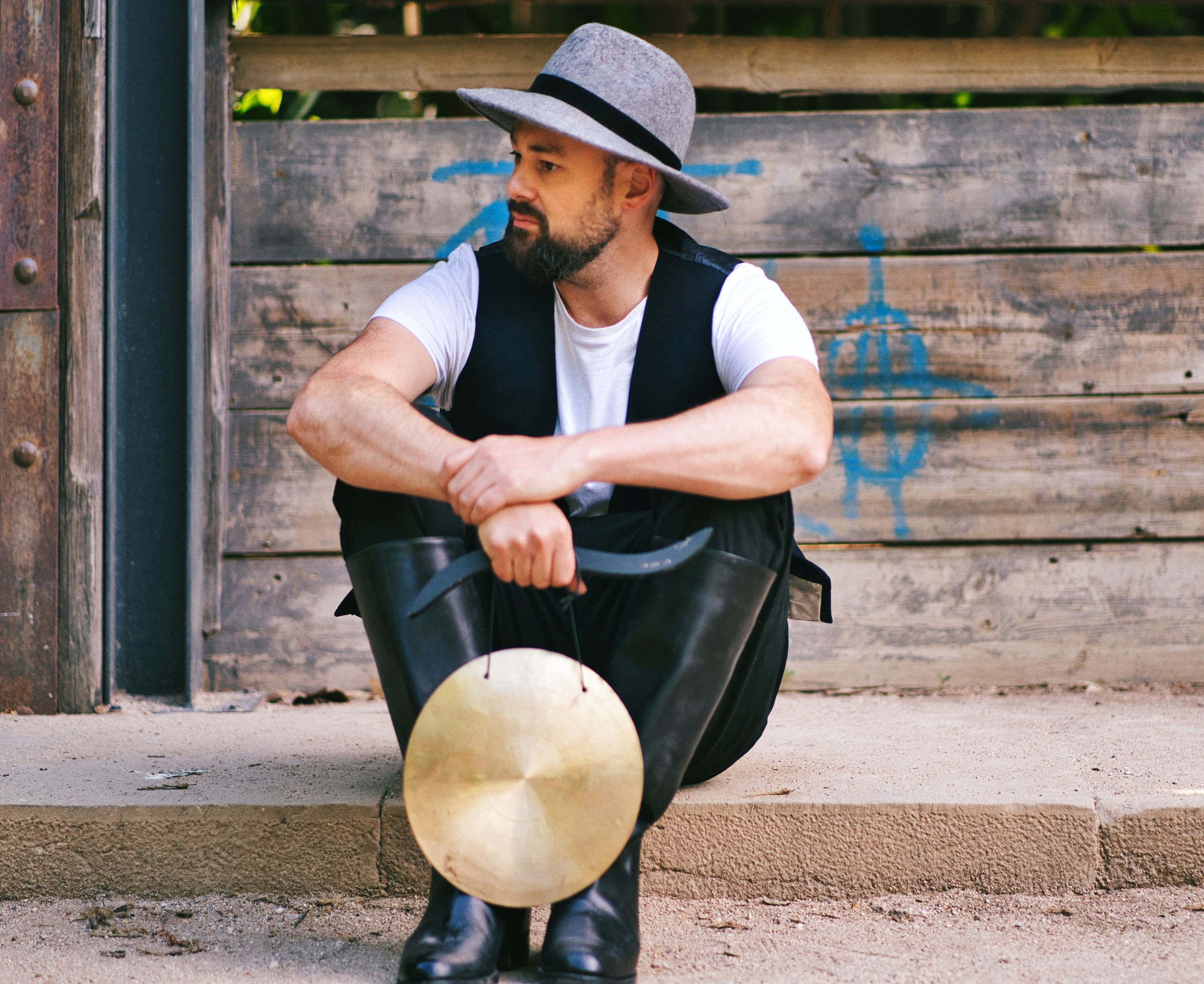 Nicolás Melmann Interview Image by Petra Klehe
“There is no such thing as “sad music.” Every sonorous act is pulsional, a vital manifestation.“
Video
