

Name: Niklas Wandt
Nationality: German
Occupation: Drummer/percussionist, vocalist, DJ, producer
Current release: Niklas Wandt is one of the artists included in Future Sounds Of Kraut Vol. 3 - Compiled by Fred und Luna, out December 6th 2024 via Compost.
Recommendations for his current hometown Berlin: Visit one of the branches of Damaskus pastry here in Berlin! Delicious!
If you enjoyed this Niklas Wandt interview and would like to stay up to date with his music, visit him on Instagram, Facebook, and Soundcloud.
How would you describe your personal relationship with Krautrock? When and how did it start?
Unknowingly in my early childhood, browsing my dad’s records and being fascinated by the artworks.
Birth Control’s Live and Grobschnitt’s Solar Music Live stand out in my memory as being particularly bizarre.
Fast forward late Oughts. The now defunct niche media discounter Zweitausendeins used to sell cheap CDs. Next to the Blue Note reissues I always went for, I noticed the old Ohr and Pilz Records reissues and started to take some home.
A fellow musician then gave me some low resolution files of Neu! and Neu! 2 and I dove headfirst into this particular world.
My own music practice in that vein followed just a few months later and, in some form or another, still permeates what I produce and play today!
Tell me about one or two of your favourite Krautrock records please.
Can – Soon over Babaluma for all its warm, glistening electricity and openness. There’s a lot of moments in which the special atmosphere between the musicians is tangible – from almost proto-Dubtechno excursions to the locked grooves in pianissimo on “Quantum Physics”.
Ashra – New Age of Earth. Minimal setup, minimal patterns and great emotional impact. Trance avant la lettre, humble, yet lush.
Krautrock always seemed like a phenomenon connected to a very specific era in German history. What about this music and its time do you connect with?
The period in which my parents grew up exudes a big fascination for me, in all its facets, history, literature, film and music. Documents of the grey reconstructed cities, its seedy underbellies, the provincial boredom and new found saturation, the desire to break out of society and find alternate forms of living.
The way that bands like Can, Harmonia and Guru Guru worked is a good reflection of this and with some of my projects it feels a little similar – retreating to a remote spot and working on music together.
That whole baggage aside, the aesthetic aspects are the most important ones for me. I love improvisation and the likes of Neu! and Can really opened my ears to the liberating power of repetition.
I also played a lot of more open form free improvisation in which a steady rhythm and a key are almost eschewed, so it was really cool to go the opposite, more minimalist way.
Many of the original Kraut musicians loved blues, rock, and psychedelia; they were intrigued by electronics and improvisation; they rebelled against virtuosity, classical education and the superficiality of Schlager on German radio. How much of that do you recognise in your own creative preferences and interests?
Coming from more of a jazz background on my prime instrument, the drums, it was important for me to have a certain technical level for fluid expression. Free improv also gave me a lot of interesting sounds and techniques to work with in other contexts – they end up in pretty much every one of my projects.
I enjoy both the more “primitivist” Kraut bands like early Amon Düül and the more sophisticated fusion acts. Kraan or Munju would come to mind.
I guess that’s part of being socialised on the web – no rebellion, no rejection, just vibes from whatever I get my hands on. To tell the truth - I like a lot of Schlager
Both in the music and the way it was made, Krautrock was about imagining different worlds. What is the experience of listening to this music like for you and what kinds of worlds is it taking you to? What is your preferred way of listening to it?
As it’s such a broad term, it’s hard to pin it down. My preferred ones are the more breezy electronic acts and they take me to a place of serene calm and transcendence, in that dynamic space created between stasis and propulsion. Could be anywhere really.
Also it’s interesting to see how records you know from front to back can still take on a new face depending on the situation. I remember recently absolutely freaking out on La Düsseldorf’s “Cha Cha 2000” randomly on a train ride where it just made perfect sense, which it doesn’t always!
A lot of the Kraut spirit came to life through musicians living in communities, playing and recording together every single day. Have you ever tried working and creating in such a constellation? Is it possible to emulate this process from a home studio?
Yes, I remember recording an album on a farm in Northern Germany and as Neuzeitliche Bodenbeläge, we work in a private studio space of our producer Ali Europa in the tranquil town of Meersburg right by Lake Constance, but only for maybe a week on end.
During Covid, home studio was pretty much my only choice, so I guess in that period it worked out of necessity. Impossible today!
What, to you, are the main elements that make something “Kraut?” What are the practises of the musicians from the 70s that inspire your own practise today?
A stripped down electronic music aesthetic focussed on repetition and slow variation and maybe a certain pastoral, flowing quality to the harmonic and melodic material.
What instruments or equipment are you using to create your music? Are there any vintage instruments that you find essential to get your sound right?
Any old analogue gear will give you that extra little sparkle.
I guess the most obvious piece in my collection for that specific Kraut vibe would be the Farfisa Syntorchestra, a synth that Klaus Schulze and Manuel Göttsching prominently used as a string machine and lead synth. It has a slightly shaky but oddly yearning sound.
[Read our Manuel Göttsching interview]
Could you describe your creative process on the basis of your most recent Kraut-leaning release?
Just fiddling around freely, then recording some bits and finally arranging. No special preconceptions.
I got into Kraut via Tangerine Dream and early Ash Ra and to me, the motoric beat was never quite as important. Today, it seems as though it's the defining element. Are you interested in it? Are you making use if it? What makes it special to you?
It works just as much without drums as long as there’s a propulsive element, some basic little sequence.
With my band Transport, really all we do is move through shifts of rhythm and of its intensity.
There it really is the key element to the development of the pieces. It’s quite amazing to guide and sort of live through these changes.

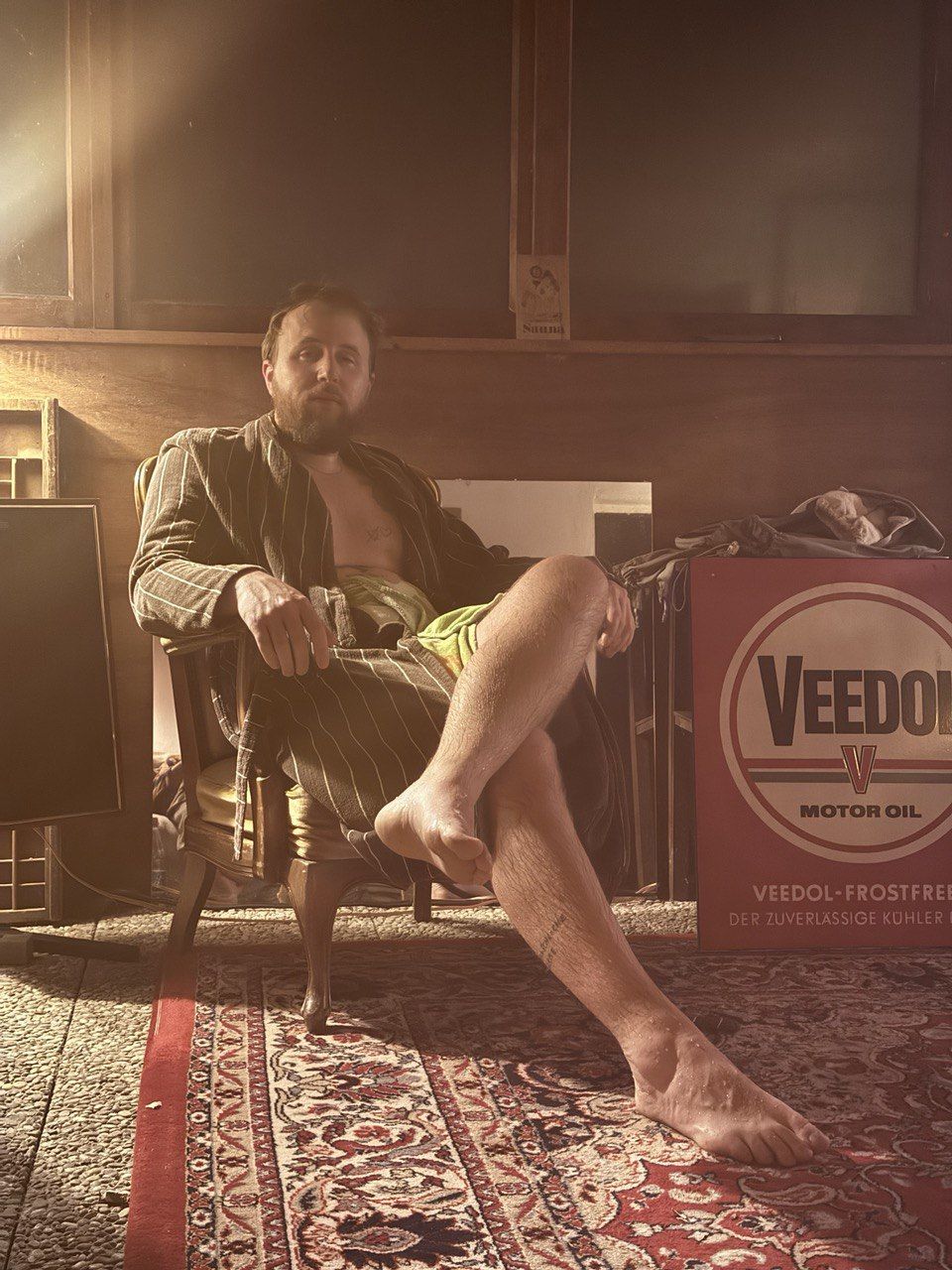 Niklas Wandt Interview Image by Thieu An Ly
"My creative process? Just fiddling around freely, then recording some bits and finally arranging."
Video
