Published
Name: nilipek.
Nationality: Turkish
Occupation: Singer, songwriter
Current release: nilipek.'s new album Uydurdugumuz Oyunlarla is out now. Order a physical copy directly from nilipek. here.
Recommendations for her hometown: My hometown is Izmir and right now I am living in Berlin-they are like two opposite cities in terms of the weather. But I would recommend the same for both: go to that pub everyone goes and have a beer while the sun is setting. Do it in Kordon (Alsancak coast) or Kıbrıs Şehitleri in Izmir, and Holzmarkt, Prater, or any biergarten in Berlin. Somehow all my good memories are wrapped around sunset beers.
Topic I am passionate about but rarely get to talk about: I wish I had one. I am ocassionally into stuff from time to time but there is nothing I am super into. Right now I am trying to learn more about “Aruz Vezni”, a concept they thought us in high school but never explained on a deeper level. It is a poetic type of prosody, rooted in Arabic geographies and used in Persian and Ottoman/Turkish poetry as well. The Turkish language is more suitable for syllable based poetry, but some poets and songwriters have succesfully adapted it. My curiosity flows that way now.
If you enjoyed this nilipek. interview and would like to know more about her activities and music, visit her official homepage. She is also on Instagram, Facebook, and bandcamp.
For you to get started, do there need to be concrete ideas – or what some have called a ‘visualisation’ of the finished work? What does the balance between planning and chance look like for you?
It almost always starts without realizing it is starting, with playing with words, playing with chords. In order to form them into a song, some planned work is needed, but starting by planning never got me somewhere I liked.
Some notes, some words, some melodies just come while walking or playing, and then, if they get stuck on my mind, if I realize I’m turning them over again and again, then I start working on them.
I usually have a visualization of the “vibe” or the “emotion” of the finished work, but the composing and arrangement processes are usually not planned.
Is there a preparation phase for your process? Do you require your tools to be laid out in a particular way, for example, do you need to do 'research' or create 'early versions'?
I almost always need a pen and paper right beside me, I have to take notes constantly.
I procrastinate a lot, I do a lot of stuff that is unrelated to my music during the day - I mean I could be a better singer and a better guitar player if I didn’t do that. I am really not a good student in terms of musicianship.
But I think all those unrelated things become a whole and shape the words and melodies that – sometimes - automatically come.
For your new album Uydurdugumuz Oyunlarla, what did you start with? If there were conceptual considerations, what were they?
It started with the realization of having a few songs that could form an album.
I have been writing songs in a different way for a while, in a more improvisational manner, and when I looked at the songs, I saw some repeating themes; like the struggle to be yourself in a highly collective country, the struggle to survive, the inability to move on previous friendship break ups … I was also in a process where I was moving from Istanbul to Berlin for several reasons.
There were a few complete, a few half-completed songs, and I was trying to create my own political vocabulary, my own oppositional poetic attitude. So the concept started to show itself to me; everything we make up to prevent us from being ourselves. The rules of the societies, the religions, the relationships, the excuses, our comfort zones, everything … I wanted to pinpoint them, understand them and make fun of them.
Tell me a bit about the way the new material developed and gradually took its final form, please.
After writing a few songs, we locked ourselves with Berkay into our studio in Istanbul.
For a week we worked like we had a full-time job; I was finishing the songs and arrangements, and Berkay came and added the drum arrangement. We finished five songs’ arrangements during that time. We worked as a band in some songs’ arrangements and Taner and Berkay (producers) arranged some songs themselves. During this process I realized that I loved arranging, but not the recording / producing part. So it automatically became a great division of work: I left the production part to Taner and Berkay.
I also had a vision about the artwork, but was unable to realize it. I found Volkan Aslan, and he came up with the amazing cover after our discussion. I am really happy that it became a whole.
nilipek. Interview Image (c) the artist
What makes lyrics good in your opinion? What are your own ambitions and challenges in this regard?
I think one should understand that writing lyrics is actually a humbling craft, involving rhythm, poetry and communication all in itself. And there is a combination of sincerity and refinery.
When the lyricist is not honest to themselves, or when the lyrics are not sincere, you'll feel it. And I don’t mean that the lyrics should always talk about real events, real experiences. What I am trying to say is, I sometimes feel like the song is making a fool of me, it is just for easy gain.
I try not to have any ambitions about that, because I feel like ambitions lock me somehow. I have released an album, and I can stand behind all the songs on it, but I cannot imagine myself writing new ones now, it causes anxiety:)
But I know what challenges me. I know that I get bored pretty quickly, so the refining part can be ignored sometimes. I am trying to slow down while writing, and try to write every day.
What are areas/themes/topics that you keep returning to in your lyrics?
A very broad theme would be disappointment I think.
Many writers have claimed that as soon as they enter into the process, certain aspects of the narrative are out of their hands. Do you like to keep strict control or is there a sense of following things where they lead you?
I totally agree, especially the beginning of the process is usually not under my control. I love following it, but after a while, when it becomes something I can see, I start working and carving it into something more solid.
With this album, I lost the feeling of having songs of “my own” actually, it was such a flow.
There are many descriptions of the creative state. How would you describe it for you personally? Is there an element of spirituality to what you do?
I think there always has to be an element of spirituality in the creative state, otherwise the result would be dull. I am getting more and more dogmatic on that subject, but I think the artist has to let themself flow with the current to some degree.
I also think one should try to get in that state everyday, like a divine service, and the way of doing it does not have to be the field of the artist. Drawing, writing, looking at clouds, thinking, cooking, anything can be a part of that state, and one should always feed the creativity monsters. Creativity monsters are almost always hungry:)
Once a piece is finished, how important is it for you to let it lie and evaluate it later on? How much improvement and refinement do you personally allow until you're satisfied with a piece?
It depends on what you call “finished”. If we are talking about the lyrics and the music, I think it is very important, but it is also important to know when the song doesn’t have anywhere else to go. I like doing the refinements by singing, because while hearing your own song, you can also hear the words that do not sit or feel well in their position.
In terms of arrangement, I like doing the initial arrangement very fast, and leave the refinement to someone else. It becomes richer when other people are involved, and sharing the responsibility helps us understand when to end the process.
In terms of what they contribute to a song, what is the balance between the composition and the arrangement (including production, mixing and mastering)?
It depends on the genre, it depends on the song, depends on the audience …
As a singer-songwriter of course I usually think lyrics and composition are the song; if they are not good, the song is not good. However, as a full piece of art, sometimes the arrangement and creative mixing add another layer of meaning, or they can create a new context for the song - then the lyrics are just another aspect of the instrumentation. Mixing is important because it provides the listenability, and mastering is the great varnish.
In the end, they all work to manipulate the emotions as a whole. If they can, the song is good.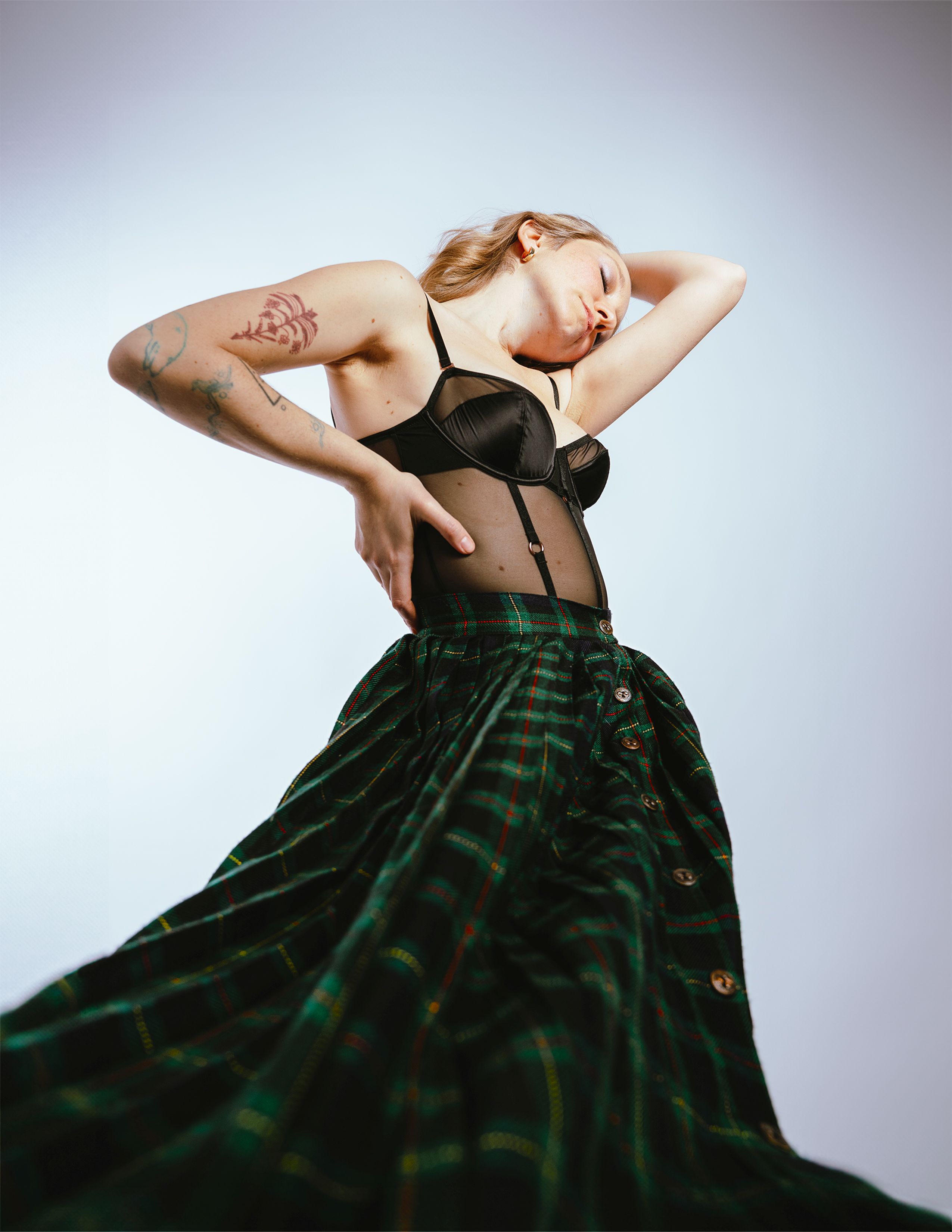
nilipek. Interview Image (c) the artist
After finishing a piece or album and releasing something into the world, there can be a sense of emptiness. Can you relate to this – and how do you return to the state of creativity after experiencing it?
Oh that feeling. It almost always causes a panic, but since I am familiar with that now, I try to move on. Usually creating nothing music-related for a week or two works well, it is like a creativity holiday.
But to be honest, even if you want to, immediately starting creating is almost impossible, because as a self-releasing artist you have to deal with everything after the release :)
Then, step by step I try to write and play again, a couple of lines here and there, I start making up funny lyrics and so on … It takes me a while to be ready to release something again, but I try to keep the creative state on.
Creativity can reach many different corners of our lives. Do you personally feel as though writing a piece of music is inherently different from something like making a great cup of coffee? What do you express through music that you couldn't or wouldn't in more 'mundane' tasks?
If the great cup of coffee also alters my emotions - which sometimes does - I think that’s also something. I wouldn’t use the word ‘creativity’ per se, not to belittle coffeemaking, but to prevent overamplifyng the craft of songwriting.
Of course they are not the same, but the same approach can touch both of them, and a great coffee can affect someone more than a ‘meh’ song. But, if we look at it from a culture making perspective, with enough money and publicity a good song would create a greater and faster effect on culture than a perfect cup of coffee.
And - since we are talking about mundane tasks - I think creative people need mundane tasks to be humbly creative. They should play with dirt, clean the house, cook a dull meal, to be aware that they are not “special” themselves.