Published
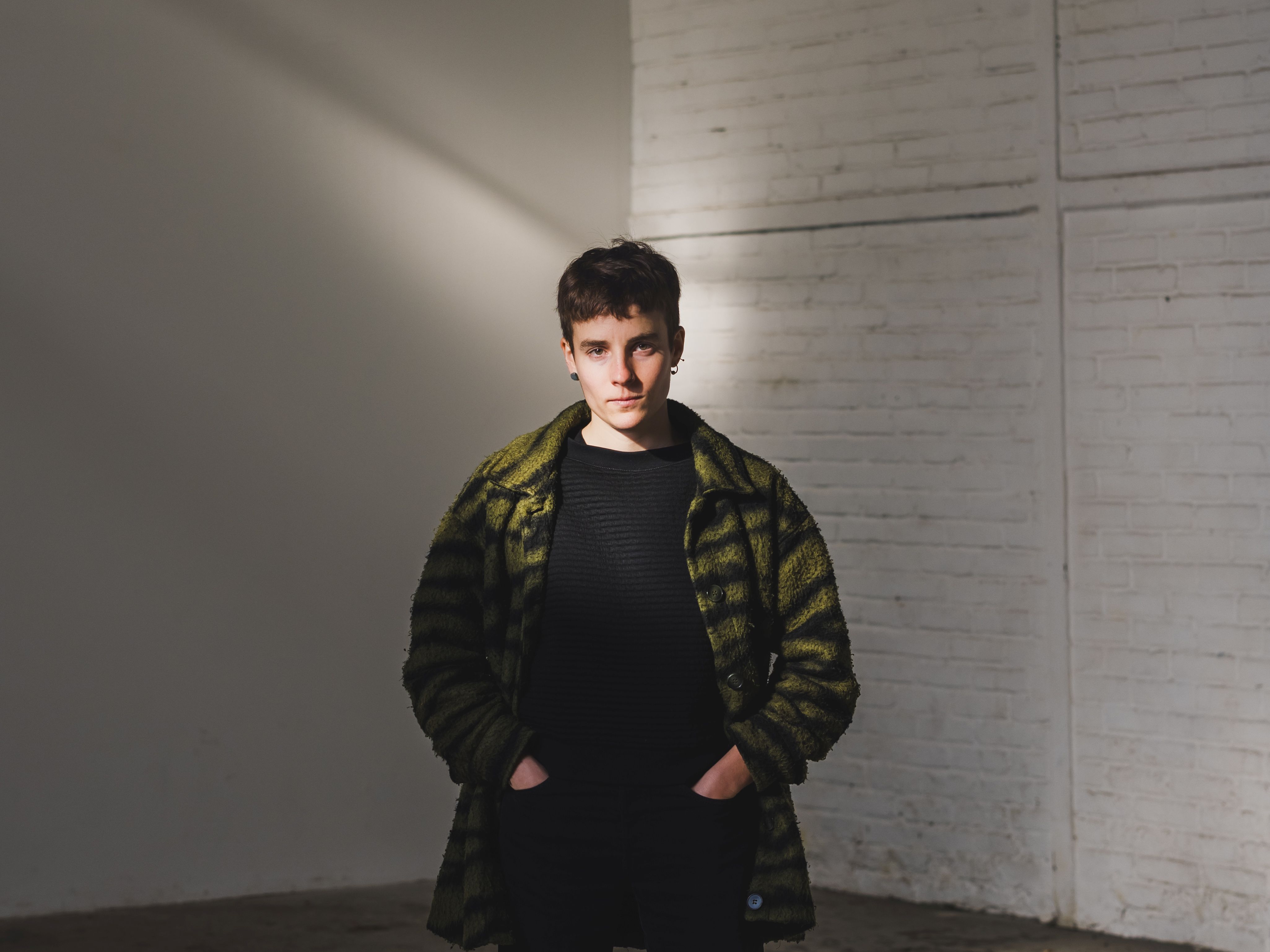
Name: Nina Garcia
Nationality: French
Occupation: Guitarist, composer, performer, improviser, sound artist
Current release: Nina Garcia's new album Bye Bye Bird is out via Ideologic Organ.
Global Recommendation: Best concert place: Instants Chavirés in Montreuil.
If you enjoyed this Nina Garcia interview and would like to know more about her activities and music, visit her official homepage. She is also on Instagram, and Facebook.
Where does the impulse to create something come from for you? What role do often-quoted sources of inspiration like dreams, other forms of art, personal relationships, politics etc play?
The impulse is above all an inner one, and it's a very mysterious mechanism.
Obviously I'm influenced by my world, the context in which I live, what I see and hear, but the moment of creation is a process that I find quite mysterious. It's necessary, it comes from within, and it's gestures, emotions and sounds that guide me the most. That's the first impulse.
Then of course come the ideas, the concepts, the taking a step back from what I'm doing - but that's very secondary.
For you to get started, do there need to be concrete ideas – or what some have called a 'visualisation' of the finished work? What does the balance between planning and chance look like for you?
My first explorations are always fairly intuitive. I do a lot of free improvisation, so it's the sounds themselves and listening to them that drive me. I almost never start with a conceptual idea or a preconceived idea of what I want to achieve. It's hours of playing that lead me to certain musical areas that I then choose to explore, rehearse, dig in and learn to master.
It was through improvisation and gestural practice of music that I came to compose the pieces for this record. But this is relatively new for me, up until now I've mainly improvised. Of course I often have a feeling that sets the tone and gives me direction, but that never materialises in a visualisation of the finished work.
I think as I make, and practice is at the centre.
Is there a preparation phase for your process? Do you require your tools to be laid out in a particular way, for example, do you need to do 'research' or create 'early versions'?
I don't have a standard way of doing things or a procedure to follow; it varies a lot depending on the moment.
But for Bye Bye Bird, I spent a lot of time searching with my new device (a pick-up that I hold in my right hand and which requires me to pay close attention to all the micro-gestures of this hand). I then spent a lot of time composing and perfecting the pieces.
Far from my old improvisations, the pieces recorded on this album are not “jaïssements;” on the contrary, they are pieces that have been thought through, composed, pruned, supported and replayed. There were several versions up to the final versions that I recorded.
I really enjoyed this work over time, which allowed me to think about the music in a different way, and to create in a different way, a long way from improvisation, but just as exciting.
Do you have certain rituals to get you into the right mindset for creating? What role do certain foods or stimulants like coffee, lighting, scents, exercise or reading poetry play?
I don’t have rituals at all!
Tell me a bit about the way the new material developed and gradually took its final form, please.
I started working with this new device in 2022, and it took me a long time to get to grips with it, and to come up with sounds and playing modes that were satisfying enough for me.
This little tool gives me access to new sounds and other modes of playing. I've gone from playing the guitar in a very physical way, with a lot of movement, to paying attention to the micro gestures. This pick-up gives me the impression of being a tightrope walker with sounds. Every tremor, every hesitation, every little movement of the hand or finger is picked up. It's this fragility added to the new sonic and rhythmic possibilities that interests me.
This has enabled me to incorporate a longer time, a more subtle suspension, and more sparse melodies into my playing, all the while retaining the more noisy vocabulary I've developed up to now. In this sense, Bye Bye Bird is both a new chapter in my work and a continuation of it.
Many writers have claimed that as soon as they enter into the process, certain aspects of the narrative are out of their hands. Do you like to keep strict control or is there a sense of following things where they lead you?
It's a very complex question that goes back to the question of the driving force behind creation.
I think that a large part of creation escapes us, whether we like it or not. Even if an artist has the impression of mastering everything, what is transmitted will be as much the unconscious part of what he is presenting as what he is aware of, all the more so in live performance where you are showing yourself to the audience. Reception is also entirely out of our hands, and that's one of the most beautiful things about art, this possibility of receiving individually, subjectively.
However, I'm not invested in automatic writing and I think a lot about the form and meaning I put into each piece. It's a question of balance. It would be wrong of me to say that I'm not in control of the creative process, I certainly am, but I have fun and I leave a lot of room for chance, for mistakes, and for the moment, which again comes from my regular practice of improvisation. It seems to me essential to be right in the moment, to be in tune with the present, to accept what comes as it comes, and to compose with it.
I imagine this balance a bit like trying to control water (I remember irrigating trees at my grandparents' in Spain): all of a sudden a huge flow of water arrives, you've prepared gullies and channels, but this water will eventually go where it wants, and then you follow it with your shovel to try to bring it to the tree by digging new gullies, and eventually the water reaches the tree but probably not by the path initially planned.
That's what I sometimes feel, that we're trying to propose a path to the sounds.
There are many descriptions of the creative state. How would you describe it for you personally? Is there an element of spirituality to what you do?
It's not spiritual for me, but it's undoubtedly a very intense inner state, which allows us to detach ourselves a little from material life. It's the world of sensations, of the indescribable.
But it's very physical for me, it's a state that takes hold of the body, just like listening.
How do you think the meaning, or effect of an individual piece is enhanced, clarified or possibly contrasted by the EPs, or albums it is part of? Does each piece, for example, need to be consistent with the larger whole?
Every time I make a record, each track is thought of as part of a whole piece, which is the LP. So each track responds to the previous one, and it all forms a whole.
In fact, that's what allows me to play these tracks live.
What's your take on the role and importance of production, including mixing and mastering for you personally? In terms of what they contribute to a song, what is the balance between the composition and the arrangement (performance)?
These steps are essential in the creation of a record, especially the mixing. It's a stage that fascinates me, because at that precise moment you can make your record take such different turns.
It's just as important to me as the recording. You can make the music aggressive, soft, highlight certain parts, it's like a second step of creation.
I'm always part of it and I was lucky enough to work with Etienne Foyer on the recording and mixing. Etienne knows my music very well, so he knew how to make the record sound the way I like my amp to sound.
After finishing a piece or album and releasing something into the world, there can be a sense of emptiness. Can you relate to this – and how do you return to the state of creativity after experiencing it?
I don't feel empty, this record's just come out, I've got the great pleasure of doing a big tour to present these tracks live, and it's a chance to be able to share this with the public in several ways.
I don't think much in terms of projects, creation seems to me to be a continuous movement, so I'm not worried about what comes next. I'm going to play these tracks and probably little by little the live show will change and I'll modify it with things that seem more in line with my future present.
Who knows what I'll be playing a year from now!
I would love to know a little about the feedback you've received from listeners or critics about what they thought some of your songs are about or the impact it had on them – have there been “misunderstandings” or did you perhaps even gain new “insights?”
I'm very moved and surprised to receive so much feedback that's very close to my perception of the album. I played and wrote these tracks with a lot of heart and I'm the first to be surprised to see that listeners receive it with a similar emotion. It's quite wonderful to be able to share that, without words.
Sometimes, after live shows, I get feedback with very different receptions from one listener to another, and that's something I love, this plurality of points of view. I'm aware that experimental music can be a projection screen for listeners and everyone can put very different things on it. But so far I've found a great deal of consistency in the way the album has been received, and it really moves me to see that there can be a bit of universality when you're doing something so personal.
I wasn't expecting that.
Creativity can reach many different corners of our lives. Do you personally feel as though writing a piece of music is inherently different from something like making a great cup of coffee? What do you express through music that you couldn't or wouldn't in more 'mundane' tasks?
Oh yes, for me it's radically different, above all because my music is made without words, so it's a space that can't be closed off with words and knowledge.
It seems to me that these long moments of sharing without words are quite rare in life, and that's what I like about it.