Published
Name: Nina Vanhoenacker
Nationality: Belgian
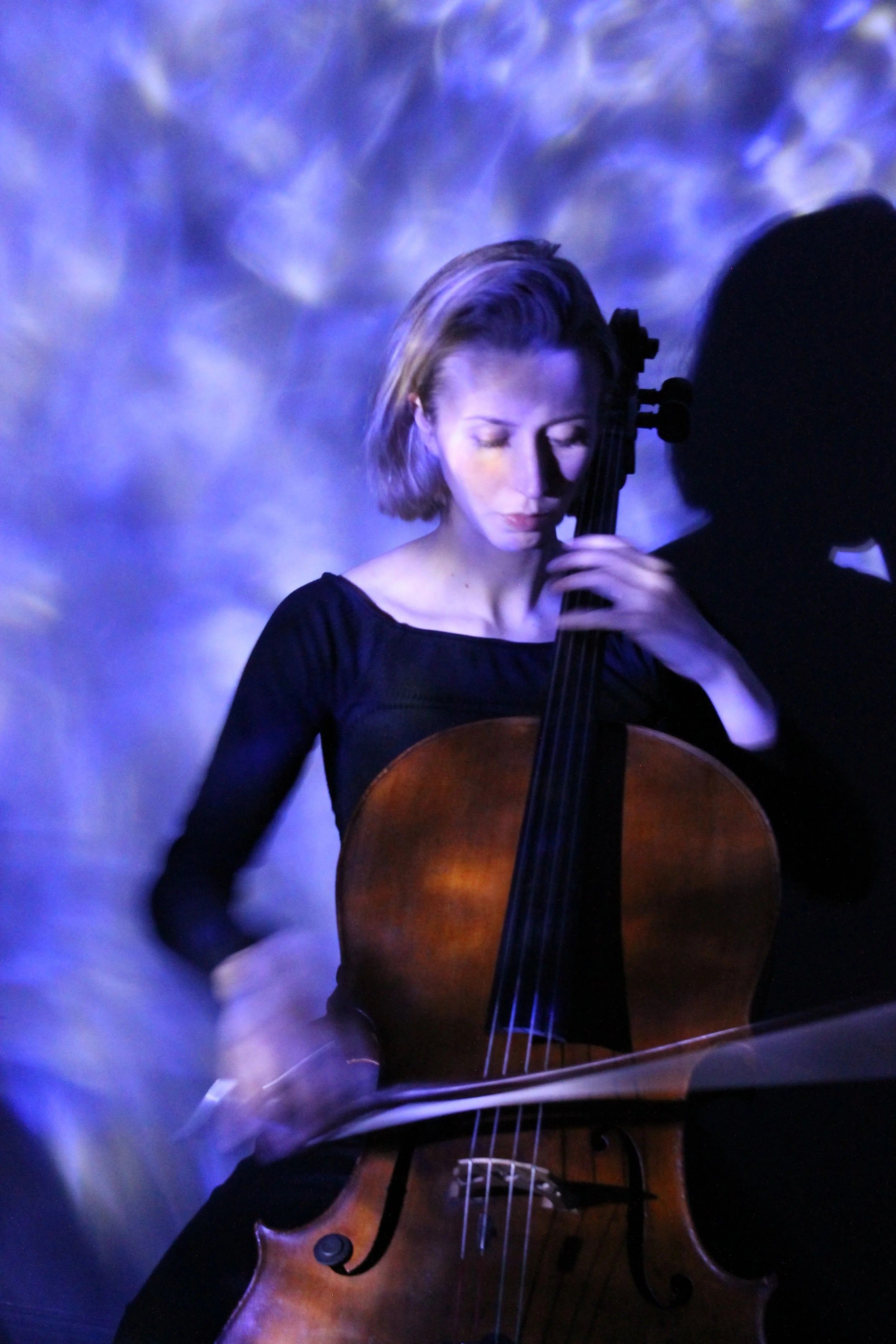
Occupation: Cellist, composer, performer
Current release: Nina Vanhoenacker's new album An unbalanced piece of wood is out via Protomaterial.
Recommendations for Brussels, Belgium: music: Smog, food: Terter
If you enjoyed this Nina Vanhoenacker interview and would like to stay up to date with her music, visit her official homepage.
When did you first start getting interested in the world of alternative tuning systems? Which artists, approaches, albums or performances using alternative tuning systems captured your imagination in the beginning?
During my studies in classical cello performance several years ago, I first encountered music that demands scordatura—using a tuning different from the standard cello setup. These were works from the more ‘standard, old repertoire, such as J.S. Bach’s Fifth Cello Suite or Zoltán Kodály’s Sonata for Solo Cello.
As a performer, these pieces immediately captured my interest. Playing with alternative tunings for the first time felt slightly uncomfortable, but also playful, as my entire understanding of positions and fingerings was challenged when discovering the scores.
I was especially intrigued by the change in resonance that emerged simply by retuning one or more strings, and by the harmonic possibilities this opened up. At times it felt as if my instrument had transformed into another one: certain tunings caused it to reverberate differently, producing a warmer or darker timbre.
Later on, as my focus shifted toward contemporary and experimental music, I realized that there was a lot more to be discovered.
For An unbalanced piece of wood, what did you start with, including your choice of tuning system? If there were conceptual considerations, what were they?
The album is a collection of contemporary cello works by several composers, including one piece by myself.
While selecting the repertoire for this release, I realized—almost accidentally—that I had chosen pieces which all require a certain detuning of the instrument, with only one exception. Although this was not an initial conceptual decision, it confirmed for me that I am intrinsically drawn to works
involving alternative tunings.
Through this, each piece creates its own distinct soundworld, with very specific characteristics shaped by the tuning of the instrument.
My own piece, Glerá, which requires an extremely low detuned C string, emerged from a series of improvisations in which I wanted to explore the limitations of string pressure and its acoustic consequences.
Tell me a bit about the way the new material developed and gradually took its final form, please.
Some of the music on this album already existed, while other pieces were written specifically for the project or for me as a performer.
Over several years, I collaborated with Anqi Liu on I don't know that I know; I don't know that I don't know. Anqi first created a semi-graphical score intended for acoustic performance.
The piece features many high harmonics, and the graphic notation breaks down the physical aspects of playing into multiple parameters. This structure gives the performer significant freedom while engaging with aleatoric elements and the instrument’s natural limitations.
Later, Anqi added a set of aleatoric electronics to fully realize the piece’s concept. As a result, each performance is unique, and evolving depending on interpretation and interaction with the electronics.
In as far as it is applicable, were there tuning-specific challenges for your new release or recent performances? In how far has working with alternative tuning systems changed your collaborative practise in general?
Alternative tunings have presented both creative opportunities and practical challenges for my performances. While improvising, I often feel constrained by the standard cello tuning and sometimes question why we hold onto it.
This is part of why I feel such a strong connection to the compositions on my album: each composer begins with a specific sound world and translates it into a particular tuning of the cello’s four strings, giving every piece a distinct identity.
Eden Lonsdale’s Appearings, for example, uses a very different tuning from the standard one. Some strings are tuned very low, which significantly affects string tension and responsiveness.
This, in turn, changes how I physically interact with the instrument, influencing articulation, bow pressure, and overall timbre of the instrument.
I would love to know a little about the feedback you've received from listeners or critics about your music written for different tuning systems. Were there surprising responses, did you perhaps gain new “insights?”
As most of the music on my new album uses different tunings, much of the feedback I’ve received has focused on the distinct characters and timbres that emerge from these alternative setups.
This has sometimes led to amusing comparisons: a friend once remarked that my performance of Balance Piece by JP Merz made my cello sound like a hurdy-gurdy!
Beyond the humor, these reactions have given me a new awareness of how tuning choices shape the instrument and music’s identity and character.
In how far has working with alternative tuning systems led to creating different music for you personally? Are there creative ideas / pieces which you could not realise in equal temperament?
I often experiment with playing solely on open strings and using natural harmonics. This has always fascinated me, but when combined with alternative tunings, it opens up an entirely new world of sounds, making the possibilities endless.
Pairing these tunings with reverberant spaces adds another dimension, which makes this a very interesting path to me that I’d like to explore even more.