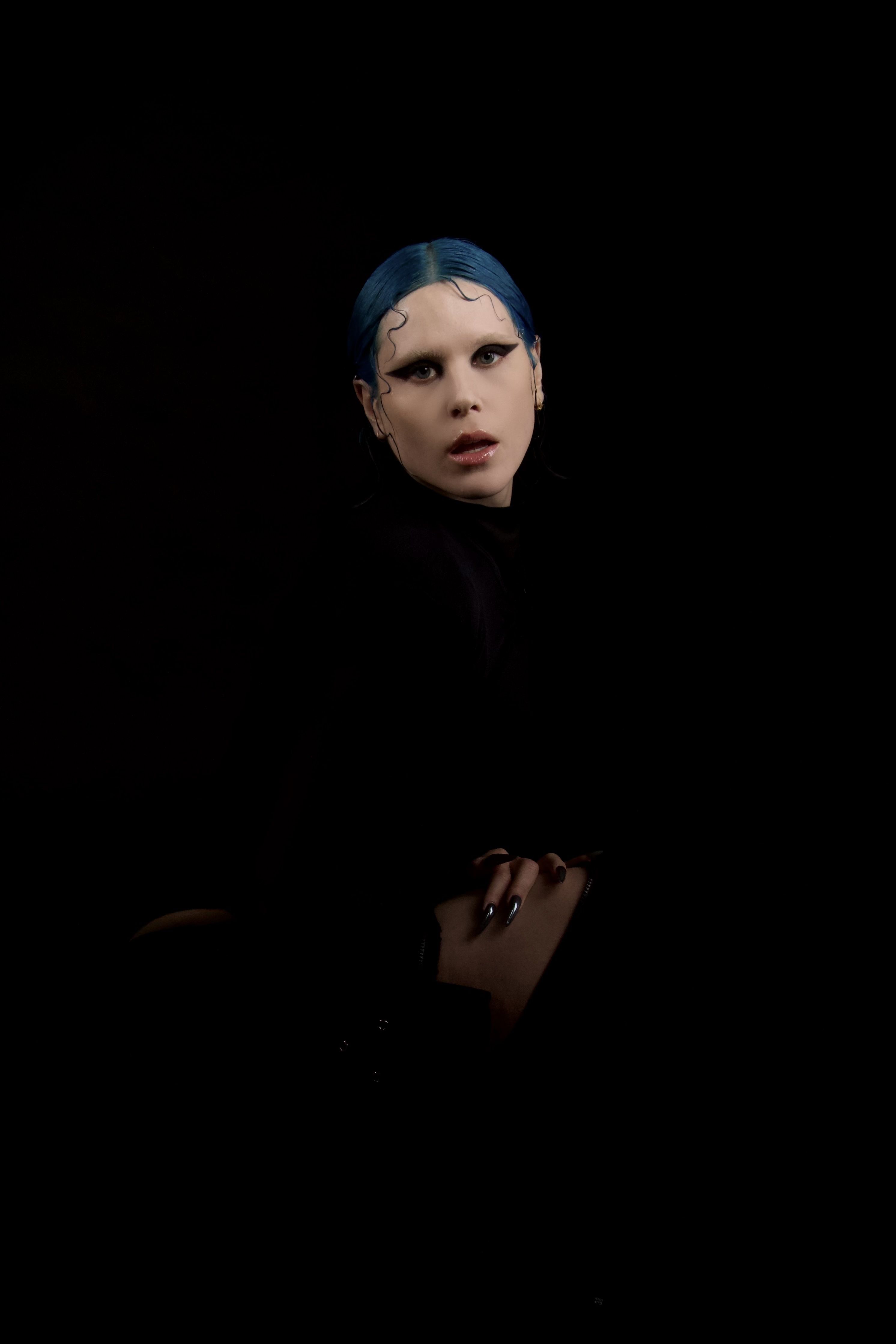
Published
Name: NLI
Nationality: British
Occupation: Producer, DJ, label founder at adhesive
Current release: NLI's Initiation album is out via adhesive.
Fashion Recommendation: I always (surprise!) love a good catsuit or bodysuit, they are so versatile and comfortable; you can dress them down with jeans or go full drama for the stage. Composition and material is key, I’m very particular about the composition of my bodysuits, they need to be soft but still offer support. The colour is also very important, a true black is the most flattering and doesn’t look harsh against the skin in certain light. I also really like a good, high-quality oversize black tshirt. I generally stick to quite oversize fits in my day-to-day wear, a baggy tshirt or hoodie with baggy jeans and an oversize blazer or bomber jacket is pretty much my everyday uniform. All in true black of course :-)
If you enjoyed this NLI interview and would like to stay up to date with her music and upcoming live dates, visit her on Instagram, and Soundcloud.
Do you think that some of your earliest musical experiences planted a seed for your interest in fashion as well?
Yes most definitely, I was really into goth and alternative fashion when I was a teenager and loved experimenting with different materials, textures and pieces.
I remember saving up for this incredible floor length PVC coat and was over the moon to wear it to school the next day; I attended this really snobby prep school where I had always been the odd one out when it came to clothes so naturally the first reaction to my beautiful new coat was: “Is that a refuse sack you’re wearing?”
That didn’t stop me from wearing it though!
Fashion and music are often closely related to one's identity. Can you please tell us a bit about your own sense of identity – and how it concretely influences your creativity?
I draw a lot of inspiration from imagined dystopias, cyberpunk and the artificial realm; my visual identity as an artist is constantly evolving together with my creativity.
Some visual elements have become a part of me, like my signature black siren eye and my claw-like manicure. Everyone always asks me how I can DJ with long nails but the truth is that they’ve become an extension of who I am.
I go through periods where I change up my appearance in whatever way feels most naturally aligned with my music, most often with my hair. I’m currently happy with my natural copper red but who knows, now that I’m working on new music that really excites maybe that’s going to change soon?
According to scientific studies, we make our deepest and most incisive musical experiences between the ages of 13-16. What did music mean to you at that age and what role did fashion play for you at the time?
Music has always been my whole life. I grew up around the piano and listened to a lot of classic rock and industrial music. I was never one to follow trends really, I was never the ‘cool’ kid at school and my classmates would make fun of both my interest in art and music as well as my sense of fashion.
I think a lot of people think of fashion as a way to express themselves but in all honesty, I’ve always dressed up to become someone else; perhaps a future version or more evolved version of myself? I love Futurism and avant-garde fashion, the crazier the better.
I really like unusual textures, I’m a big fan of scuba materials, latex, PVC and any materials that look like skin. I wear a lot of black, as you may have guessed by now, so I tend to experiment more with textures rather than with colours.
Describe your personal style, please, and how your choice of fashion allows you to express it. Which fashion brands or style icons do you personally find inspiring - and why?
I personally see my visual identity as a representation of what my music sounds like; very structured yet textures and with a lot of depth. I like minimalism but with an edge.
I’m a huge fan of Balenciaga, Acne and LaQuan Smith. I also think that Virgil Abloh was a genius, the way he was able to intertwine streetwear with high fashion was just extraordinary; in my opinion, he was one of very few fashion designers who could actually dress the human body, which transcends everything that we know fashion to be.
His ‘ironic detachment’ and approach to originality really pushed the industry forward, which I find very interesting and inspiring.
Fashion can embody ideals that extend far beyond aesthetics, reaching into ecology, politics and social issues. Does this apply to you as well, and if so, in which way?
Absolutely, very much so.
I was once told by a friend that I’m a bit like a video game character when I’m performing; I almost don’t appear to be real. Some of my fans have told me the same, that it’s strange meeting me in real life for the same reason because to them, it feels like they’re meeting a character that has stepped out of a simulation. It makes me really happy to hear that because my work is exactly about that – reality vs simulated reality.
This aligns with the perceptual dichotomies of my sound, I always strive to deliver the unexpected to my audience and have an impact on their perception. At the same time, humanity is so important to me. I feel that in this day and age, DJs are the new rockstars and unfortunately many of them come with an undesirable attitude. I’ve seen how many artists treat their fans, which I find both shocking and disappointing.
As a performer, I put a lot of effort in breaking down the invisible barrier between myself and my audience, making sure that every person in the room feels included, desired and seen. I would hope this reminds the crowd not only of my humanity, but also their own. At the end of the day, we’re all just people who have come together to rave in environment where everyone is equal.
What do fashion and design add to your perception of music?
They’re essential!
I think especially nowadays, where creative expression is so visual, to communicate your vision using different mediums, which interact with one another, you can end up with really interesting results.
Fashion can project an image, just like music can. As such, it is part of the storytelling process. What kinds of stories are being told, would you say?
I think fashion is so interesting to explore when telling a story with music. For instance, we finishing shooting the visualiser for my track “Riot” a while back ahead of the release of my debut album Initiation, where I had 2 costume changes. One was a fully matte black catsuit and the other one was a see-through bright red catsuit.
My character in the plot of the visualiser was a symbol for the female experience in the music industry, where we are often treated like a piece of meat. My friend Cooper, who played the male character in “Riot,” used a piece of raw, red meat as a prop, which was a key part of the storyline. This created an interesting dynamic presenting me as a piece of meat that was force fed ‘his meat’ within the story.
Mind you, it was autumn in London and we were shooting in a freezing cold warehouse and I was essentially naked. The discomfort that I experienced translated into each shot and was then served to the viewer in a very direct way. In that sense, fashion helps flesh out the story visually and enhance the storytelling of the artist.
What can fashion express what music can not?
I think fashion and music speak a different language, yet the message that both communicate are understood universally.
It’s all very poetic if you think about it, seeing both of these artforms striving to embody one vision.
It seems obvious that fashion and music are closely linked, but just how that influence works hasn't always been clear. Would you say that music leads fashion? Is it the other way round? Or are they inseparable in some ways?
I would say both can definitely work independently from one another, but I think we can all agree that cross-disciplinary collaborations will always enrich any kind of art project and deliver a beautiful result.
I would even go as far as to say that they lead each other, hand-in-hand.
Fashion and music can be expressions or celebration of identity, but they can also be an effort to establish new ones or break free from them. How would you describe your own approach in this regard?
I always strive to evolve as an artist and am not the type to cling on to the past. I embrace change and when I feel change coming I never fight it but try to understand what direction it is leading me in and adapt to it in my own way.
As someone who has gone through many changes both visually and sonically, the core of who I am both on an artistic and personal level has always remained the same, which is why I think it’s important to not let fashion or trends dictate your artistic identity but rather be a guideline to understand where you would like to go creatively.
Does what you wear change your personality – and thus the music you create or the way you perform?
To be completely honest, I have been told by many people that the second my siren eye is on, I stop being Nellie and become NLI instead. I typically wear a catsuit or a bodysock when I perform as well, so I definitely do have a uniform for the stage;
I would say that as soon as my makeup is done, my hair is gelled and my stage costume is on, I automatically enter this mindset where my whole existence is about entertaining my crowd and even pleasing them, their experience at my performances is so important to me.
I’m always very humbled and in awe by the fact that my supporters go out of their way to travel to come see me (some have messaged saying they travelled long distances and across borders) so it’s my top priority to make sure that I return the favour and always give them my 100% during a show.
Are you currently active in the fashion industry? If so, tell me about your experiences, please.
My mother has an avid interest in fashion and used to take me to fashion shows as a child!
I love the fashion world and speaking to fashion people, I’m always eager to learn more about fashion pieces and hearing them speak about it with competence and passion is always an incredible experience.
I have rarely heard of actors, authors, or even painters design a piece of clothing – but is quite a regular feat for musicians. Why do you think this is?
That’s a great question!
I’d say what fashion and music have in common is that they’re both artforms that are highly sensitive to cultural change and both are focused on the inner world or self-expression. As a musician, you’re essentially a part of the actual artwork that you create and I would say the same can be said about dressing the body.
I think that music and fashion are intertwined more than ever before now that we have the internet and the enormous impact of social media on our daily lives. The reach of social media in the digital age means that the fashion industry is better equipped than ever to work closely with the music industry and help artists quickly gain global traction, covering huge cultural and geographic areas in a short amount of time.
The possibilities are endless, it’s very exciting to see how this will continue to develop in the coming years!
Fashion extends to the artwork of releases and promotional photography as well. Could you talk about your approach in this regard and what some considerations were for some of your most recent cover designs and images?
I’ve worked very closely with my press photographer, Maya McDougall, since day one and she also happens to be my best friend! We’ve developed this symbiotic relationship where we fulfil one another both creatively and artistically, she understands my vision and I understand hers!
We’ve spoken about this a few times actually; choosing your press photographer as an artist is a bit like choosing your spouse, you just have to work on a fundamental level together in order to create art, not just take photos in a studio setting.
Maya truly understands my vision as an artist, she understands my music and my own personal world I live in as an artist. She also took the photos that we used for the cover of my debut album, which were taken using slow shutter speeds and intentional camera movements.
As Maya herself put it, her
“photographic practice is closely intertwined with the emotional and atmospheric landscape of NLI’s music. While much of my photographic work embraces distortion and movement, I am equally focused on the sharpness and precision of certain elements within the frame. Collaboration is central to my work with NLI. We begin each visual project with a core concept or emotional thread – such as ‘digital decay’ or ‘siren’ – and I build on this through extensive visual research and experimental shooting techniques”.
Creativity can reach many different corners of our lives. Do you personally feel as though designing a fashion item or even putting together a great outfit for yourself is inherently different from something like composing a piece of music?
I have no doubt that a professional fashion designer or stylist would take a very different approach to putting together an outfit, in the same way me making music or even just listening to a track would of course be done differently than someone who is not a professional musician. So to me personally, fashion is more an addition to my artistry in general rather than the main artwork.
It may sound silly, but it’s so hard for me to not listen critically to music or think about the technicalities of a track when hearing it, in the same way a professional stylist would think about the compositional elements of an outfit.
For me, it’s a personal form of enjoyment that elevates my sonic art and expresses my own personal interpretation of my body and self.