Published
Name: Noémi Büchi
Occupation: Composer, sound artist
Nationality: Swiss
Current release: Noémi Büchi's Liquid Bones is out February 14th 2025 via -OUS.
If you enjoyed these thoughts by Noémi Büchi and would like to find out more about her work, visit her official website. She is also on Soundcloud, Instagram, and bandcamp.
For an even deeper look, check out our previous Noémi Büchi interview, and our interviews with her about sound and sound as matter.
Production is a discipline bordering technology, art, and creativity. How do you see the relationship between these and what is their balance for your own music, do you feel?
On one hand, technology, art, and creativity can be interconnected — but only as long as you choose to link them. However, they are fundamentally independent entities that can be utilized or combined as desired.
On the other hand, for me, creativity is an uncontrollable force that often occurs in an inexplicable way. It emerges spontaneously and can just as easily vanish — unlike technology, which can be systematically learned.
Art, much like creativity, is a vague and subjective concept. What is art? Where do the boundaries between art and science lie for example? At what point can we confidently call something a work of art? These are questions I find difficult to define.
For me, a piece of art is defined by the moment it deeply touches someone, triggering something unexpected — memories, events, epiphanies, or insights. It evokes strong emotions that may not be immediately tangible, often requiring time to fully “digest.” If a work lingers in someone’s mind, occupying their thoughts in an uncontrolled and intangible way, then it qualifies as art in my eyes.
When I compose or produce music, I don’t consciously think about these connections. The process is usually very intuitive. For instance, when I learn something on a technological level, it’s almost always tied to an artistic goal. Technology serves as a tool in the service of my creativity. The idea— the creativity — takes precedence and can demand “everything,” so to speak. My skills then have to adapt and follow wherever creativity leads.
Whether the result is considered art, however, is ultimately for each individual to decide.
Which part of the production process do you draw the greatest fulfillment from?
I love it when a very abstract idea comes up, which I slowly try to understand — long before I start to translate it into music.
These moments of profound euphoria are invaluable, and I would never trade my work for anything else because of them.
For you personally, where does composition end and production start (or vice versa)?
When I slowly understand what this first, abstract idea has in it and as soon as I have made aesthetic decisions, such as instrumentation, structure, etc., I can start to work on it.
It can also happen that I start to improvise on something which I like — even the day after — prompting me to develop it further into a complete piece.
Is technology something that you would like to have disappear behind your music – or is it a musical element that you want to bring to the fore and play with?
How could you hide technology from electronic music? I wouldn't understand why I should either.
The computer is my main instrument. I also don't think that technology is a “musical element”. It's a tool, just like the bow, the quality of the wood or the strings on a violin.
Could you describe how your relationship with your studio/set-up feels like - is it an extension of your self/body, a partner and companion, a creative catalyst, a challenge to be overcome, something else entirely?
For me, my studio represents a place of total concentration and separation from the outside world and, above all, from the human world. In this place I try to enter the world of the fantastic and dreams, and try to reconnect with nature through sounds (whatever that term “nature“ really means, but that's another topic).
So this place is kind of very “loaded“ and it is not easy to enter mentally.
How and for what reasons has your music set-up evolved over the years and what are currently some of the most important pieces of gear and software for you?
I would say it's the opposite, my setup has become smaller.
I’m increasingly drawn to the idea that “less is more.” You need so little to create something “beautiful”. My most important instrument is still my upright piano and my digital Roland piano.
On the electronic side, my module from Rossum Electronics, the “Panharmonium”.
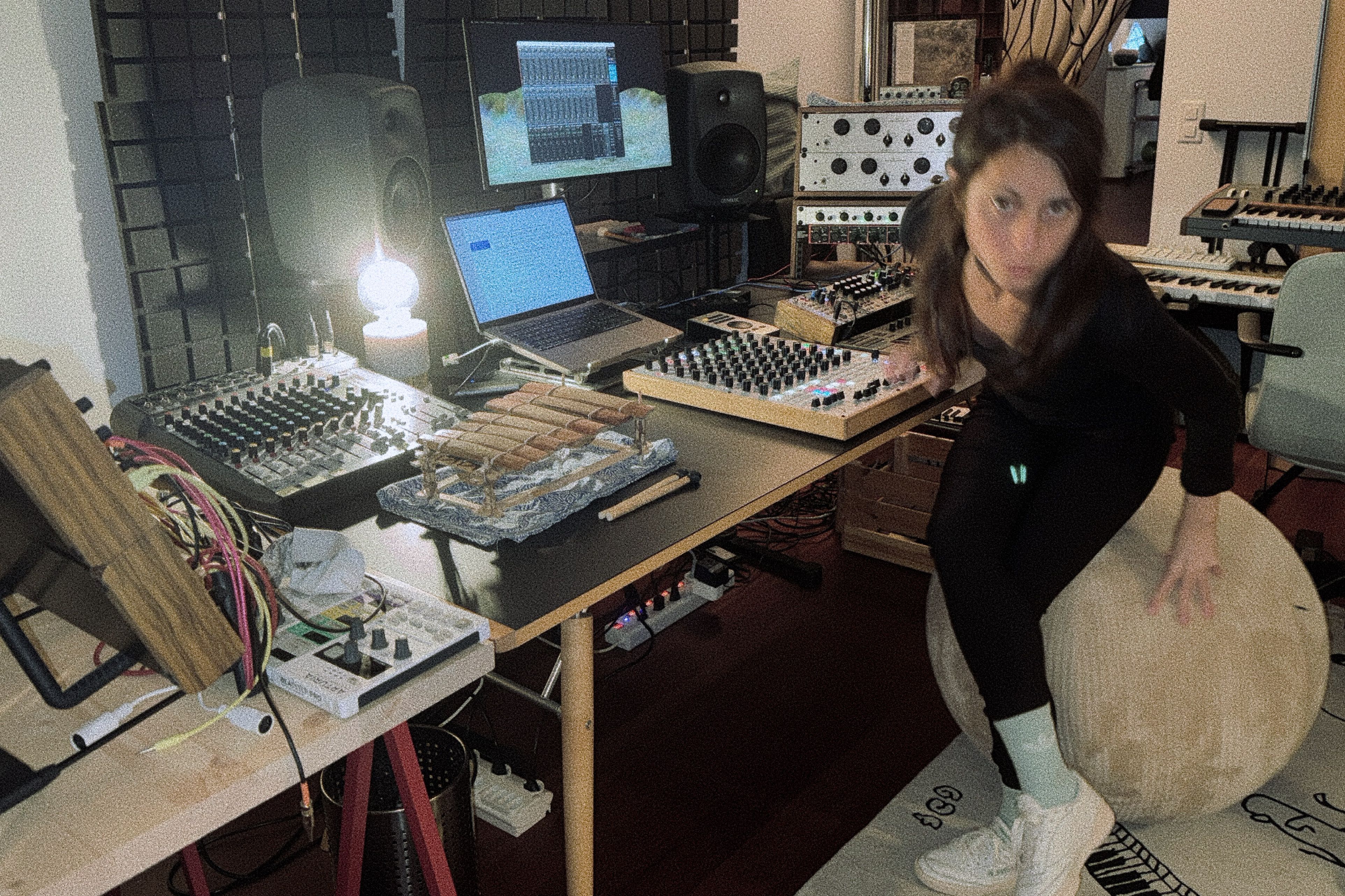
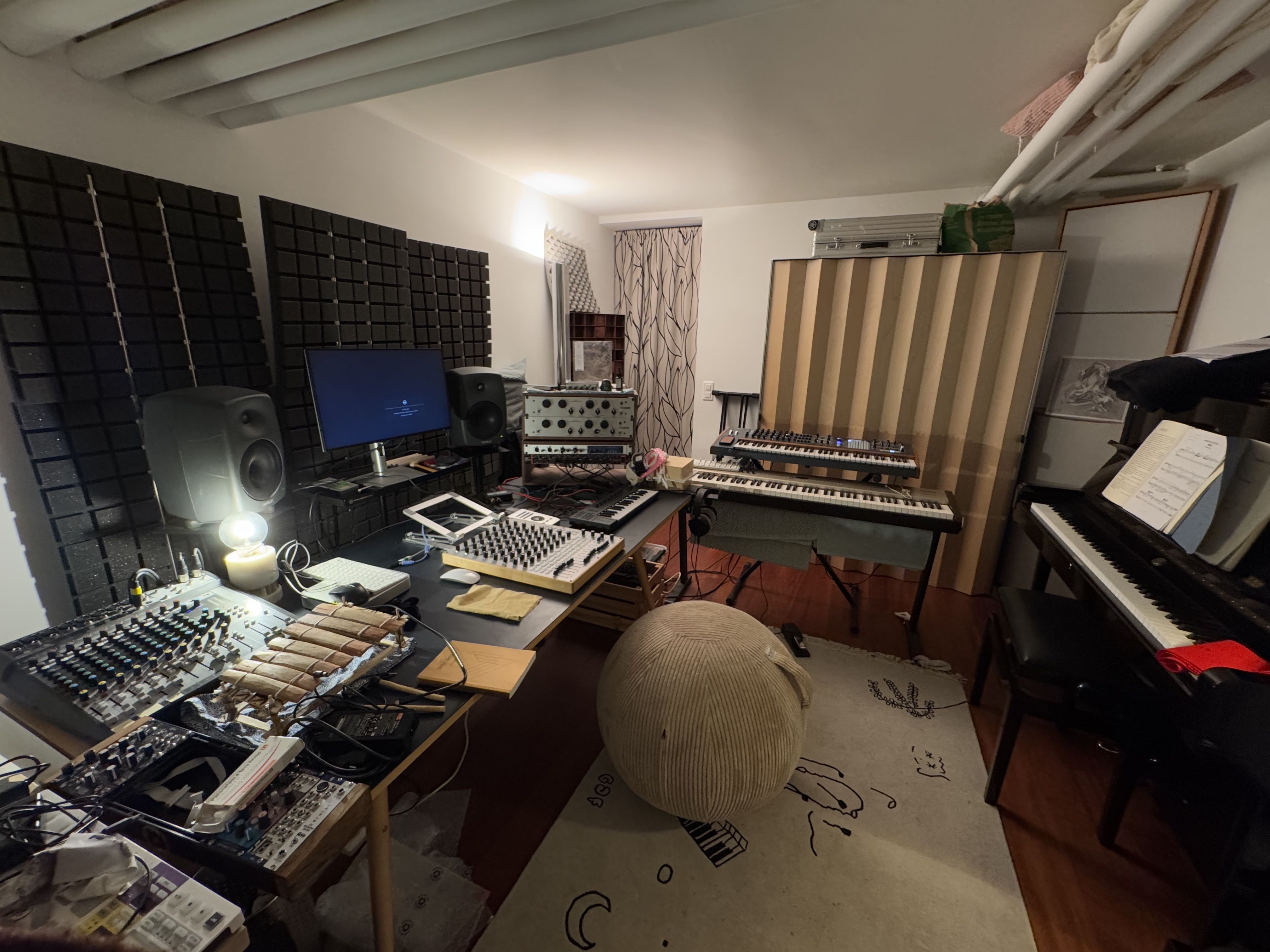
Tell me about the space of your current studio/workplace and how you've set it up to further your creativity? 
Noémi Büchi Studio Photo (c) the artist
Late producer SOPHIE said: “You have the possibility with electronic music to generate any texture, and any sound. So why would any musician want to limit themselves?” What's your take on that?
I believe limitation can be just as exciting as infinite possibilities. In the end, everything depends on the initial idea.
Limitations can often lead to incredible outcomes — things you might never have created otherwise, because they force you to adapt and explore new ways of thinking.
Tell me about one or two of your early pieces that you're still proud of (or satisfied with) in terms of production – and why you're content with them.
I think the favorite piece I made is "Elemental Fear" from my debut album Matter. Somehow this piece is perfect and yet imperfect at the same time. I really like that about it.
In terms of sound, it’s somehow not entirely “clean” — it’s as if I ran it through a washing machine, haha. Yet, to my ears, the structure feels exactly as it should be, not a second too short or too long. It aligns perfectly with the dramaturgy and emotionality of the piece.
I have to admit, I don’t often succeed in achieving this balance.
From the earliest sketches to the finished piece, tell me about the production process for Liquid Bones, please.
The pieces of this release are mostly based on improvisation.
Initially, I wanted to create a new live set to perform with a drummer. After putting together this small live set, I decided to turn it into tracks, as I found the rhythmic, almost danceable character quite refreshing.
This release feels very playful and light to me.
There are seemingly infinite parameters to change, influence and shape the sonic results. From your experience, what actually makes a piece better and what sets a “finished” version apart from one destined to linger in the archives?
Mixing plays a central role. During the mixing process you can actually change and manipulate the whole character and the whole energy of the piece — that’s a crucial moment for music production.
I don’t know if it’s “better” or “worse.” It’s so individual and subjective. As I mentioned, I find the sound on “Elemental Fear” unprofessional, and that’s what makes it unique in a way.
For this EP I wanted a perfectly mixed, crystalline sound. But that was an aesthetic, artistic decision.
How do you see the relative importance of arrangement versus sound design versus composition (including, potentially, lyrics)?
Structure versus arrangement is everything for me. It decides and controls the whole dramaturgy, can valorize sound, emphasize connections between the different sounds etc.
Sound design is the second step, which is the embellishment, so to speak — determining the aesthetic character or the “style“ of the piece. Composition is nothing other than the arrangement of all these components.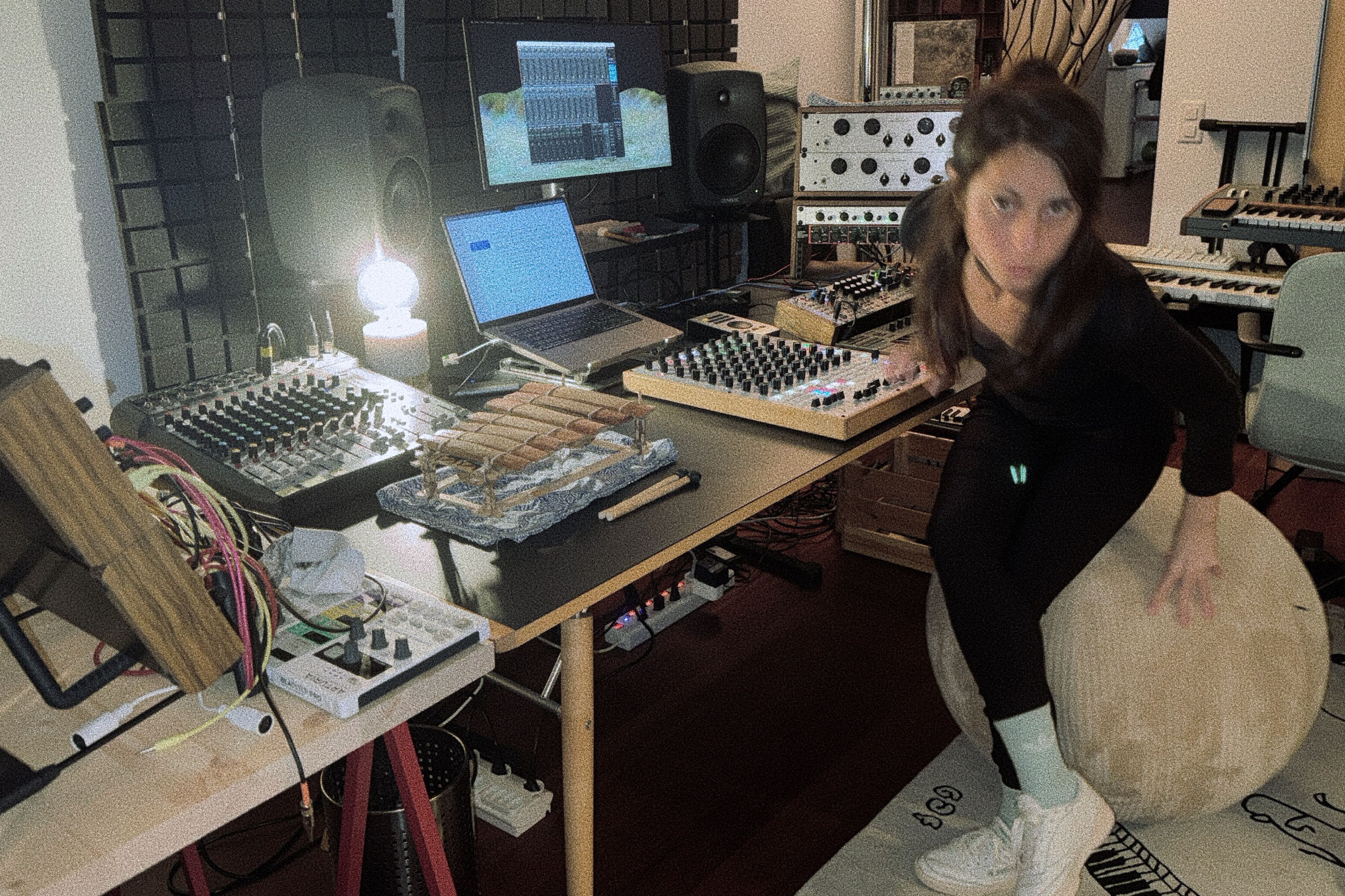
Noémi Büchi Studio Photo (c) the artist
How, would you say are your live performances and your recording projects connected at the moment? How do they mutually influence and feed off each other?
In the last two years, my live performances have been the basis of my album productions. That used to be different in the past — my live performances were totally independent of my productions.
I miss that feeling a bit, it was nice to separate those two things. It was also much more surprising for the audience to hear something live that they can't find online afterwards. I tend to go back to that.
Have you used AI or generative music tools for your own productions? If so, in which way and what did they add?
No.
One big question resulting from the use of "intelligent" production tools and AI is whether the results are as important (or even more important) than the process (and the joy of creating). How do you see that yourself?
For me, creative work and composing music is something that I want to take into my own hands and enjoy the process. I'm almost less interested in the result, which is then intended for the outside world.
In this sense, I only want to use AI for certain visual effects, but they are all based on self-created material (video).
Once again, I see AI as a tool, as a technology — something that supports my creativity, never a substitute for it.
How much potential for something “new” is there still in production? What could this “new” look like?
The “new” does not exist. I only believe in variations on what already exists.
The range of variation is infinite, so everything can be unique without having to be “new”.