Published
Name: Nusantara Beat
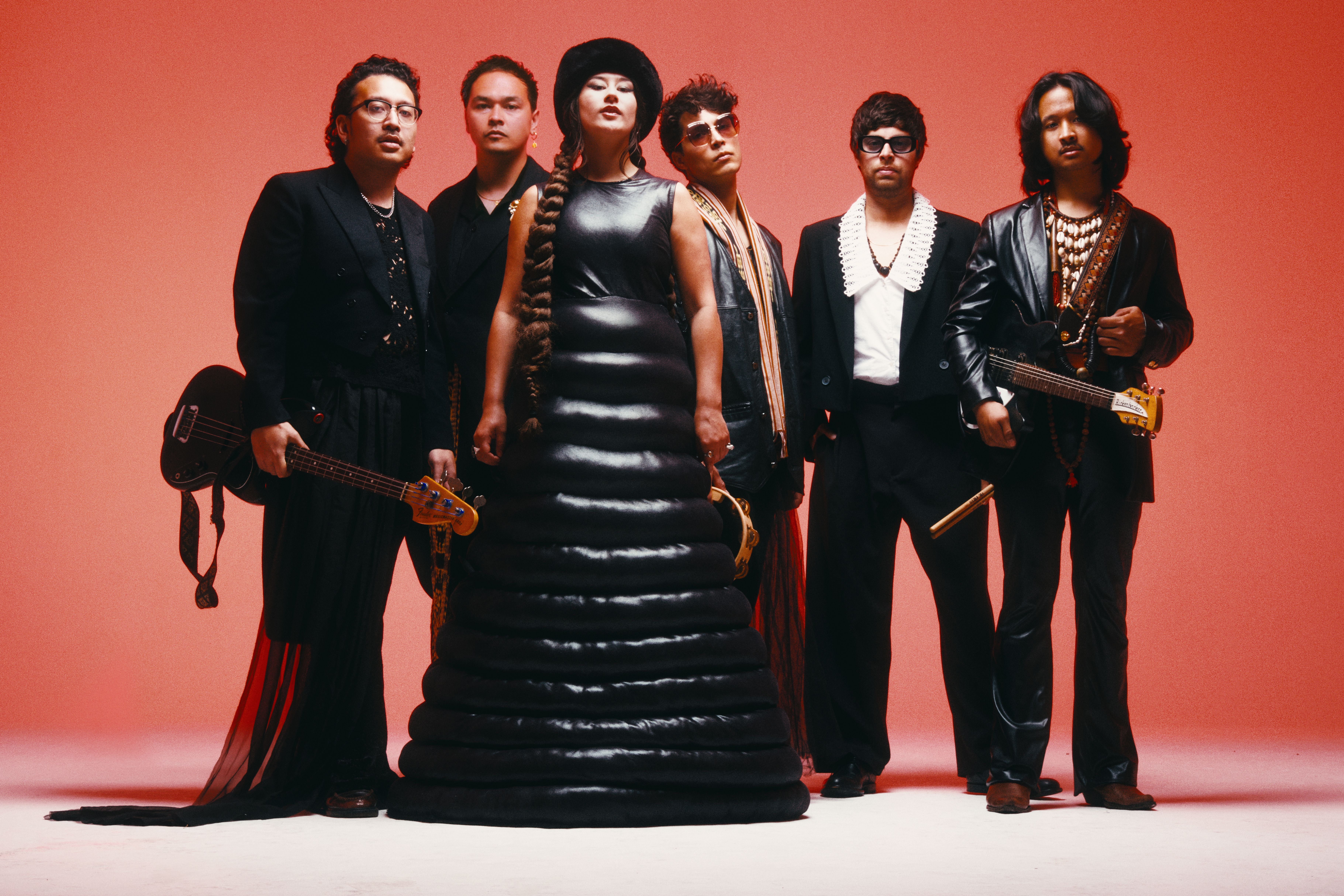
Members: Gino Groeneveld (percussion), Jordy Sanger (guitar), Megan de Klerk (vocals), Michael Joshua Yonata (bass), Rouzy Portier (guitar, keys), Sonny Groeneveld (drums)
Nationality: Indonesian-Dutch
Current release: Nusantara Beat's self-titled full-length debut album is out via Glitterbeat.
Current event: Nusantara Beat are currently on an extended tour. Catch them live at one of these dates:
FEB 17 // NOCHTWACHE // Hamburg, Germany
FEB 18 // Prachtwerk // Berlin, Germany
FEB 21 // Parotia // Amsterdam, Netherlands
Mar. 6 - 9, 2026 // WOMADelaide 2026 // Adelaide, Australia
Mar. 20 - 21, 2026 // m4music Festival 2026 // Zürich (kreis 6), Switzerland
APR 2 // L'Aéronef // Lille, France
Apr. 3 - 6, 2026 // Pasar Malam 2026 // Rotterdam, Netherlands
MAY 9 // Falafelpop 2026 // Tilburg, Netherlands
May. 27 - 30, 2026 // Druga Godba Festival 2026 // Ljubljana, Slovenia
JUL 3 // Wilde Weide 2026 // Kraggenburg, Netherlands
Jul. 10 - 12, 2026 // Cactus Festival 2026 // Brugge, Belgium
Fri, AUG 21 // Lowlands Festival 2026 // Biddinghuizen, Netherlands
Aug. 27 - 30, 2026 // Into The Great Wide Open 2026 // Oost-vlieland, Netherlands
If you enjoyed this Nusantara Beat interview and would like to stay up to date with the band and their music, visit their official homepage. They are also on Instagram, and bandcamp.
Where does the impulse to create something come from for you? What role do often-quoted sources of inspiration like dreams, other forms of art, personal relationships, politics etc play?
For me it comes from the urge to present the magic of the combinations of different states of mind, rhythm, harmony and melody.
I want to share the sensation that I experience myself with other people.
For you to get started, do there need to be concrete ideas – or what some have called a 'visualisation' of the finished work? What does the balance between planning and chance look like for you?
For me it’s always been more interesting if it’s stays at 50/50, even when the demo is finished by one person.
By doing this you let the full potential of a song grow by bringing in the input of all of the band members, and their state of mind at that moment.
Is there a preparation phase for your process? Do you require your tools to be laid out in a particular way, for example, do you need to do 'research' or create 'early versions'?
It always starts with a main ‘hook,’ whether it’s from a guitar lick or a drum or even a mood.
And from there we build it up.
Do you have certain rituals to get you into the right mindset for creating? What role do certain foods or stimulants like coffee, lighting, scents, exercise or reading poetry play?
This group is quite dependant of the state of hunger. From good food comes good inspiration.
For your debut album, what did you start with? If there were conceptual considerations, what were they?
Megan: When we started working on the album, we had a lot of covers in mind.
At first, we thought about mixing them with our own songs, but we decided to focus solely on original material. We wanted the album to give listeners a first look at our own ideas and sounds. We began by collecting everyone’s ideas, and over some time in our Amsterdam studio, we picked and developed the strongest songs.
Playing covers and exploring different styles inspired us along the way, helping us create an album that feels fresh, honest, and completely ours.
What makes lyrics good in your opinion? What are your own ambitions and challenges in this regard?
Megan: I love lyrics that create a strong atmosphere. For me, they grow naturally out of the mood and melody, which often already tell a story on their own. I don’t think too much about rules. I let the feeling guide the words and melodies.
Because I’m not yet fluent in Indonesian, I first wrote many songs in English and later rediscovered them. One of them is “Cinta Itu Menyakitkan”, written in the attic at Jordy’s house with Rouzy.
We translated the ideas from our English jam as accurately as possible into Bahasa Indonesia.
The song is about standing on a mountain, seeing the place you want to reach. What is beautiful feels far away and unreachable, like love you can admire from a distance, unless you find the courage to climb toward it.
I don’t focus on whether lyrics are “good.” What matters most is that I feel them in my heart, so I can express them freely when I perform
What are areas/themes/topics that you keep returning to in your lyrics?
Megan: Our album is about friendship, love, growing older, and facing the ghosts of the past. It’s about the chaos we live in, where everything happens at once and you can drown in noise and expectations.
But beneath this chaos lies something hopeful. Pain, love, and confusion are all pieces of the same whole we’re trying to understand.
Many writers have claimed that as soon as they enter into the process, certain aspects of the narrative are out of their hands. Do you like to keep strict control or is there a sense of following things where they lead you?
Megan: For me, the process is a mix of control and letting things flow. With Nusantara Beat, our music is shaped by exploring our Indonesian roots, the traditional scales, sounds, and stories already guide us in a natural way.
When we write, we always have this in the back of our minds, but we also follow whatever comes up in the moment. So there’s intention, but also discovery.
There are many descriptions of the creative state. How would you describe it for you personally? Is there an element of spirituality to what you do?
Megan: My creative process always starts with a melody. The instruments and musical parts set the mood, and that atmosphere tells me what the song should be about.
I don’t really see my writing as spiritual, but during live performances I often lose myself completely in my emotions. Music makes me feel more fre and more honest than speaking ever does.
When I write, I like dimmed lights so I can stay close to my feelings
Once a piece is finished, how important is it for you to let it lie and evaluate it later on? How much improvement and refinement do you personally allow until you're satisfied with a piece?
Sometimes we try songs out in live shows. Afterwards we learn what could’ve been better or not. But a song is never truly finished, it’s a continually evolving thing.
So everything you hear on the record is not about perfection but more about capturing the moment.
How do you think the meaning, or effect of an individual piece is enhanced, clarified or possibly contrasted by the EPs, or albums it is part of? Does each piece, for example, need to be consistent with the larger whole?
There’s a certain theme going on for our whole sound but we don’t like to put barriers on our creative process.
We make what we make at that moment and we're not looking back too much.
In terms of what they contribute to a song, what is the balance between the composition and the arrangement (including production, mixing and mastering)?
A good composition and arrangement is the mother of production, mixing and mastering.
After finishing a piece or album and releasing something into the world, there can be a sense of emptiness. Can you relate to this – and how do you return to the state of creativity after experiencing it?
JS: Well actually no void or emptiness at all. Maybe shortly after the process of recording the album I might’ve experienced some sort of emptiness, like the birth of a child and the feeling thereafter. But that didn’t take that much time.
For now, while our record has been released I mainly sense joy and a sense of pride. And I look forward to discovering new sounds and creating new songs with the group!
Creativity can reach many different corners of our lives. Do you personally feel as though writing a piece of music is inherently different from something like making a great cup of coffee? What do you express through music that you couldn't or wouldn't in more 'mundane' tasks?
JS: Making a great cup of coffee is like chemistry: there is the quality of ingredients, which is subjective, and therefore awesome because we all have different tastes in coffee. But in making coffee there is also the chemical process, which is less subjective.
We all know water boils at 100C - but with songwriting you can have great ingredients, put them together but unfortunately it just doesn’t work out. For me, music just doesn’t works the same as science. Sure, music uses some principles based on facts out of research which are scientifically probably valid. But it differs from the hard facts you have in the chemical process of making coffee.
And that’s great; making music can feel like you’re a wizard! You can practice your skills and twist knobs to have a nice sound but in the end it’s the energy of that particular (emotional) moment in time and space you’d like to capture sonically.
And if it works out … well that feels like magic. And it’s captured forever.