Published
Name: OCTO
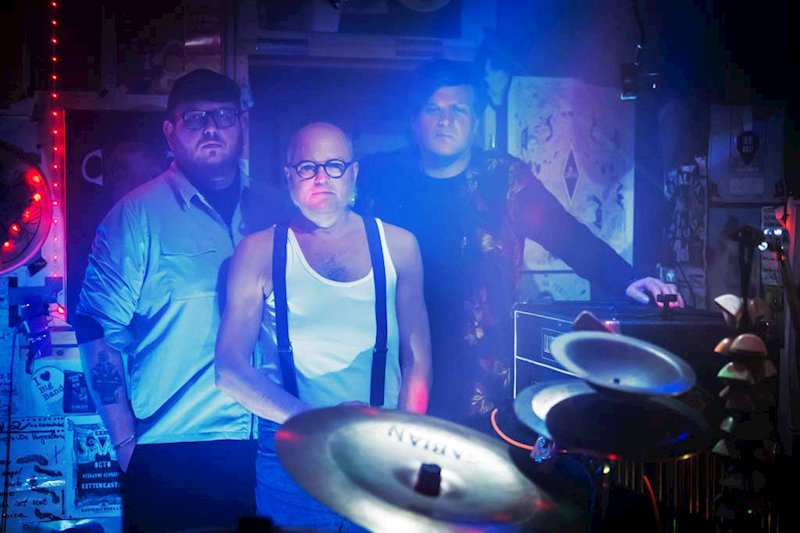
Members: Felix Arnoldt (bass, synths), Tobias Göbel (bass, artwork), Guido Karnstedt (drums)
Interviewee: Tobias Göbel
Nationality: German
Current release: OCTO's new album Idyll is out via Mörtel Sounds.
Recommendation for Cologne, Germany: Heuschreckenbrücke!
Things I am passionate about but rarely get to talk about: I love animals, I‘m a big dog fan, and I‘m interested in cynology. Where and why did a dog breed or a specific type of dog originate? That says a lot about people, culture, and history.
If you enjoyed this OCTO interview and would like to know more about the band and their music, visit them on Instagram, and Facebook.
When it comes to experiencing the sensation of “energy” as as a listener, which albums, performances, and artists come to mind?
Neurosis sometime in the early to mid-’90s at a festival in Holland—at night in a tent, everyone banging on oil drums, and the gates of hell open. Swans about 10 years ago—2.5 hours of very loud psychotherapy. Guido, our drummer, said after the concert, “What the hell was that? I don’t even know if I liked it or not—I just feel completely drained.”
That kind of energy is incredibly hard to capture on an album. We always try to capture some of that energy by recording our albums live.
There can be many different kinds of energy in art – soft, harsh, healing, aggressive, uplifting and many more. Which do you tend to feel drawn to most?
Cathartic, healing energy and the creative power itself.
It is a wonderful human privilege to be able to express oneself through art.
I have had a hard time explaining that listening to death metal calms me down. When you listen to a song with a particular energy, does it tend to fill you with the same energy – or are there “paradoxical” effects?
Death metal is, first and foremost, a coded form of energy—a language of its own that can make it difficult to get into at first. If someone has never heard distorted guitars before, Entombed, Slayer, and Deftones might even sound similar to them.
You have to be able to interpret that energy. Two bass guitars and drums are also coded at first. If a listener has a hard time connecting with it at first, it might have less to do with the fact that we don’t make sophisticated music, and more to do with the brain seeking out familiar sounds, vocals to guide the way, or something similar.
If you manage to open yourself up to this art form, the energy will change and, in the best-case scenario, it will inspire you.
In as far as it plays a role for the music you like listening to or making, what role do words and the voice of a vocalist play for the transmission of energy?
We mainly play instrumental music, and that’s partly because vocals are very important to us. We’ve always found it difficult to find a singer who can convey the essence of our music without the musicians becoming mere extras in their own performance.
A singer would have been great, but if you can’t find someone who speaks the language of two basses and a drum set, their vocabulary is limited too, and we just don’t click.
Still recording albums, even without vocals, is just our kind of punk.
When it comes to experiencing the sensation of “energy” as as a creator, how would you describe the physical sensation of experiencing this energy? [Where do you feel it, do you have a visual sensation/representation, is there a sense of release or a build-up of tension etc …]
When composing, a good gut feeling, a sense of happiness.
Live, when the band works like an unstoppable machine, one gear meshing into the next, and catharsis races up my spine.
When it comes to composing / songwriting, are you finding that spontaneity and just a few takes tend to capture energy best? Or does honing a piece bring you closer to that goal?
Definitely the second one. As a German band, we’re not so much Krautrock jammers, but more like der Musikant mit dem Taschenrechner in der Hand, like Kraftwerk :)
Our music is completely composed, and it gets its greatest energy when we switch off our minds during live performances and just let the program run its course.
How much of the energy of your own music, would you say, is already part of the composition, how much of it is the result of the recording process?
Studio techniques usually drain the energy from our music.
The Surveillance by Trans Am is a good example of what we envision as an honest and energetic recording.
For your current release, Idyll, what kind of energy were you looking for?
We always strive for maximum energy. It‘s more about finding the right balance between composition and live energy.
How do you capture the energy you want in the studio?
Playing live as a band, creating a sense of movement, not using click tracks. Focusing as much as possible on the tempo of the count-ins. Placing more emphasis on good room miking than on layering in the mix, and so on.
These days we’re a bit more open-minded—we’ll do an overdub now and then—but generally speaking, we aim for a good room recording in the spirit of Steve Albini.
What role do factors like volume, effects like distortion, amplification, and production in general for in terms of creating the energy you want?
Volume is always a factor in our music. Drums in an energetic section are played at maximum volume. We want to capture that energy, and too much processing just smooths it out way too much.
Amplifiers also sound better when they’re at a certain volume, but that’s not the deciding factor at all. Here, too, it’s the drums—if you’re playing next to a loud drum kit, whether live or in the studio, you still have to be able to hear yourself, no matter how loudly the cymbals are clanging.
And sure, amps and pedals are important; they’re part of the instrument, and especially with two bass guitars in the band, you have to balance them out.
In terms of energy, what changes when you're performing live on stage, with an audience present, compared to the recording studio?
At a live show, there‘s a sound engineer who tells you that everything is way too loud, without ever having heard your music.
When you‘re recording, you have a sound engineer who knows your music and tells you that everything is way too loud.
How does the presence of the audience and your interaction with it change the energy of the music and how would you describe the creative interaction with listeners during a gig?
We make niche music, and what we do is clearly defined—it has a beginning and an end, just like a play or a movie.
Of course, we’re happy when the audience enjoys it and we can tell that we’re taking them on a journey. But the exchange of energy in the sense of interaction doesn’t play a direct role.
What kind of feedback have you received from listeners or concert audiences in terms of the experience that your music and/or performances have had on them?
That our music is like a soundtrack to a movie played out in the listeners’ minds. That they can let themselves be carried away by the music.
And people who spend too much time on their phones, can’t control their dopamine levels, and have an attention span like an amoeba say, “You need vocals :)
Would you say that you prefer to stay in control to be able to shape the energy or do you surrender to it and allow the music to take over? Who, ultimately has control during a live performance?
You can do both at the same time, and I prefer that combination.
A well-rehearsed band that just gets going like a well-oiled machine—no matter how tricky or complicated it gets, just keep your head down and let it flow from the gut.
The energy that music is able to generate can be extremely powerful. How, do you think, can artists make use of this energy to bring about change in the world?
It’s an offer that musicians can make. Whether people choose to go along with it isn’t our responsibility. But for us, a band is also a utopia brought to life.
One rule, for example, is: We don’t work with assholes. We try to keep everything on a reasonable and mutually respectful level. The people who like us and are involved with our band in any way are, through that, living out the idea of a better world together with us.
Of course, we can’t judge every concertgoer, but if [German politician] Jens Spahn were a club owner, we certainly wouldn’t play at his place.