Published
Name: Markus Rom aka Oh No Noh
Nationality: German
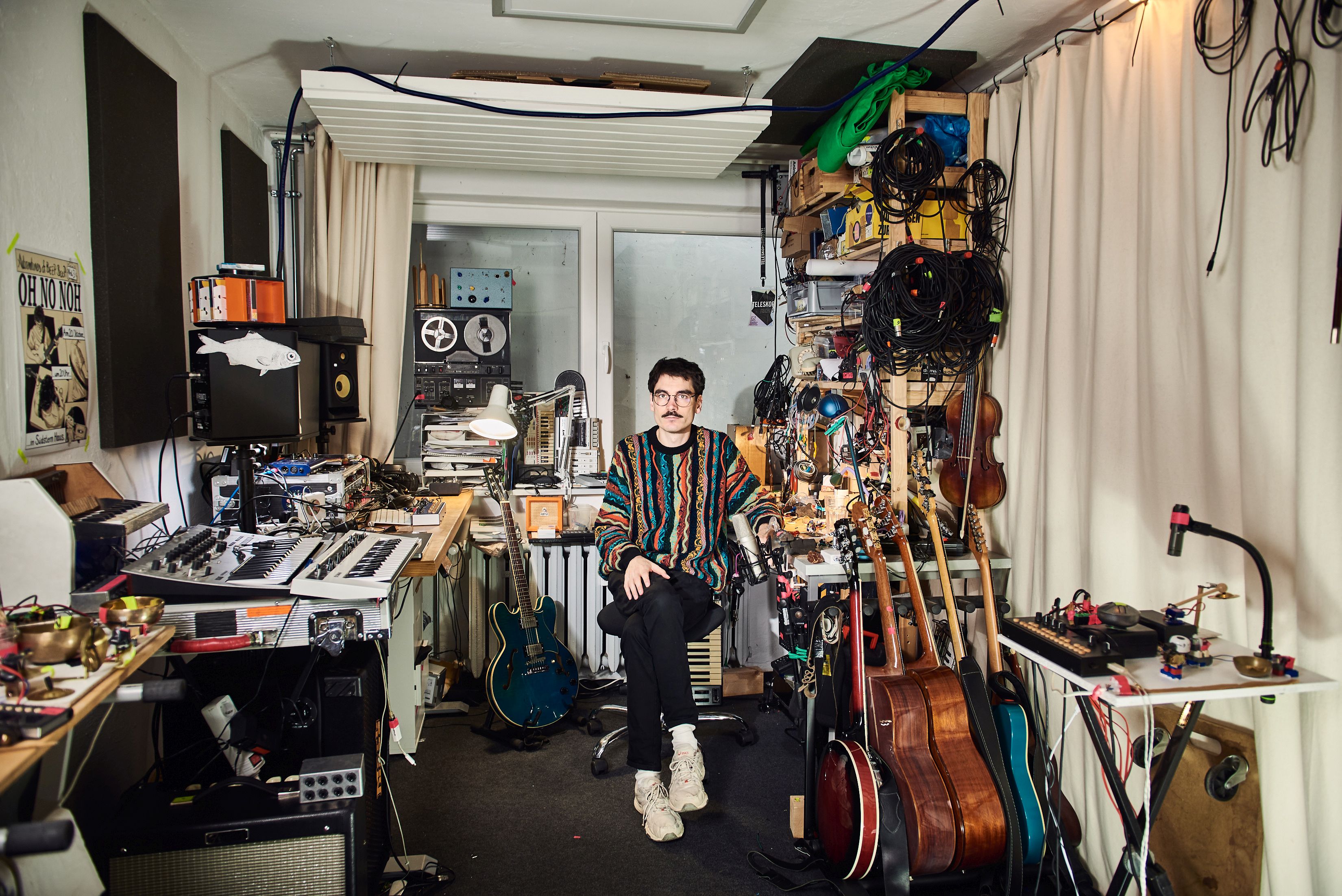
Occupation: Guitarist, robot programmer, magnetic tape shredderer, composer, producer
Current Release: Oh No Noh's As Late As Possible is out now.
Recommendations on the topic of sound: Fanny Chiarello wrote a book called Basta Now, listing female, trans- and nonbinary artists in different fields of experimental music. It is such an inspiring book, I discovered many amazing artists while reading it.
If you enjoyed these thoughts by Markus Rom aka Oh No Noh and would like to stay up to date with his work, visit his official website. He is also on Instagram, and Facebook.
For a deeper dive, read our earlier Oh No Noh interview and our Markus Rom interview about improvisation.
When I listen to music, I see shapes, objects and colours. What happens in your body when you're listening? Do you listen with your eyes open or closed?
I listen to music on a lot of different occasions; sometimes more, sometimes less concentrated, but mostly with eyes open.
When I hear something that really touches me I get goosebumps.
Tell me about some of the albums or artists that you love specifically for their sound, please.
Jenny Berger Myhre - Here is always somewhere else
Such a cool combination of voice messages, field recordings and beautiful compositions. I love listening to this album and be surprised again and again in a very positive way.
Schntzl – catwalk
The recording sounds very fresh and in the moment, and at the same time the compositions are simply very clever.
Jan Roth – LOW
This album has such great layers and details, and for my taste the perfect ratio of playful and produced.
EYE - Honolulu Saigon
I love how linear and dense this album sounds. It’s a collage of unreleased material, and yet it seems so conceptual to me.
Do you experience strong emotional responses towards certain sounds? If so, what kind of sounds are these and do you have an explanation about the reasons for these responses?
I remember discovering Hi How Are You by Daniel Johnston as a teenager.
Growing up in a household where music exclusively existed in top 40 radio programs, it felt so fresh to listen to something raw like that. The recording sounded so alive.
I think whenever there are “underproduced“ aspects in music, like unintended backgroundnoise of poorly recorded instruments or fieldrecordings, most of the time it opens a room for me. It makes the music real and special.
There can be sounds which feel highly irritating to us and then there are others we could gladly listen to for hours. Do you have examples for either one or both of these?
I think most of the time you kind of can tell when music has a lot of intent to impress, to sell or to fit in.
Or to put it differently: If people are putting a lot of heart into their music, I can usually listen to it for hours.
I’m not sure if I answered this question correctly, haha.
Have you ever been in spaces with extreme sonic characteristics, such as anechoic chambers or caves? What was the experience like?
I once played in a Planetarium.
It was extremely irritating to play in a completely round room and to loose all sense of width and deepness.
What are among your favourite spaces to record and play your music?
That would probably be my studio space, although it is very very small and unfortunately without daylight.
It’s a room that I spend a lot of time in and where I feel very safe for all sorts of musical experiments.
Do music and sound feel “material” to you? Does working with sound feel like you're sculpting or shaping something?
Because my live-setup is very material and my tracks are more based on “real“ instruments than virtual ones, I guess the answer is yes.
For me, a way of shaping new material is often playing something through a cassette tape or an effects pedal and somehow tweaking it. As with many other people, it works better if it’s not a plugin but something haptic.
Sound, song, and rhythm are all around us, from animal noises to the waves of the ocean. What, if any, are some of the most moving experiences you've had with these non-human-made sounds?
Not so much of a personal experience but definitely a little mind-blowing-moment was reading music, the brain and ecstasy, with a chapter about this topic.
Comparing human ears to auditory organs of other species really puts surroundings and imagination in perspecive.
Tinnitus and developing hyperacusis are very real risks for anyone working with sound. Do you take precautions in this regard and if you're suffering from these or similar issues – how do you cope with them?
Last year I had a temporary tinnitus caused by stress. It really sucked, but luckily it went away and now it only comes back shortly in stressful times.
It really had me appreciate my hearing ability. It also made me evaluate some stressful aspects in my life which I try to handle better now.
We can surround us with sound every second of the day. The great pianist Glenn Gould even considered this the ultimate delight. How do you see that yourself and what importance does silence hold?
I think silence is extremely important to open the ears for new input.
My tolerance for constant sound depends on how much information it contains and in what frequency or pace it is presented, but also on how concentrated or distracted I am in general.
Seth S. Horowitz called hearing the “universal sense” and emphasised that it was more precise and faster than any of our other senses, including vision. How would our world be different if we paid less attention to looks and listened more instead?
My first reaction to this quote was to disagree, because I think a sounding environment holds so much detail that can be perceived so very differently by different persons. But that holds also a lot of potential.
So yes: it’s a nice utopia and probably would lead to less bias in communication.