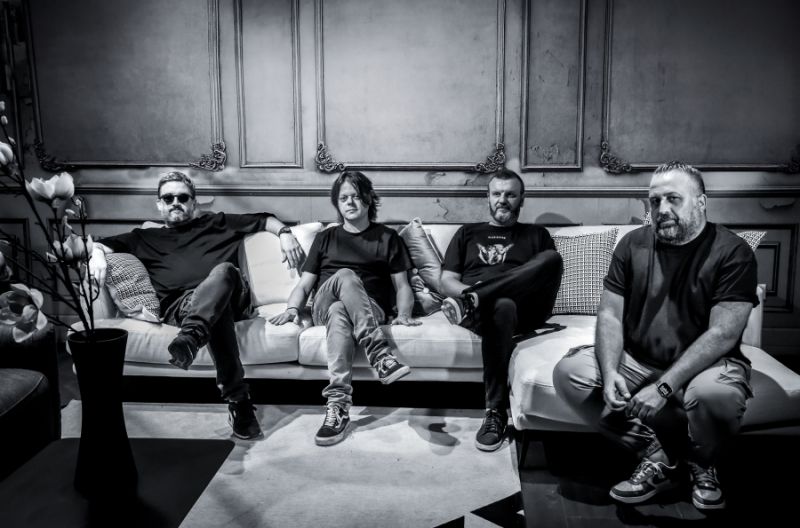
Published
Name: Marco Campitelli aka Oslo Tapes
Nationality: Italian
Occupation: Producer, composer
Current Release: Oslo Tapes's Låst Comet is out November 14th 2025 via Worst Bassist. It features Emil Nikolaisen, Håkon Gebhardt and Emilie Lium Vordal.
Shoutouts: Label like Worst Bassist Records or Crazysane are the best for a new form of krautrock!
Kraut-related Recommendations: I'm thinking about the latest album by my producer Amaury Cambuzat with the band Ulan Bator. Their album will be out soon and it's fantastic.
If you enjoyed this Oslo Tapes interview and would like to know more about the project's music, visit their official homepage. They are also on Instagram, Facebook, and bandcamp.
How would you describe your personal relationship with Krautrock? When and how did it start?
I started listening to krautrock after my adolescence. I was more interested in a different way of making music, so I was listening to post-rock, prog, and electronic bands. By going back in time, I discovered this 'new world.'
An important moment for me was the artistic meeting with my producer, Amaury Cambuzat, a member of FaUSt and Ulan Bator.
Tell me about one or two of your favourite Krautrock records please.
The first Neu! album and Faust IV by faUSt.
Many of the original Kraut musicians loved blues, rock, and psychedelia; they were intrigued by electronics and improvisation; they rebelled against virtuosity, classical education and the superficiality of Schlager on German radio. How much of that do you recognise in your own creative preferences and interests?
Maybe virtuosy isn't the focus of this genre, but mentally you need the autocontrol of a virtuoso. I found rigour in the way of playing this music with a good dose of crazyness.
In Oslo Tapes I melt these elements together.
Both in the music and the way it was made, Krautrock was about imagining different worlds. What is the experience of listening to this music like for you and what kinds of worlds is it taking you to? What is your preferred way of listening to it?
Oh yes, exactly! Every form of kraut-music transports you to a different world. It's incredible! This music can do that, and many people feel this sensation.
For me, the best way is to be in solitude at home or with a close friend.
A lot of the Kraut spirit came to life through musicians living in communities, playing and recording together every single day. Have you ever tried working and creating in such a constellation? Is it possible to emulate this process from a home studio?
I'm lucky enough to have more than one home studio with spaces that allow for recording improvisations and working alone.
When we're composing new music, we spend a lot of time together, both day and night. We can't live like a community because it's not the '70s and the world has changed.
However, Emilie (the other voice of Oslo Tapes) lived with me and my family for five months last year, and we recorded some of the album at night.
What, to you, are the main elements that make something “Kraut?” What are the practises of the musicians from the 70s that inspire your own practise today?
I believe it's the freedom and the ability to not seek perfection in every single track, but instead to pursue the dreamlike.
Current productions are clean, tidy, and formulaic, almost to the level of pop, whereas musicians in the '70s would leave in imperfections that ended up characterizing their sound.
Personally, I apply a hands-on process to my music, trying to achieve a sound through the manipulations of a craftsman, not a big producer. I like to get a unique sound using analog or handmade methods that make the whole thing one-of-a-kind and specific to that moment.
Tell me about one or two of your own early Kraut pieces that you're still proud of (or satisfied with) – and why you're content with them.
On the latest album, there are two specific tracks.
One is "Transpace," a track with characteristics of the genre, but they've been fused with '80s sounds and synths, making it a fun and unique piece.
Then there's "Pyramid Shape," where I managed to blend synths from the Tangerine Dream school with tribal rhythms, and this fusion is very intriguing. You'll hear it!
What instruments or equipment are you using to create your music? Are there any vintage instruments that you find essential to get your sound right?
I mainly use a mix of modern instruments and some vintage ones. But as I was saying, Stefano Micolucci and I took a craftsman-like approach to the individual sounds, re-amplifying them through special pedals. The result is a careful process of what we call "sonic washing" on the instruments.
We also worked on the drums to get a particular sound from the very beginning, something reminiscent of the late '70s
Could you describe your creative process on the basis of your most recent Kraut-leaning release?
The creative process is different from track to track. It starts with a sound or a sequence of notes, an archaic and tribal rhythm that then transforms into something more modern.
In some cases, even dreams have helped in creating compositions.
I got into Kraut via Tangerine Dream and early Ash Ra and to me, the motoric beat was never quite as important. Today, it seems as though it's the defining element. Are you interested in it? Are you making use if it? What makes it special to you?
It's an oversimplification to associate Krautrock with just one rhythm. For me, it's a psychedelic experience, a journey into the cosmos; it's trance music. You don't necessarily have to use conventional instruments.
Personally, I've never used a classic motorik beat, but I love to blend a BPM that comes from the motorik with more Mediterranean and Scandinavian rhythms.