Published
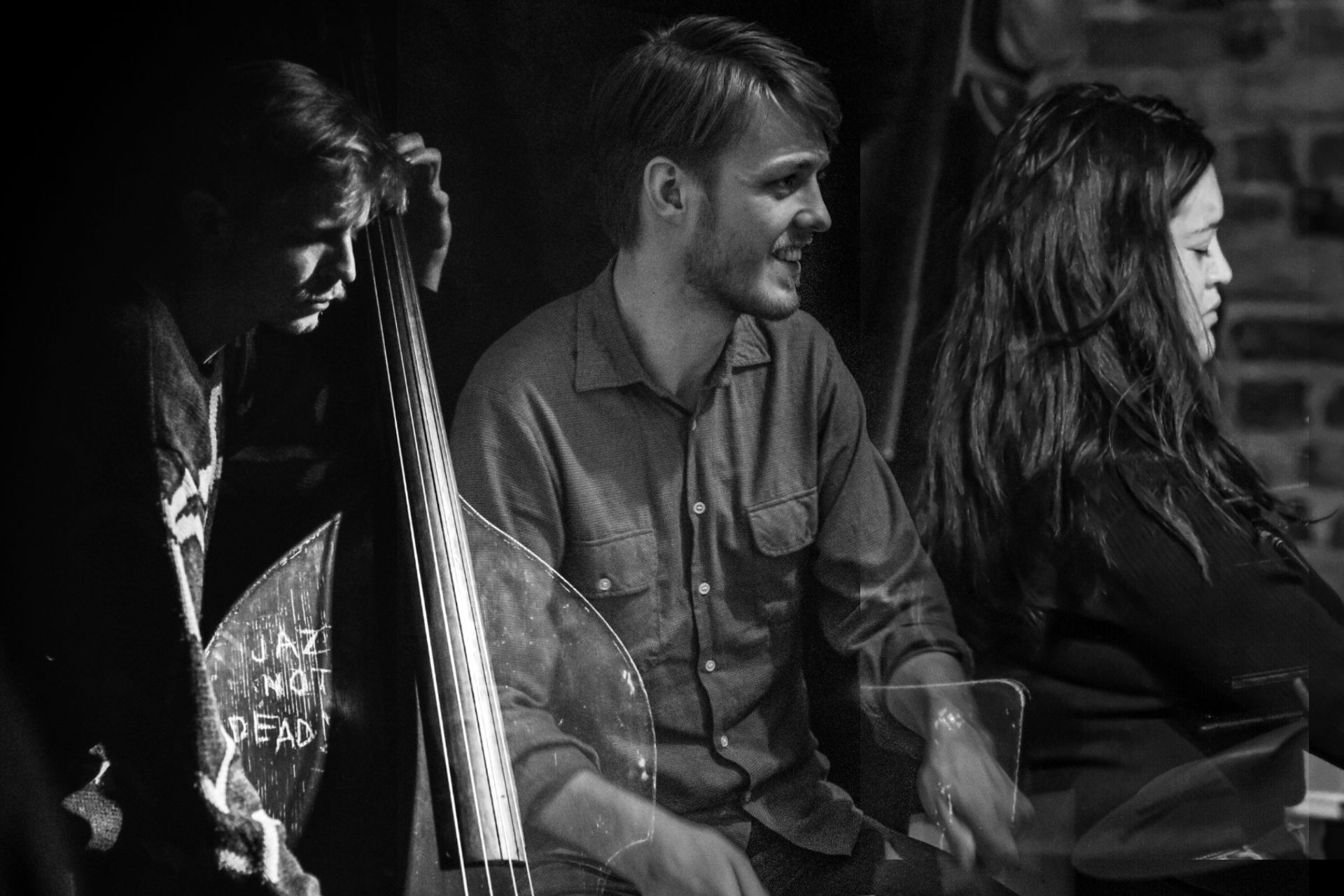
Names: Ivar Myrset Asheim, Margaux Oswald, Aurelijus Užameckis
Nationalities: Lithuanian (Aurelijus Užameckis), Norwegian (Ivar Myrset Asheim), Swiss (Margaux Oswald); the band is Copenhagen-based
Occupations: Pianist, composer, improviser (Margaux Oswald), double bassist, composer, improviser (Aurelijus Užameckis), drummer, composer, improviser (Ivar Myrset Asheim)
Current release: The new album by Oswald | Užameckis | Asheim, The Third Place, is out via Nakama.
Hometown Recommendations:
A.U. If you are visiting Kaunas, I recommend taking a long hike around the city. It's a pretty town. Eventually visit Lithuanian Business Alley which celebrates capitalism (for the anthropological thrill).
IMA: When in Copenhagen, check out the program in Koncertkirken - that’s where our album was recorded live at a concert. Koncertkirken is a very important venue for improvised, contemporary and experimental music in Copenhagen. Great place!
Topics we are passionate about but rarely get to talk about:
A.U. Herbal teas, Balkan turbofolk music, liberation from imperialism.
M.O : Marine life/ scuba diving, bluegrass, why Glenn Gould doesn't like Mozart, Hein Westgaard.
I.M.A: Cute birds, food, housing politics in Copenhagen
If you enjoyed this Oswald | Užameckis | Asheim interview and would like to stay up to date with their music, visit individual members' homepages or social media profiles: Margaux Oswald; Ivar Myrset Asheim; Aurelijus Užameckis.
When did you first consciously start getting interested in musical improvisation? What was your first improvisation on stage or in the studio and what was the experience like?
AU: I was still in school, the last years of it. I had a friend - a clarinet player with whom we would ditch the classes almost every day and go practice until the school closed.
Sometimes we would visit each other’s practice rooms, drink some light booze and have jams together. From time to time we would improvise in “contemporary” music style, in a way having a laugh at it, and I remember it being extremely funny to us.
Though now that I think about it, improvising also felt extremely liberating and joyful, compared to playing classical scores. Maybe that’s why I got drawn to it later.
Tell me about your instrument and/or tools, please. What made you seek it out, what makes it “your” instrument, and what are some of the most important aspects of playing it?
MO: I play the piano. In my case, one of the specificities of it is that it is never “my “ instrument. I don’t own a piano and therefore I enjoy some instrumental nomadism.
My task is to negotiate with the new medium every time around, and have a quick understanding of the instrument’s possibilities to calibrate what can be done with it.
How would you describe your own relationship with your instrument – is it an extension of your self/body, a partner and companion, a creative catalyst, a challenge to be overcome, something else entirely?
IMA: Like any relationship, it’s not a constant. It changes. From day to day, concert to concert, year to year.
Sometimes I feel totally free behind the drums. Like I can do whatever I want and it just happens. A flow. And sometimes it feels like I need to negotiate with the instrument and spend a lot of energy understanding how to play it.
When you're improvising, does it actually feel like you're inventing something on the spot – or are you inventively re-arranging patterns from preparations, practise or previous performances? What balance is there between forgetting and remembering in your work?
AU: Presence is the most important factor in improvisation for me. I think I play completely differently in terms of style or technique, when I play with one group of musicians or another.
It is in a way levitating between personal, collective consciousness and the unconscious. Our bodies know what to do, we have been doing things for a while and develop body memory, let’s say patterns, preparations, techniques. And then it all gets interesting when you play with other people, you can just rely on your knowledge, intuition etc.
You have to be in other people's heads as much as you’re in your own.
Artists from all corners of the musical spectrum, not just “free jazz” have emphasised the importance of freedom in their creativity. What defines freedom for your improvisations?
IMA: Freedom for me is connected to trust. As long as I trust myself and my band mates’ musical abilities I can be free.
Like playing with Margaux and Aurelijus - I know that whatever I do musically, they're going to relate to it and create something from it, and vice versa. And we will carry the music on together.
Knowing this makes me feel free to go to musical places I’ve never explored before.
Taking your recent projects, releases, and performances as examples, what, would you say, are the key ideas behind your approach to improvisation?
MO: Individually: imagination and a cultivated inner world. Collectively: a common pursuit with deep and asserted musicians.
In your best improvisations, do you feel a strong sense of personal presence or do you (or your ego) “disappear”?
AU: I think there has to be an uncalculated balance that comes from sensing the whole performance space - yourself, the place, the audience, your peers.
Presence is truly the key. If you’re present, you don’t have to depersonalize to be able to listen to others, I think.
What are some of your favourite collaborators and how do they enrich your improvisations?
IMA: Aurelijus and Margaux are definitely some of my favourite musicians to improvise with. They take the music very seriously and they’re both very dynamic, which makes the music flexible in a way that suits me well.
They're also very rhythmical in their approach. We can go in and out of rhythmical patterns and connect to each other's timing very seamlessly.
In a live situation, decisions between creatives often work without words. From your experience and current projects, what does this process feel like and how does it work?
AU: In improvisational music, decisions can be quite funny.
The music that is happening in the moment could seem like rubbish to one musician and dazzling to another and they will have different imaginations of what should happen next. And then there are listeners, who perceive it all in their own way - performers would ideally sense the audience as well. So we’re mostly dancing with the unknown.
Intuition, trust and some knowledge can guide us in those moments, but can also be completely misleading at times. Improvisation is a constant juggling between different forces.
Stewart Copeland said: “Listening is where the cool stuff comes from. And that listening thing, magically, turns all of your chops into gold.” What do you listen for?
IMA: When improvising I think it would be an obstacle to be too specific about what to listen for. I try to keep my ears as open and wide as possible and not put too many thoughts and concepts into the listening part.
My attention is mainly towards the other musicians and how the room sounds. Listening to how the music and the instruments sound in the space and letting that inform the music is very important, I think.
As a listener, do you also have a preference for improvised music? If so, what is it about this music that you appreciate as part of the audience?
IMA: I wouldn’t necessarily say I have a musical preference in improvised music when I’m in the audience.
I enjoy it when there’s a deep presence and interesting energy between the musicians. When I can feel that they're ‘working’ on stage and that there’s something at stake.
When they lose that flow or focus, the music becomes uninteresting quite fast.
In a way, we improvise all the time. In which way is your creative work feeding back and possibly supporting other areas of your life?
AU: Creative work has definitely expanded my circle of people abroad and overseas. For me, this connection is the most meaningful part of the work in this polarized world.
Creative work often comes rooted in a set of values that often differ from those of a conventional society—one built on 9-to-5 jobs and material fulfilment. This path also comes with risks and potential financial instability.
It's a challenging choice that some artists have to make, often not by choice, trading comfort for something more essential.