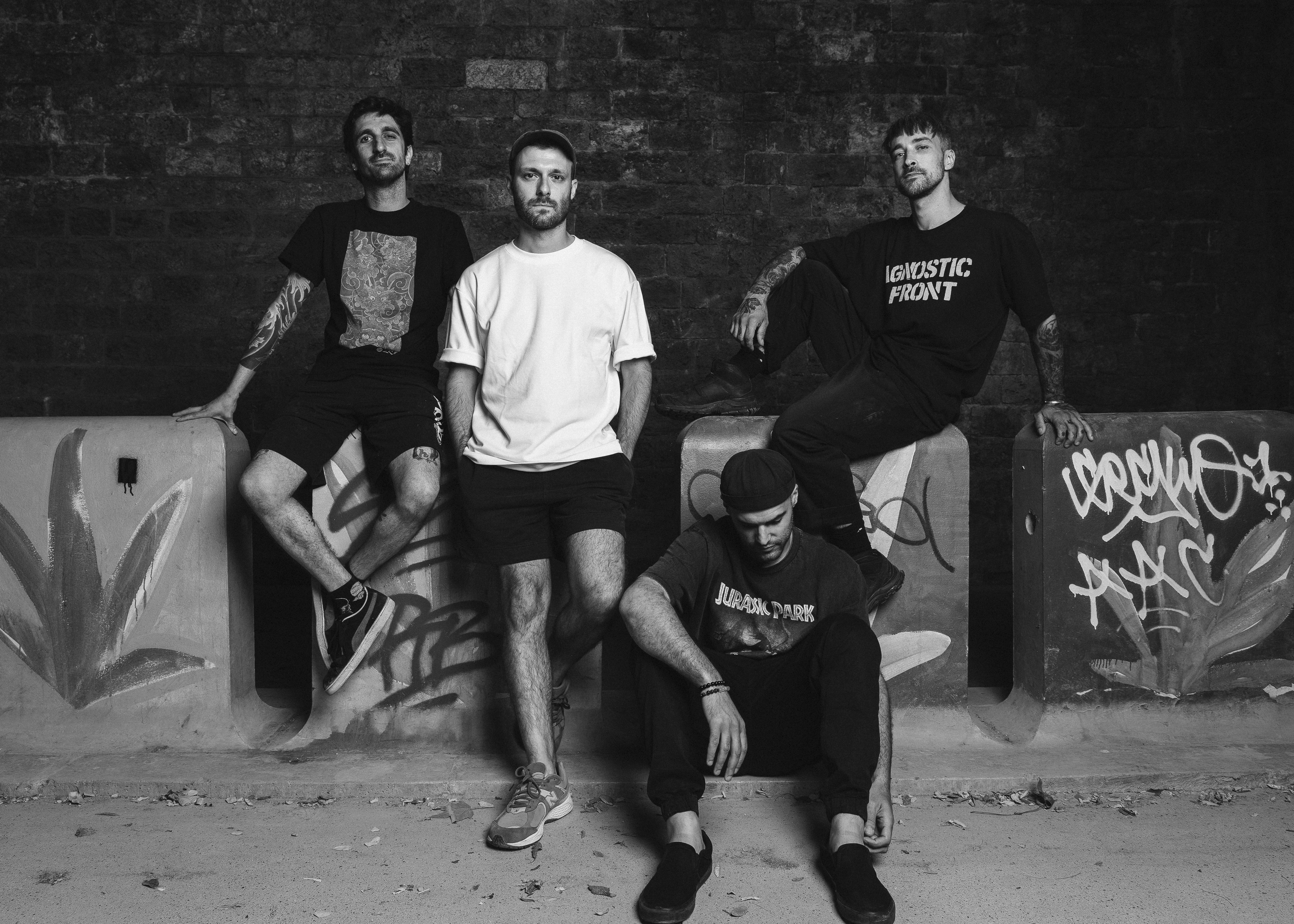
Published
Part 1
Name: Parlor
Nationality: French
Members: Arthur (voice), Yann (guitar), Guillaume (drums), Boris (bass)
Current Release: Parlor's new album Tears For Everything is out via Source Atone.
Recommendations for Paris, France:
Yann: You should definitely visit Vintage Vinyl Studio, a fantastic record store run by real music lovers. It’s a place full of life and passion. And afterward, just take a walk along the Seine, grab a good crêpe, and enjoy the calm — it’s simple, but perfect.
Topic I am passionate about but rarely get to talk about:
Yann: I don’t often talk about it, but video games are a huge passion of mine. They’re an incredibly important medium — both inspiring and social, but also just pure fun. Each game is a new world to discover, a new emotion to experience. Some titles that really blew my mind are Slay the Spire, Hades II, and of course Inside, which I can’t recommend enough.
If you enjoyed this Parlor interview and would like to stay up to date with the band and their music, visit them on Instagram, Facebook, and bandcamp.
When was the first time you noticed you were drawn to darker themes and moods in music, literature or the movies?
Boris: As long as I can remember, I’ve always been driven to the bizarre end of things. I like when something feels off in any piece of art I encounter, any people I meet, any situation I might find myself into.
As a kid, “dark” movies like Brian De Palma’s Phantom of the Paradise, Kubrick’s Shining or Ching Siu-Tung’s A Chinese Ghost Story all had a profound effect on me. Not so much because the stories had to do with evil forces but more because they suggested new layers of complexity hidden in the bland, unhinging world I was growing up in at the time. I also remember sneaking in the living-room when my dad was watching David Lynch’s Twin Peaks series in the beginning of the 90s, and being absolutely frightened by Bob.
But I wouldn’t describe myself as a darkness-oriented person, I’d rather seek the light at the end of the tunnel and embrace the absurdity of it all than wallow in self-pity.
Arthur: I’m pretty sure the first time I became interested in a darker theme was when I saw Tim Burton’s The Nightmare Before Christmas in theaters. I was just 5 years old when it came out, and I begged my father to take me to see it 5 or 6 times. I was kind of obsessed with the film and this strange and unique world Burton created, filled with humor and quirky characters, not to mention the fantastic soundtrack.
Yann: I think I was drawn to darkness quite early on. As a kid, I was fascinated by movies like Terminator, Alien or The Matrix. I’ve always had a deep curiosity for everything related to space, the unknown, black holes, and cataclysms — things that are both terrifying and mesmerizing. The darkness of the human soul, madness, the fragility of our minds … all of that has always captivated me.
These are territories that force us to question our relationship with reality, with fear, and with what we’re willing — or not willing — to face.
“Darkness” is, of course, not strictly speaking a term related to sound. What constitutes darkness to you, especially in instrumental terms?
Boris: Speaking in musical terms, darkness undoubtedly has to do with slower tempos (ie: the almost funeral-doom break in the middle section of «Solace», slowing at 42 bpm, could certainly be considered a dark part for that matter) …
Some bands I love that use slower tempos could definitely be considered dark, like Neurosis, Cult of Luna, Walk Through Fire or Bongripper … Others, not so much, like Low, Codeine or Mogwai - which I find more melancholic and moving, or even Sleep, Sunn 0))) and Earth, who are much more trance-inducing than strictly «dark»!
[Read our Earth's Dylan Carlson interview]
Also, the use of certain intervals, like minor second, minor sixth or the infamous diminished fifth (“Diabolus in Musica”) combined with different minor scales certainly produce feelings that are more associated with darkness, in our European-centered perception at least, and we do tend to use it a lot in Parlor.
But most importantly, I feel tone, the harshness or softness of the sources, plays the main role in what one can consider dark or luminous.
For example, I feel a song like “Things Behind the Sun” by Nick Drake, one of the most beautiful pieces of music ever written, all in minor key, has got a very luminous aura, …
... whereas Merzbow’s “Venereology” for example, a pure harsh-noise wall, would represent pure darkness - despite having no tempo or pitch whatsoever.
[Read our Merzbow interview]
[Read our Merzbow interview about improvisation]
The way you judge something to be dark, or chaotic, or worthy of listening, relies deeply on your personal history and acquired tastes, that’s all very subjective.
Yann: For me, darkness in music comes from heaviness and dissonance. Those two elements are key in the way I write guitar riffs — they create a sense of tension that you can almost feel physically. A solid, grounded rhythm helps anchor that feeling too.
Sometimes we like to take risks: using asymmetrical time signatures or slightly twisted structures to evoke chaos or instability. On the last album we kept that more under control, but there are still moments where that madness comes through — where dissonance and density take center stage (ie: the “Cement Diktat” music video).
How would you describe the physical sensation and possible attraction of being exposed to darkness in music?
Arthur: I guess everyone has a unique experience with this.
As for me, listening to a dark musical work stimulates my imagination and allows me to project images without plunging into a depressive or morbid state. On the contrary, it gives me a sense of being more alive and enables me to take a step back from reality. Dark music, and even more so extreme music genre, creates a space where I can live out an epic imaginary scenario just for the duration of a song.
That said, the nature of this projection also depends on the work being listened to: the experience of hearing a song by French artist Barbara is probably not the same as that of listening to Celtic Frost, haha.
Yann: There’s definitely a cathartic aspect to listening to dark and heavy music. It allows me to release something, to turn tension into raw energy. A band like Breach, for example, perfectly embodies that kind of controlled madness — in their melodies, their riffs, their overall sound.
When I listen to them, it’s almost a physical experience, a kind of emotional discharge. It’s not about sadness; it’s about liberation. Finding power through chaos.
Does your interest in darker musical themes extend into extra-musical fields such as fashion, or politics?
Boris: Surely. I feel both fields are connected. Everything is political. And evolving in a local alternative scene for some years now, making connections with fellow musicians, venue owners, labels, technicians, audience - people for whom your music matters, this radiates into a certain DIY ethic we share and use to do better, together.
As for fashion, we tend to keep things very simple, I usually play with the same old shirts I wear everyday at work! Nothing especially dark about it, I just love to collect vintage band shirts, but I can play in Primitive Man or Spice Girls with equal fun and pleasure.
Yann: Yes, but in a different way. Dark themes also live in cinema and video games, which both have a huge influence on how I approach music.
Dark soundtracks, oppressive atmospheres, dystopian worlds — all of that deeply inspires me. These mediums are emotional vectors; they can make you feel fear, melancholy or beauty in such a direct way. For me, they’re as important as the music I listen to.
What were some of the first performances or releases when you became active in exploring truly dark places in your music yourself?
Yann: I’ve always had a natural inclination for the darker side of music. It started with my very first band, SaaR, and our self-titled debut EP.
Even back then, there was already that duality I was drawn to. The first track, “Fight For Your Life,” was more straightforward and energetic, but then came “Dark Person” — and finally “Black & White,” which remains my favorite.
That song really captured the tension between light and darkness that I love exploring.
It was around 2010, and even in those early recordings, you could already feel that need to balance heaviness, melancholy, and contrast.
I have had a hard time explaining that listening to death metal calms me down. When you're performing a piece with a darker energy, does it tend to fill you with the same energy or feeling – or are there “paradoxical” effects?
Boris: I feel you!
I can assure you nothing can beat the feeling of playing songs on stage with your friends, with the guitar and bass cabs blasting beside you, the drummer crushing his cymbals and the singer yelling at a fanatic audience in a kind of organised maelstrom. This doesn’t happen every night, but when the magic happens, that’s pure collective joy.
We recently played a show in Paris for the release party of our new album, and people were losing it in the pit. There are photos of people smiling, dancing and holding each other. It’s funny how such harsh music can create such positive connections with people. This is why we do this. Trance and pure collective joy !
Yann: Playing this kind of music is a double-edged sword. It’s demanding — because even though it’s dark, it’s also incredibly energetic. It needs a real connection with the audience.
When people move, react, mosh, when there’s that feedback loop between us and them, it’s electric. But when the crowd is more static, it can be harder to give everything and transfer that emotion.
When everything clicks, though, it’s euphoric. There’s a sense of collective trance and pure joy that comes from that intensity — even if the music itself sounds dark on the surface.