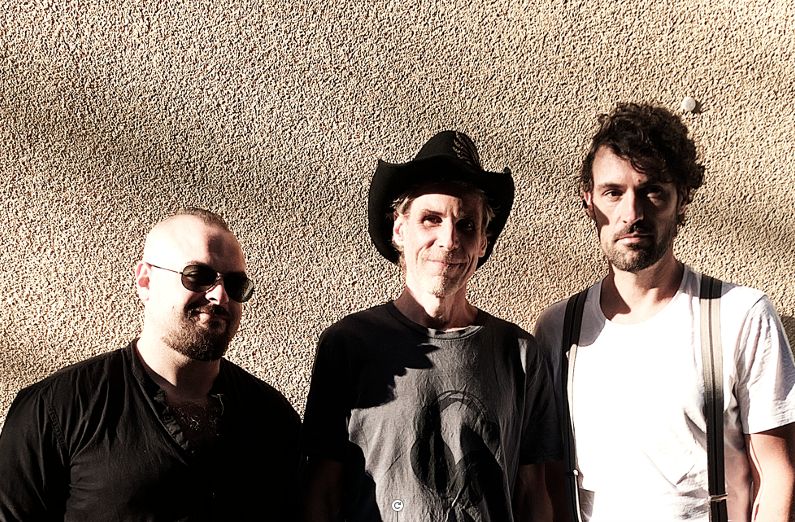
Published
Name: Pat Carter
Occupation: Singer, songwriter
Nationality: German
Current release: Rodeo FM's latest album is Right Wing Planet.
Recommendations: Here’s a few songs you should definitely check out: “Hard Times” by Gillian Welch, “Shelter from the Storm” by Bob Dylan (the 1976 live version). “To live is to fly” by Townes (and actually I prefer the Steve Earle version, it is less ethereal and thus more relatable).
As for literature, there is of course the “Capital” by Karl Marx and - for starters - David Harvey’s complementary material. Elementary reading.
If you enjoyed this Pat Carter interview and would like to stay up to date with his music, current live dates, and Rodeo FM, visit the band's official homepage. They are also on Instagram, Facebook, and tiktok.
Do you think that some of your earliest musical experiences planted a seed for your interest in writing lyrics or poetry?
My earliest musical experiences certainly triggered my interest in music, in expressing the emotions and inner landscapes that I knew were there but were not reflected in my environment.
When I was like 7 or 8 years old, I discovered the Beatles. It was like someone switched on the colour in a black and white world. I was pretty much awed by the beauty of these songs and by the feelings they could trigger and reflect. I couldn’t quite believe there are such things out there. Early stuff like “Help” or “I feel fine,” and a bit later “Strawberry Fields” and “Let it Be.”
I had the red and the blue album and later I discovered that my mother owned Let I Be and Abbey Road. Those albums were pretty much the soundtrack of my early childhood.
At the time I also got into Queen’s News of the world, Pink Floyd’s Dark side of the moon and later The Wall - especially the latter. Though I could not understand the lyrics, the Wall totally matched my vibe at the time. Post-war traumatised upbringing, no emotional stability, all framed by the context of German 70s and 80s village life. Music was my lifeline.
How and when did you start writing?
I didn’t really start writing lyrics until I was 17 or 18. I was more focused on learning how to play guitar.
When I started out writing, in the late 80s, early 90s in a pre-Nirvana, punk and hardcore band, I was careless about consistency, sometimes about conveying any meaning at all. I was listening to Black Flag, Hüsker Dü and especially Dinosaur Jr. at the time and again I couldn’t understand much of the lyrics (try catching J Mascis mumblings with no internet to look them up).
But I heard a certain vibe of desperation, you know music by and for young disorientated people (men?) in an overwhelming, hostile, depressing world. I heard the melancholy and the rage. And the joy of liberation. And I wanted to express all that myself.
Only later, when I started making sense of the world, when I started reading and got wise about exploitation and power mechanisms, about trauma and psychoanalysis, about discourses explaining the world, Marx, Gramsci and disciples, my lyrics got more consistent and sharper.
Discovering country music helped, it is a great genre to tell stories, to make a point with words. At their core, all my songs are still about melancholy and rage, to this day.
It is sometimes said that “music begins where words end.” What do you make of that?
Well, it seems that the way I grew up and discovered music seems to confirm that. Even without quite understanding the words I realised that there are other people making similar experiences – of joy and sorrow – and they are singing about this, writing about this.
I have always been more intrigued by the melodies than by the lyrics, though sometimes I come across certain lines and think, God, that is so good, I wish I had written that.
I came across “Go easy Kid” by Monica Martin only recently. That line “Go easy kid, its only “Rock n Roll” in the context of the rest of the song (which is probably about loss, at least that’s what I hear) struck me like lightning when I first heard it.
Sometimes lyrics can have an almost historic dimension. Dylan asking how does it feel? Has this ever been asked in public? Certainly not by the pre-war generation and not really by the boomers either. This was powerful stuff. A revolutionary question asked in times of progressive upheaval (before all this got integrated into capitalism).
Anyway, I guess the main thing and function of experiencing music for me, besides the reflection and manifestation of an inner emotional state, is the connection. With other people going through similar experiences. Maybe with the human condition as such.
That way, music has pulled me through bad times many times. Both listening and writing myself.
Entering new worlds and escapism through music and literature have always exerted a very strong pull on me. What do you think you are drawn to most when it comes to writing?
These days, when it comes to writing I basically use words as a tool to accuse. To expose. The wrongdoings of the world, small and large, personal and corporate, in relationships, on the job, in war. I look at the darkness. The wounds. After all, that’s what music gave to me, other people looking at the darkness and the ensuing sense of connection. So I am trying to contribute to this.
I try to be as accurate as possible, in my depiction and interpretation of this so-called reality. After all, most of my songs are cases in point of the larger picture, the unjust world and the struggle against it. No matter how you frame it, personal hurt, abuse, structural violence, exploitation, capitalism, you name it. So, I dont really deal in new worlds and escapism, at least not lyrically. The world we live in offers just enough material to discuss it.
Ultimately, I am rooted in a romantic notion of the world, in a mire of feelings and ultimately in hope and faith, at the same time I look at the world and on the surface I don’t see much good in it. So while I am really an eternal optimist, my songs are mostly about the darkness. Classic country stuff really.
Being able to express this inner disposition and the way I see it reflected in the world is what drives my writing.
What were some of the artists and albums which inspired you early on purely on the strength of their lyrics? What moves you in the lyrics of other artists?
As I said, early on, I didn’t really understand most lyrics. And I didn’t care too much about them. “Depression” or “Damaged” by Black Flag, “Divide and conquer“ by Hüsker Dü, “The Wagon” by Dinosaur Jr, I didn’t need to understand all of it to get the point.
I can't really remember when I really started listening and appreciating. As a kid and a young man I was never much into guys like Leonard Cohen nor Bob Dylan for that matter (I only discovered Dylan in my late 20 and that process is not nearly finished). I was always acutely sensitive trying to detect pretense and phoniness, something that appaled and bored me and initially drove me away from these “great” writers.
Authenticity was key. That’s why I liked punk or late 80s hardcore. That’s why I liked Mötorhead and Lemmy (one of the great philosophers of the 20th century): “Believe me, the hammer’s gonna smash your dream”. “Born to lose, live to win”. It was raw. It was not subtle or refined. But very true. And certainly not without sophistication, not without grace.
One of the first songs that actually amazed me in terms of craftsmanship was “A Boy named Sue” by Johnny Cash. The Folsom version. I was completely amazed how Johnny Cash could be so funny, yet so deep and serious and how he could deliver this epic story over 5 or 6 minutes without getting boring. That was a small epiphany.
It led me to work on consistency, you know story-telling. Which I am not such an expert at to this day.
“Middle-Age Crazy” by Jerry Lee Lewis crazy comes to mind, too. I heard that song in my mid-twenties and always knew I was gonna play this on my 40th birthday (which I did).
There were “uplifting” songs, too. “Dancing in the moonlight” by Thin Lizzy, a ballad of innocence. So it was possible to express joy within a melancholy setting, too, right. I found this interesting. I downloaded information from these songs and they shaped my manoeuvering space in writing and in life.
A definite gamechanger for me was Lou Reed’s New York album. The clarity and precision paired with Lou Reed’s cocky arrogance and self-assuredness, but also the heart and soul in there paired with the intelligence changed my writing forever.
“There is no time” was written in 1989, it is still, even more so, relevant today.
That album drove home that consistency and accurateness within the story told are super important. The song and the melody can soothe you but the lyrics need to cut like a knife. That’s how I write songs.
Well, at least I am still on it.
I have always considered many forms of music to be a form of poetry as well. Where do you personally see similarities? What can music express which may be out of reach for poetry?
Music touches the soul. My experience has always been, and this sort of gets reconfirmed again and again: “Good musicians make me smile, even laugh. Good songs make me cry”.
That touching of the soul I have hardly ever had just reading a poem or a text. It is the melody that touches, the lyrics are really just a sideshow.
However, when those two come together and complement each other, this makes a hell of a difference. Sometimes this gets me stuck on one song for weeks.
The relationship between words and music has always intrigued me. How do you see it?
I guess every songwriter wants to write that memorable hook that will resonate with others. And that of course includes a catchy line or two.
Personally, I use way too many words way too often, because usually I have a lot to say, considering that the topics of my songs deserve elaborating so their complexity can be done justice. So, I got quite some criticism for that and I am trying to get better.
“Right Wing Planet” was a shot at exactly that. So was “Open Wide.”
The new material I am working on which will be released next year is pretty wordy again, though I am trying to think lyrics and melody together when it comes to the hooks and choruses. Again, I am making more of an effort with every new piece I write.
What kind of musical settings and situations do you think are ideal for your lyrics?
I find good lyrics are conceived while walking, while having mental downtime, that is when they come spontaneously, sometimes in seconds. However, I also discovered that in order to come up with great results, you need discipline.
So, for some years now, and especially while writing Right Wing Planet (the album) and also the new album out next year, I actually sat down every day, late at night, and wrote for an hour or so. Sometimes with a song in mind, sometimes just lines I might use later. After a while, this process gets much better and faster and I got better at mixing spontaneous ideas coming “from beyond” with the grind of pulling together a coherent song. For this I use Rhymezone a lot.
I would say that half of the time now, I have a plan when I start writing a song. I have a topic and some general ideas on what to say about it, does it include protagonists, real or fictional, am I looking at political structures or do I want to express a feeling or a predicament and how do I do this without sounding shallow.
Or worse, too self-centered which I think is a problem with a lot of singer-songwriters and which also makes this genre potentially boring for me.
When working on music, when do the lyrics enter the picture? Where do they come from? Do lyrics need to grow together with the music or can they emerge from a place of their own?
90% of the time, the music comes first. These days I tend to write a lot on the piano, it makes it easier to come up with hooks and melodies and the words, at least some dummy words.
The basic sounds and vowels come in pretty early. The trick is then to transfer them into meaningful words and lines which sometimes works well and sometimes takes ages. Unless I have a plan, the rest of the song emerges from those first lines. Sometimes I just steal a line from somewhere else and take it from there.
“Side of Summer” off the first Rodeo FM album is a good example for this.
So is “Open wide” where I stole from myself. I have also had the experience that lyrics come to me in real time, I have written songs at the speed of writing and they were like 90% finished. Some polishing here and there, some application of rhymezone to refine it. Finished.
I read somewhere that Dylan did this a lot.
In how far can music take you to places with your writing you would possibly not have visited without it?
It somehow is the other way round, writing can help me make sense of the places (and other occurrences) I have seen and been to. Integrate it into this narrative called life.
When you're writing song lyrics, do you sense or see a connection between your voice and the text? Does it need to feel and sound “good” or “right” to sing certain words? What's your perspective in this regard of singing someone else's songs versus your own?
Oh yes, totally, voice and melody as well as lyrics blend together. I am mainly writing songs for myself (as a a singer) and the covers I choose resonate strongly with me, so I am at ease with all this most of the time.
I have had a few collaborations with other writers and sometimes it certainly feels difficult to connect to someone else’s vision and portray it with my voice, if only partly, I guess that’s natural. That’s why I like singing harmony vocals so much. Even if I cannot deeply connect with a song I can contribute and add some beauty via harmonising, I can merge.
Working with others is also something I’d like to explore more as I really like working with other writers and have always learned a lot from it, though it is not an easy process. There is a lot of diplomacy and need for respect and ultimately trust involved.
But in my own songs, yes, the lyrics, the melody and the voice are intrinsically connected.
Creativity can reach many different corners of our lives. Do you feel as though writing or performing a piece of poetry is inherently different from something like making a great cup of coffee? What do you express through music that you couldn't or wouldn't in more 'mundane' tasks?
That is a very good question and ultimately I would say yes. This is Beuys, no? I could always relate to that: Everything’s the same at different times, mundane things can have transcendental beauty. There is always an element of Zen in everything, no matter what.
However, the immediate, deep, potentially life-changing connection with someone else or yourself that you can have through a piece of music is something I have not seen induced by a cup of coffee.
And I have had some cool people make me some good coffee.