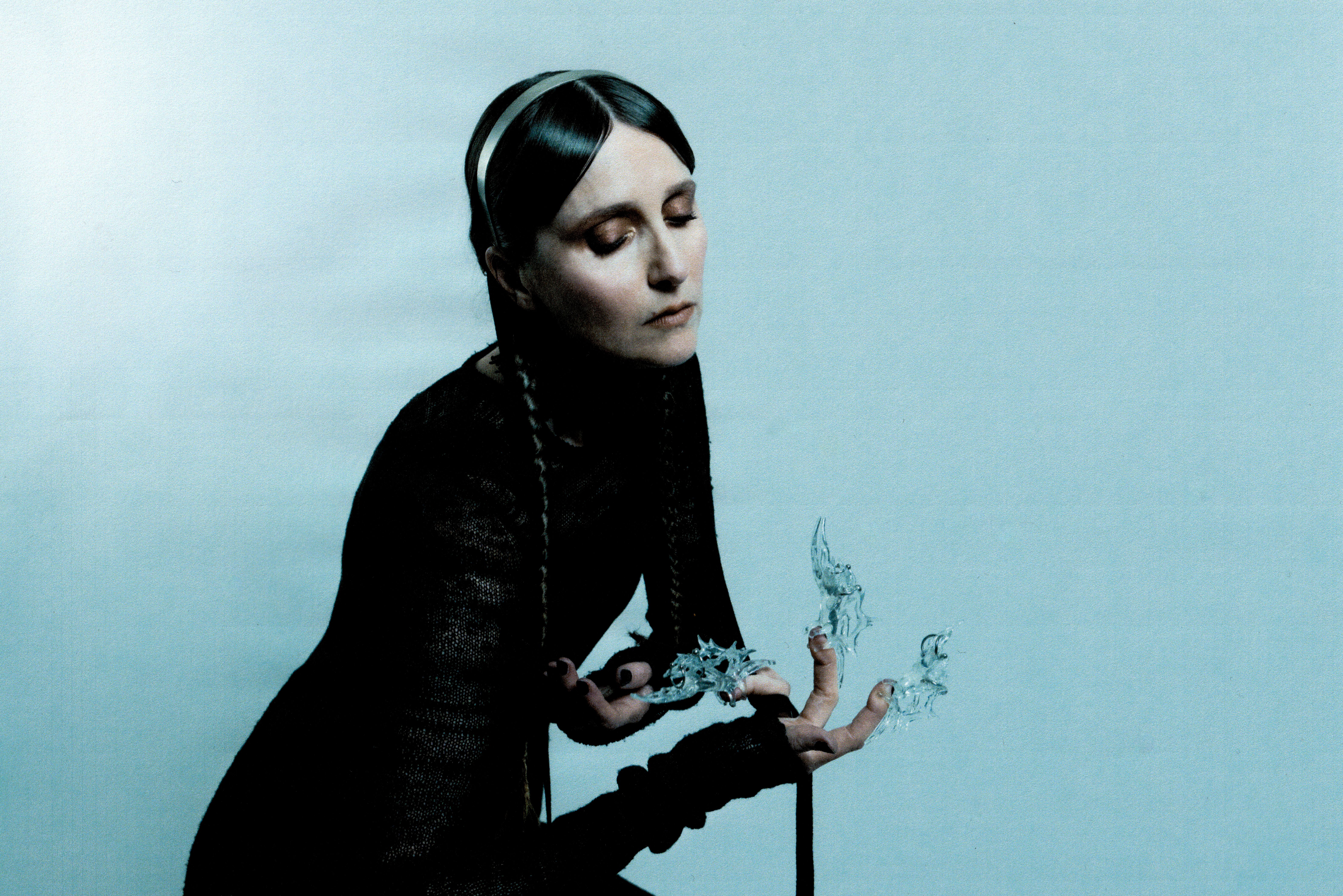
Published
Name: Penelope Trappes
Nationality: Australian
Occupation: Composer, musician, vocalist, producer
Current release: Penelope Trappes's new album A Requiem is out via One Little Independent.
Global Recommendation: Craven Woods - on top of the South Downs, it feels like a forest amidst a city with a beautiful view south to the sea.
Things I am passionate about but rarely get to talk about: I am very passionate about acupuncture. I get ‘doctorly’ advice from my therapist about how to take care of my body, process my daily energy and allow emotional energy to move through me. It has been life-changing, but doesn’t really seem to come up much within music journalism.
If you enjoyed these thoughts by Penelope Trappes and would like to know more about her music, visit her official homepage. She is also on Instagram, Bluesky, and Facebook.
For a deeper dive, read our earlier Penelope Trappes interview.
If, for a moment, we forget about streaming numbers, target audiences, social media followers, and sales - why are you drawn to sound and music as a creator and listener? What is it that you give and receive through it?
Sound is life to me. As a vocalist, my first memories are of the power of voice. Self-expression via word or song is so eternally powerful.
Also, the sound of the land on which I grew up in rural Australia: All of the native animals and bird calls were ever-present and very impressionable. My memory and emotion are tied deeply to these sounds and have shaped how I respond to every natural environment when I travel. Through sound, my connection to the environment is visceral which helps me to be peaceful and aware.
I often capture these moments and channel them into my music, not just as field recordings, but more as an actual aura connected to my songwriting or instrument-playing.
In how far can music be considered "essential" for humans?
We communicate via sound. We feel via vibration. These are essential tools of human expression and life experience and the basic building blocks of “music”.
I feel it is 100% essential for a sustainable life, unless one adapts to an alternate way to hear - the way those who have lost their hearing do. But even then it is still via the vibration of sound.
Take us through a day in your life, from a possible morning routine to your work, please, and how music and sound accompany you through it.
My morning routine starts with chanting and yoga - moving sound through my body, stretching it out to all the corners of my being.
After a black coffee, I then go deeper into this practice with forty minutes of voice exercises based around my recent studies with a teacher who introduced me to the practice of the ‘Vowel Resonance Ladder’ or ‘Vowel Tree’ developed by Kristin Linklater in the 1970’s. It helps by taking me out of ‘the head’ and into ‘the body’, where the sound is created.
For me, this helps so much as I have a tendency to overthink. Less thinking and more resonating, feeling, and intuition helps me to access the more ‘spiritual’ aspects of singing as well as writing music.
What artists, albums, performances, or even aesthetics and philosophies are inspiring to your life in and beyond music right now and in which way? Have there been songs, albums, performances, and artists that changed / influenced your life?
There are so many, but a few that come to mind:
Lisa Gerrard / Dead Can Dance - her vocals - particularly on ‘The Host of Seraphim’ from ‘The Serpent’s Egg’ - move me and inspire me to embrace the full potential of my own voice.
For me, it is about surrendering all of oneself to the music and accessing the deepest feelings of power, sorrow, love and every other emotion that lurks deep inside - the full range of the human experience.
[Read our Lisa Gerrard interview]
Patti Smith - Her live performance of ‘Beds Are Burning’ at All Points East festival in London in 2018 reduced me to tears.
It began with her reciting her poem about the devastation of the Australian land and the post-colonial desecration of Aboriginal spirituality and culture. It turned into a fierce political version of Midnight Oil’s cry to end racism, acknowledge socio-political injustice and the environmental repercussions of capitalism.
Laurie Anderson’s album Big Science - The whole album taught me as a child that the use of voice can be bigger than song and that the freedom to go beyond singing, into art through sound design, could be spirit-expansion into the future.
Billie Holiday - Strange Fruit (live in 1959) - every intonation in each vowel is embedded with pain, anger, grief.
Billie’s performance is consummate in conveying the horrors of bigotry and hatred. It’s a historical document, an artwork, an anthem, and an essential icon of protest.
Tell me about some of the feedback you've received from listeners about how your work has impacted them.
One of the most memorable was about 15 years ago, after a performance with a previous project. A young woman told me how inspired she was to keep going - even though she felt old at 26 - after seeing me perform.
I also get messages from people weekly about how my music has helped them through tragedies, grief, and other hardships. Just this past week, during a run of live shows, my cellist admitted that she cried during our performance of ‘Thou Art Mortal’. Music is powerful and moving stuff!!
Knowing that my work reaches people - that it moves them to feel, think, grow, heal and deal with life - is such an enormous gift. I often feel like I am just a vessel delivering messages from the universe, but if the universe is inside us all, then it’s just a realisation.
What are some of the goals and ambitions you have for your music?
As I continue to grow through this life, I hope the sounds I create reflect this expansion. I hope that by continuing to surrender to the experience of creating, I can gather all of my experiences and intuitions to unlock something far beyond me, and that I can share whatever that is with as many people as possible.
I like the idea of my music being a kind of gathering or community, where we can all feel connected to something infinite.
What kind of music/art do you feel the world needs right now - does it need “healing,” “shaking up,” “an escape from reality,” “consolation,” “a sense of community,” “holding up a mirror,” something else?
Music needs all of all this and more. It is meditation, it is communion, it is pure vibrational energy that moves through our bodies. The world is in an unprecedented upheaval right now, which requires all energies to be stirred via sound.
I feel that the music that comes into our lives needs to inspire us, console us, and help us to heal from the trauma that we constantly encounter. If it can bring us together where we can feel the collective anger, pain, escape, community and love, it can inspire us to make enormous changes out of small things.
What are some of the non-musical topics and causes you feel strongly about? Do you keep them separate from or try to connect them to your creative work?
My daily practice of meditation and yoga allows me to stay even-keeled in the chaos. I study Buddhist philosophy, tarot, astrology, herbal and alternative medicines. I am also a vegan and an animist and anti-capitalist.
As an artist, I feel that every human has the right to be free. To self-identify their gender, religion, belief systems, or career. I don’t believe in any institution making humans conform to others’ social norms, dogma, gender roles, sexuality, nor beauty. I believe that personal freedom is integral to our lives here on earth.
Naturally, this is very much reflected in my art - and at the forefront of how I live my life as a creative human.
French Saxophonist Sakina Abdou told me that she "witnessed a powerlessness towards a world that is in absolutely no way in line with my values," and that she hasn't "yet found a way to overcome this in ways other than music, but I admire the activists around me who do it." Can you relate to this and what does it say about the role of music in overcoming our sense of powerlessness and actually empowering us?
I understand this sentiment completely. But nihilism just makes things worse. A negative collective consciousness could just be manifesting more negativity into a downward spiral.
I believe in accessing love via the power of compassion, which I feel is where activism should come from. Music can be a part of that … small positives can snowball into bigger positives over time, if time is even linear.
Every thought matters. Every word counts.
What do you make of the idea that music and sound are a universal language - and how can artists use its specific and universal qualities to bring about change on a global scale?
Whether we are trying or not, we connect via vibration, sine wave, drone, rhythm, or song. That is energy transference. We connect. We hum together.
We all have a frequency, and can tune it to be more collective to access common human ground, access universal emotion, and know that we are all in this together. Find solace.
How would our world be different if we paid less attention to looks and listened more instead?
Sound came first, in our mother’s womb. There was no sight. It was just vibrations through the amniotic fluid.
As we grow into our bodies, we wake to another day and open our eyes. Light enters us. Visuals are immediate and relatable and allow communication of memory. “Looks” can be so powerful, inspiring and moving. Storytelling via creative visuals, film and photography are a huge passion of mine. As is costume to help transform into a character.
But unfortunately, we have become constantly distracted by mixing the visual and ‘entertainment’ with capitalism and dishonesty towards ourselves. There isn’t really a way around that in this world we have created, outside of finding moments to close your eyes and listen and look within and observe.
But yes, I think the world would be much more compassionate if we all listened more.
Performing music or creating sounds with others opens up the possibility of resolving conflicts in a different way. From your personal experience in collaborations or group performances, how does this work and do you believe it is possible to apply these approaches to areas outside of music?
Yes. For my live performances, I am working with a cellist and an organist and together, the three of us have to fully trust each other on stage, allow each other to freely express and accommodate each other’s ways of being.
In our collaboration, as we share energy on stage, we lift each other up, but it requires recognising our collective and separate nervous energies before performing. It really becomes all about listening to each other and respecting each other. It creates a deeper, unspoken understanding, which I also feel when working on recorded work with others.
This philosophical approach could definitely be applied to areas outside of music to create a more harmonious society.
It is possible for someone with an entirely different world view from your own to love or appreciate your work. How, if at all, is it possible to use this power of sound and music to enter into a dialogue?
If we quell our minds and surrender to sound, then perhaps we can learn to listen deeply and transcend beliefs. Closed-mindedness is infinitely hard to penetrate - which goes for all belief spectrums - political, religious, and beyond. But if one is open to listening, then I think the heart and mind connection should allow for discussions.
Diplomacy is not dead yet. The past informs our futures. We must all work hard to unlearn prejudices daily.
In human history, music is a universal across cultures and eras of development. Still, musicians are possibly being exploited more than ever. How do you feel they can see beyond their personal limitations, and form bonds and communities capable of tangibly furthering their cause? How can we get people to listen?
I think we need to continue to focus on the fact that music IS universal and integral to being human, versus focusing on our fears and worries of ‘exploitation’. Trust your intuition and don’t work with entities that you don’t connect with ethically. Collective fear and hate will only breed more of the same.
Everything is fleeting. I often think of the ‘wheel of fortune’ card in the tarot deck, and if you find yourself feeling exploited, work to get yourself out of that situation. If we see others being exploited, call it out.
We must continue to access our honesty through free expression of who we are, independent of familial, societal or commercial expectations. Sharing on small stages, gathering up our friends and kindred souls, and connecting - making cassettes, keeping independence, forming bonds, communities and power in music.
Smaller communities are how we begin and how we support each other. From there, larger audiences will come, but also, do it for the love and it will show.