Published
Name: Penny & The Pits
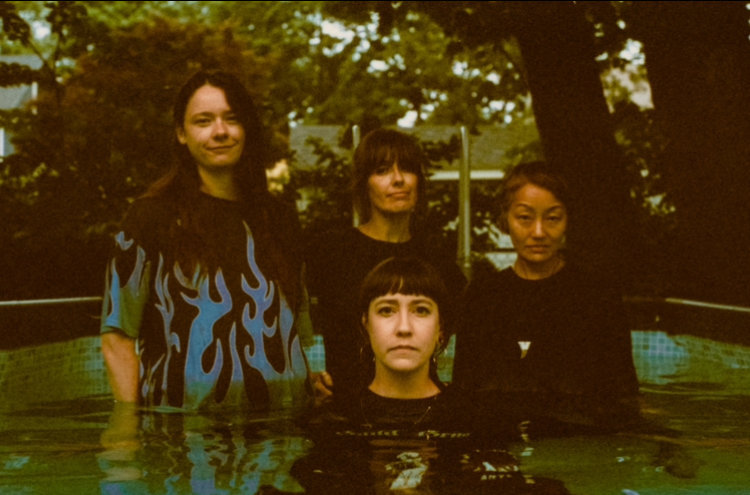
Members: Penelope Stevens, Megumi Yoshida, Colleen Collins, Grace Stratton
Nationality: Canadian
Current release: Penny & The Pits' new album Liquid Compactor is out now via Forward Music Group.
If you enjoyed this Penny & The Pits interview and would like to know more about the band and their music, visit them on Instagram.
When it comes to experiencing the sensation of “energy” as a listener, which albums, performances, and artists come to mind?
Beyoncé, TEKE:TEKE, Thee Oh Sees, Guerilla Toss, Baby Keem, Swans, Deerhoof, Rina Sawayama, Black Sabbath, Akron/Family, The Mummies, Aesop Rock, Pongo, KOKOKO!, Amyl & the Sniffers, Heaven For Real.
There can be many different kinds of energy in art – soft, harsh, healing, aggressive, uplifting and many more. Which do you tend to feel drawn to most?
The energy of music creates different outputs for me, so I’m a very dedicated DJ.
To stay awake on the overnight driving shift, I need Rihanna. For getting groceries in the North End, I need King Gizzard. For roasting miso broccoli, I need Clairo. For BBQing steaks, I need Neil Young. For morning coffee, I need Waylon Jennings.
In a live setting, I’m most drawn to intense and chaotic energy - I love seeing heavy bands play live, despite not listening to a ton of heavy music at home. Bands that can feed on a live audience’s energy are so rewarding to watch - like the more we give as an audience, the more the band gives back in this shitstorm of reciprocity.
But when I think of the music that impacts me the most, it’s the push/pull of different types of energy that keeps me engaged. The contrasts of oppositional intensities - like a country twang breakdown on a hardcore record - make the biggest imprints on my brain. I love music with twists and turns, that can find a way to weave rage in with joy, or wrap something tender in a barbed shell.
For Penny & the Pits’ first record, I was trying to process a lot of anger and resentment stemming from lived experiences in my childhood and early adulthood. But I didn’t want it to be a bummer - I wanted folks who survived similar experiences to be able to listen to Liquid Compactor and find joy and solidarity in it. For femme+ people to feel seen and for their rage to be validated.
Juxtaposing angry/harsh concepts and tones with more traditionally ‘feminine’ sounds and lyrics helped me accomplish that. I wanted songs like “Pool Party” to still feel fun and light, but to maintain an underlying ominous feeling. It was a fun challenge!
I have had a hard time explaining that listening to death metal calms me down. When you listen to a song with a particular energy, does it tend to fill you with the same energy – or are there “paradoxical” effects?
Taylor Swift fills me with unquenchable rage.
In as far as it plays a role for the music you like listening to or making, what role do words and the voice of a vocalist play for the transmission of energy?
I don’t think lyrics are as important to energy transmission as the timbre and qualities of someone’s voice, or vocal styling & delivery.
I’m not sure what’s wrong with my ears, but I usually have to look up lyrics to understand what someone is saying, so I’ve never been one to put much weight into lyrics; they’re not usually the thing that grabs me and pulls me into a song.
There are plenty of artists - especially in garage and punk-leaning genres - that are screaming at the top of their lungs about absolutely mundane things, but the energy behind the performance is anything but mundane.
Overall, I think the vocals certainly define the general quality of the song, but I’m more interested in what the band can do sonically to build worlds than whatever the vocalist is singing about.
When it comes to composing / songwriting, are you finding that spontaneity and just a few takes tend to capture energy best? Or does honing a piece bring you closer to that goal?
It depends on the project. With my main band, Motherhood, we tend to record as much live-off-the-floor as possible, and usually we’ll only track a song a few times before we get the right energy. The atmosphere during the recording has a major impact on the end result.
I believe that you can absolutely hear the difference between a song that was made live with friends and a song that was recorded piece by piece over a longer period of time. Neither process is necessarily better, but I think for rock music and upbeat genres, energy is best captured live and with urgency.
For Penny & the Pits, I wanted to capture a live band’s intensity, but in fact I couldn’t afford to hire musicians to play all the parts I could play myself! So I hand-selected a few songs on the album that I thought would benefit most from a live-off-the-floor style, and I asked the members of Motherhood to join me for those tracks.
We did “Montenegro on Ice,” “Thick Black Gloves” &” Eutychus” together live off the floor, then layered the details afterwards. I think those songs shine on the record. You can hear the dynamic that my bandmates and I have developed over a decade+ of collaborating.
For songs like “Ward of the Watershed,” I built everything by myself, on top of a lone drum track played by Colleen Coco Collins.
The layers were recorded in 3 different studios over the course of several months, which allowed me to think and re-think specific synth and guitar tones, experiment with different deliveries and melodic options, and be very intentional with how space got filled.
The synth outro on that song is one of my favourite parts of the whole record.
For Liquid Compactor, what kind of energy were you looking for?
Rage wrapped in a pink ribbon. A wink and a smile with sharp teeth.
How does the presence of the audience and your interaction with it change the energy of the music and how would you describe the creative interaction with listeners during a gig?
As I’ve gotten older and more experienced, I’ve learned how to give a consistent performance regardless of how many people are in the audience, or what their behaviour is like. But it is not easy!
When I was first starting out, I used to really struggle to play to an empty room, or a seated crowd, or an older crowd, or rooms where I can’t see the audience at all. But the unpredictability of an audience means that you can’t rely on them to produce the right vibe - that has to come from you.
And then when an audience is really great and engaged, that’s a value-add!
Would you say that you prefer to stay in control to be able to shape the energy or do you surrender to it and allow the music to take over? Who, ultimately has control during a live performance?
I believe that the artist ultimately has control during a live performance, and it’s our job to oversee the audience’s experience. Even if the odds are stacked against you, the true test of a performer lies in your ability to command the attention and interest of the audience.
I have seen solo acoustic performers play completely unplugged to 100 silent, mezmerized people, and I have also seen high-energy electro-pop artists play to full rooms that didn’t even notice a band was on stage.
Performing live is like inviting a bunch of drunk strangers to your house for a dinner party. It’s unpredictable and nerve-wracking, but ultimately it’s your hospitality and the way you serve the meal that will help them decide how they behave in your space.