Published
Name: Peter Gregson
Occupation: Cellist, composer
Nationality: British
Recent Release: Peter Gregson's new, self-titled album is out via Decca US.
Recommendation for London: I totally love everything at Lightroom which is right by Kings Cross especially their original David Hockney show.
Southbank Centre have consistently brilliant programming so that’s always on the list, but the pro move is to take the tube to Embankment and walk over the bridge: best bridge walk in the city (especially via Gordon’s Wine Bar, IYKYK)
If you enjoyed this Peter Gregson interview, visit his official website for more information. Or pay him a visit on his socials at Instagram, Soundcloud, and Facebook.
For a deeper dive, read our earlier Peter Gregson interview, and our conversation with him about "Sleep, the Subconscious and the Value of Silence."
The borders between producers, sound artists, and even songwriters are becoming increasingly blurry. What does being a composer mean today, would you say?
I don’t know that the job title matters - the outcome is the same: it’s someone expressing themselves through music, trying to share that part of themselves. It’s just nowadays we have many more words for it and many more places for it to live.
Making music can be a terrific therapy. It can be deeply personal and only you, it can be entirely collaborative, it can be your income, it can be your hobby … it can take many forms but it’s always a part of ‘you’.
So I think, however you want to label it, it is about expressing yourself, truly, through sound.
As of today, what kind of materials, ideas, and technologies are particularly stimulating for you?
I have always been fascinated by sound - for me it’s a very tactile thing. I have a clear idea how my music should ‘feel’, and a large part of that is microphone choice and room choice; how the sound interacts with the space in which you’re recording is so much a part of the performance, but for me writing it, it’s hugely inspiring for the creation process.
My studio is full of reverb units, rack mounted units and tape machines and plates that exist to put sound in a different space, to augment the reality of the music. I am increasingly excited by reverbs that are entirely true to themselves, whether it’s a room with a great sound, or a Plate reverb (I have recently received an EMT 240 plate and it sounds like nothing else), less interested in an artificial reverb sounding like a nice hall, or an emulation of a church. I’d rather go to the church, or go to the nice hall.
I think my latest album, Peter Gregson, has been about stripping away and really focussing on the honest creation and capturing of my music, and this is all part of that conversation, inspired by an image I saw in a book: a beautifully photographed, immaculately lit glass of water with the caption, “This is a photograph of a Glass of Water” and on the other page, a polaroid of the same glass, captioned “This is a Glass of Water.” That has stuck with me and really resonates with me.
How much potential for something “new” is there still in composition? What could this “new” look like?
I don’t think chasing ‘new’ is the goal. I think being open to the rapidly evolving world around us and creating work that is somehow listening is key.
Art should reflect our times, our lived experiences. I don’t fully know what that means in terms of ‘what does 2025 sound like’ but I think if you shuttle through the decades, you get a good blurry overview of the sounds and feelings of the times.
Perhaps it’s the abundance of relaxation music, meditation apps, binaural beats to calm us … the world is a fast and frantic place right now.
What role do electronic tools and instruments play for your creative process? What does your creative space / studio look like and what tools does it contain?
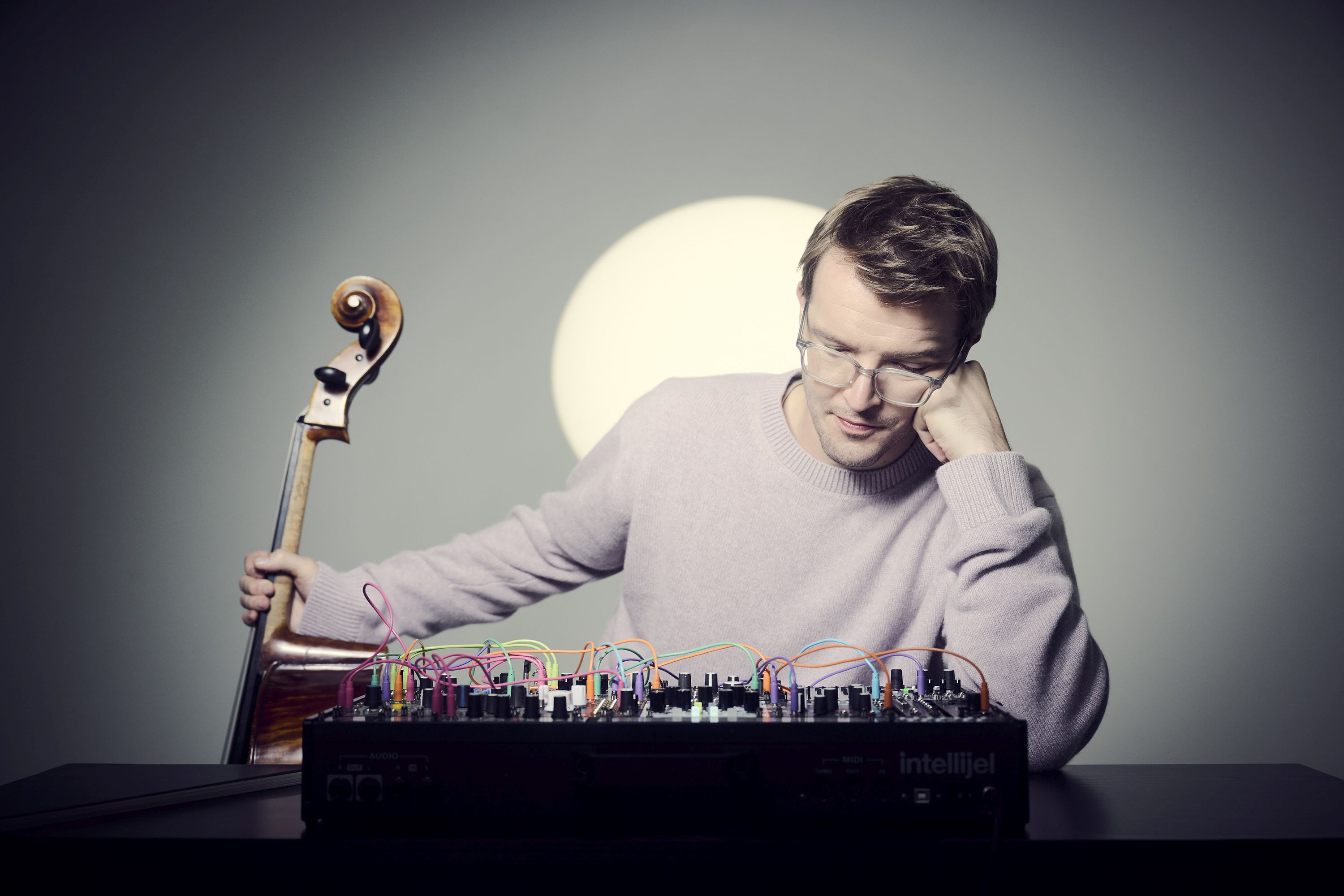
My new record has a modular synthesizer at its core - it’s an interesting one because normally when we talk about synthesizers, we think of oscillators producing electronic sounds from sine waves etc.
I made my modular synth to have no oscillators, only a microphone input for my cello - so every sound is lovingly, and laboriously, processed by hand through the modular synth. This speaks to the whole.
Working with long forms, complex concepts or new vocabulary is potentially more challenging today because they require us to remember things that happened perhaps minutes ago – while most of us are finding it hard to focus even on what's happening right now. Both as a composer and as a listener yourself, how do you deal with this?
It’s a good question. Attention is a real currency, something that holds your focus, stops you doom-scrolling on Instagram or checking WhatsApp … that’s increasingly, and depressingly, rare these days.
That said, you never know in a concert hall when someone’s mind has drifted - it’s just now all these things can be measured, quantified, studied. As I type this, I have a ‘Binaural Beats for Concentration’ playlist on my headphones to blank out the noise of the cafe I’m sitting in, but I’m also enjoying watching the world go by, so it’s a tricky balance isn't it?
On one hand, there’s a real joy to writing music for the concert hall where The Audience has made the effort to come to experience the show in a communal setting. But, as is so often the case, our music is now experienced in the Concert Hall for One: headphones. The joy with this is the constantly evolving ‘soundtrack to your life’ element, hearing a familiar piece of music in a new setting can be really refreshing - and is unique to this modern age of portable (and high quality) music.
As a composer, I find that if a melody (or other compositional element) can held my attention and keep me engaged, interested, curious, throughout the day, days, weeks, I might be working on it, then it has legs. I’m very aware of things that lose my interest.
As a listener, I find the tiniest things jump out at me so I rarely find myself switching off entirely, but I’m definitely guilty of a doom-scroll in a slow show on TV, but am trying to get better at just switching it off and accepting that it didn’t grab my attention.
I think it’s ok: there’s so much ‘content’ being made, there’s no way it can all be fascinating to everyone, and it shouldn’t try to be. Ironically, trying to be acceptable to everyone makes it remarkable to nobody, so I think I try to bring this to my own work.
How, would you say are live performances of your music and your recording projects connected at the moment? How do they mutually influence and feed off each other?
I’m not a big touring artist, never have been, but I love performing and sharing my music in that unique setting. I am loving moving away from recording ‘on the grid’ and being more freeform with that process.
Often we set up a musical meter and record on a metronome (called a click track) which then acts as the master reference. Sometimes music doesn’t want to sit in a strict and never moving grid, and I’m enjoying exploring that in my recording process.
It hopefully brings more of a live performance sensibility to the recorded music which allows it to breathe, allows it to feel more conversational and ultimately more human.
To some, the advent of AI and 'intelligent' composing tools offers potential for machines to contribute to the creative process. What are your hopes, fears, expectations and possible concrete plans in this regard?
I’m entirely here for progress, entirely on board with technology, but I’ve not quite grasped why anyone would want to listen to music written by a computer.
Technological astonishment, some awe at the coding of the machine that could spit this stuff out?… but what can it truly tell us about the human condition? How do we relate to a computer's interpretation of the world? I don’t know. My computer sometimes thinks it’s January 1st 2001 and email still hasn’t learned how to filter out all the junk emails so maybe we start there rather than trying to get the computer to compete with the higher forms of human achievement?
I want the machines to do all the things I don’t want to do in order free up time to write more music, read more stories, see more paintings, not write the music for me to free up time to do the laundry? If there could be a robot to do the laundry and dishes, I’d be 100% here for it.
I have experimented with some AI music tools. I’ve tried some of the intelligent compositional tools, and I’m yet to find one that can do anything musically significant, surprising, or even actually musically coherent. Completing a 4 bar chord sequence isn’t as much of a time saving as I think some of these tech companies think it might be.