Published
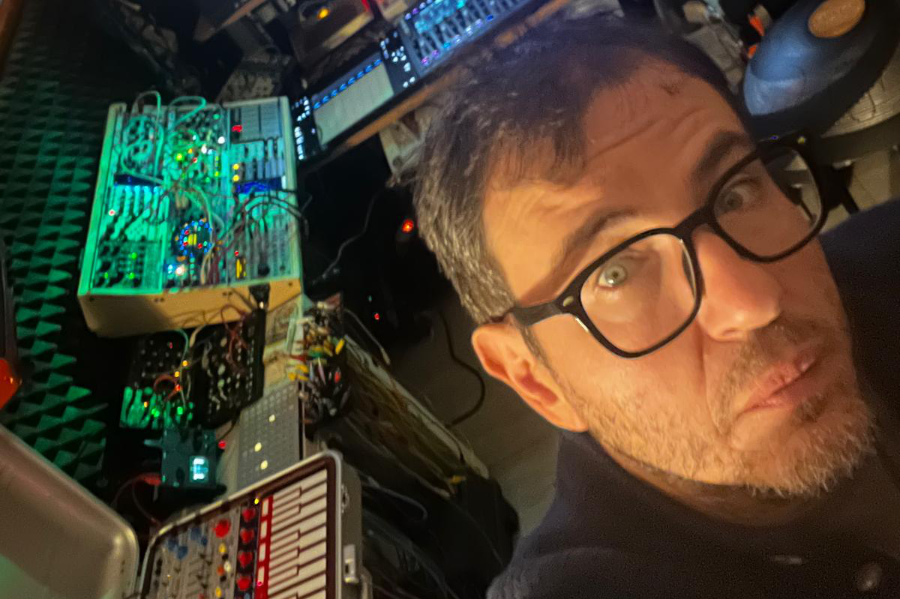
Name: Gerry Amato aka PSTMRD
Nationality: Italian
Occupation: Composer, sound artist, producer
Current release: PSTMRD's new album Lanzarote is out via Protomaterial.
Shoutout: Realtà Acusmatica, a collective of friends dedicated to experimentation and noise music.
Recommendation for Genoa, Italy: Genoa is a very decaying, almost ghostly city. The Monumental Cemetery of Staglieno is a beautiful place for anyone with musical or artistic sensitivity.
If you enjoyed this PSTMRD interview and would like to stay up to date with his music, visit him on Instagram, and bandcamp.
Many artists have told me that they're in discovery mode when working with the modular. What are some of the things you recently discovered while working with your own set-up?
Working with modular synthesis keeps me constantly in discovery mode.
I’ve always been drawn to instability and the noise generated by filters and oscillators, treating them as compositional elements rather than flaws to be corrected.
There are artists who can realise their ideas best with a traditional – or modified – piano interface, others with a keyboard and a mouse, yet others by turning knobs or touching screens. What's your preferred and most intuitive/natural way of making music and why?
Patching and turning knobs feel like the most natural gestures to me.
I prefer a physical and direct relationship with sound rather than screens or predefined interfaces.
What did your first modular look like? Tell me about the first pieces you produced and performed on it, please.
My first modular system was small and rough, built piece by piece. The music was slow, raw, and exploratory—more about creating noises and short sessions than finished tracks.
In the early years, doom sounds and slow, experimental, almost obsessive kraut-inspired textures emerged very naturally. I’ve always been fascinated by that aesthetic, and it still strongly influences my approach today.
There is a worldwide community around modular synthesizers. How would you describe your involvement with it and its role for your creative development especially in the early days of your modular journey?
I followed the modular community via Facebook and modular grid closely for many years, buying and selling modules until reaching my current system, which still has room to grow.
That sense of freedom was fundamental in the early stages.
Modular synthesizers allow for the most diverse and personal set-ups. What were some of the most surprising/inspiring configurations or ways of playing the modular that you've seen?
Today I’m more inspired by minimal systems used deeply: a few modules or semi-modular instruments with a strong identity and a clear artistic voice.
Can you take me through the evolution of your modular system up to your current set-up? What are aspects you consider when buying a new module?
Over time my system has become more complex.
The introduction of the ER-301 was crucial, as it allowed me to store and recall variables and, in some cases, entire patches.
I choose modules for their character and unpredictability rather than for long feature lists, which haven’t really changed for years.
Which modules incisively changed your way of making music – and why?
Rather than individual modules, I prefer to talk about complete or semi-modular instruments.
Soma Terra, Waldorf Iridium, and Make Noise Strega radically changed my approach, shifting the focus from control to listening and response.
Portability has been one of the main drivers for music production over the past years. What importance does mobility have for you when it comes to production – and what strategies for making the modular portable have you developed?
Portability is increasingly important to me, especially because I seek immediacy in music-making.
I look for compact systems that still allow complexity and evolution.
With a keyboard and a traditional synth, I would instantly know what something would sound like if I pressed down the keys a certain way. Would you say the same is true for the modular and certain patches and modules? How does working with wires, cables, and plugs change your perspective on music?
Modular synthesis is not predictable.
Working with cables and connections teaches you to accept uncertainty and changes how you perceive structure and time.
Modulars suggest a more immediate relationship with sound. In how far does this hold true from your point of view and what has working with them taught you about sound in general?
Modular synthesis creates an intimate relationship with sound.
It taught me to trust imperfection and to let sound itself guide decisions.
In which way does the modular influence musical results and what kind of compositions does it encourage / foster?
It encourages slow transformations and non-linear forms.
Often the composition emerges directly during the process.
Describe the creative process for Lanzarote, please.
Lanzarote is a sonic journey inspired by landscape and space.
The tracks were born from long improvisations in a small B&B beneath a volcano, recorded outdoors during the day and night, under the sun and the moon.
These improvisations were later shaped into narrative forms.
Many modular set-ups still do not support saving patches or quickly switching between them. What possible benefits or inspiring consequences does this quite severe limitation have for your own music and creative practise?
This approach has led me in recent years to prefer Buchla-style systems for their distinctive sonic character, allowing me to reach increasingly raw and full-bodied timbres.
I am under the impression that choosing the modular is not just a musical decision, but somehow extends into other parts of one's life as well. Can you reflect on this a little bit?
Choosing modular synthesis goes beyond music-making:
it shapes patience, attention, and the ability to remain within uncertainty, where surprise is always a crucial factor in modulation.
For you personally, is the goal to become as proficient and fluent on the modular as others might get at the piano – or to keep discovery mode on forever?
I’m more interested in staying in discovery mode than in fully mastering the instrument.
Surprise is essential to my work—this applies to all the synthesizers in my collection.