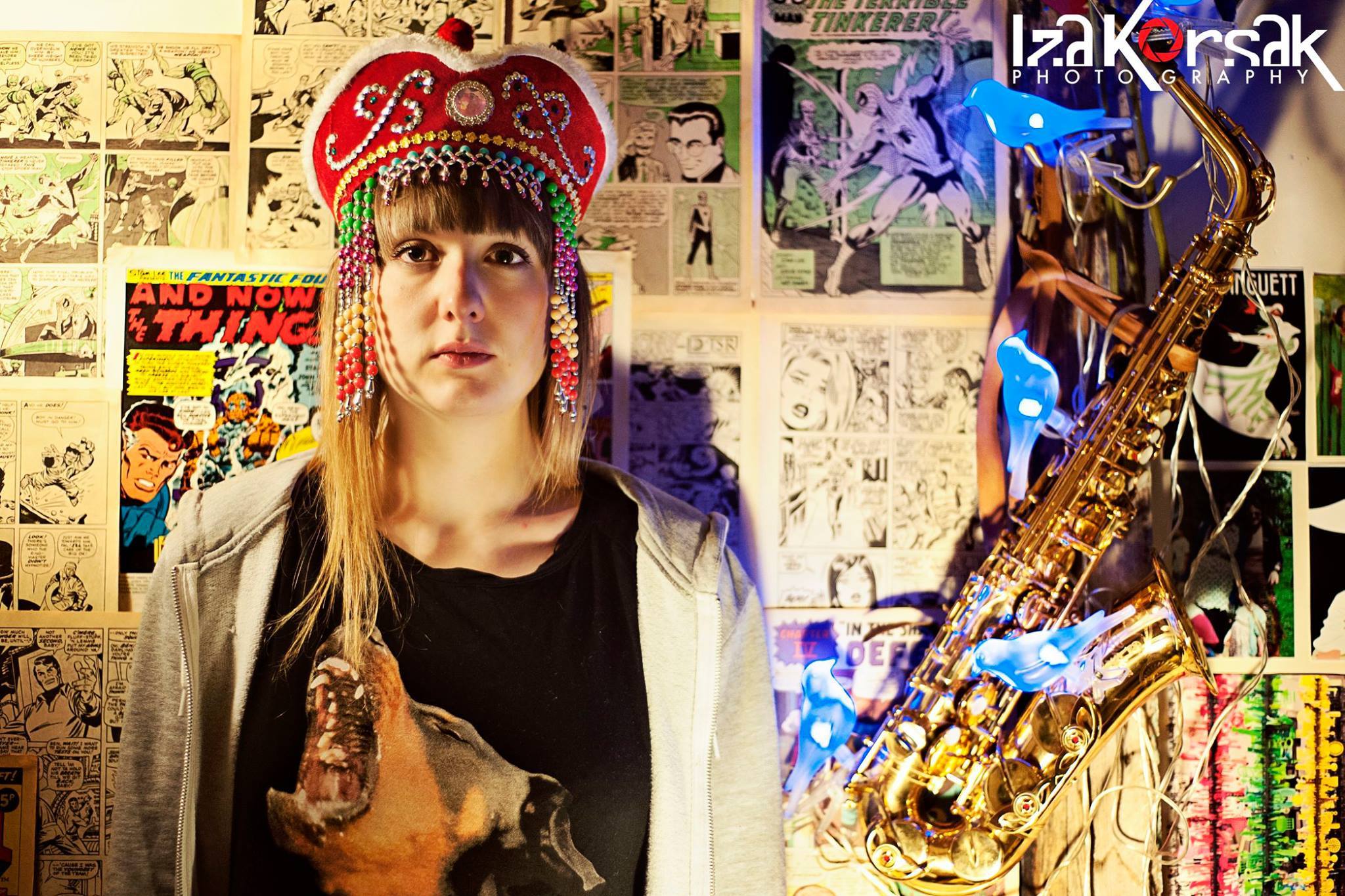
Published
Name: Rachael Cohen
Occupation: Composer, saxophonist, improviser
Nationality: British
Current event: Between 10th December 2025 and 15th April 2026, always at 11.15pm, Rachael Cohen will host the Late Late Show at Ronnie Scott's.
Recommendations for London, UK: My favourite is the beautiful Natural History Museum ….then Ronnie Scott’s Jazz club!
Topic I am passionate about but rarely get to talk about: I love vegetables and have had my own allotment patch for the last seven years growing anything and everything! It’s a great feeling being able to eat the things you’ve grown, and a great skill I can pass onto my daughter.
If you enjoyed this Rachael Cohen interview and would like to stay up to date with her music, visit her official homepage. She is also on Instagram, and Facebook.
When did you first consciously start getting interested in musical improvisation? What was your first improvisation on stage or in the studio and what was the experience like?
Consciously, it was in my High School jazz band. Unconsciously, it was at my piano at home.
I come from a musical family so there was music everywhere - I would constantly change the music I knew to how I wanted to play it, whether that was Mozart or something else. I didn’t call it improvisation, and nobody else did either ha. But that was me doing what I heard in my head.
When I first had to take a solo on the horn, I was in high school, probably 13 or so, and my teacher said ‘Just play stuff from the scale!’, and I knew I could do that, so that’s what i did. After that, once people saw I had the confidence to do it I started to pay attention to what my solos actually sounded like.
Tell me about your instrument and/or tools, please. What made you seek it out, what makes it “your” instrument, and what are some of the most important aspects of playing it?
So I play the Alto Saxophone, and I certainly didn’t seek out the Saxophone; it came to me by chance.
I grew up a piano player, but in primary school, they offered me an instrument to play, and it was either the fiddle or the saxophone. Bearing in mind I grew up in the Shetland Islands, every man, woman and child could play the fiddle (and extremely well!), and I’d never even seen a saxophone before, so I wanted that!
The Alto is a difficult Saxophone to make sound nice. Getting a good tone can take years, and that’s something I spent a long time on. That’s really what makes it mine; everyone knows when it’s me playing, and that’s very important to me.
How would you describe your own relationship with your instrument – is it an extension of your self/body, a partner and companion, a creative catalyst, a challenge to be overcome, something else entirely?
It’s a family member, like a sibling.
You can only say certain things to them. They’re the only ones that really understand you, no words needed. But you don’t always get along, and sometimes you can’t talk every day. It can be frustrating.
But they’re always there, and they always have time for you - even if you don’t like what they have to say! You can’t live without them.
Derek Bailey defined improvising as the search for material which is endlessly transformable. What kind of materials have turned to be particularly transformable and stimulating for you?
All music is transformable if you have an imagination and have fed that imagination with enough material to influence it.
Jazz musicians are constantly studying music which has been transformed - the great American songbook is one of the templates for that. How many ways can you interpret a melody, how can you improvise and reference the melody, rather than just taking a ‘solo’.
Standards are a constant source of inspiration for me with those ideas in mind.
Do you feel as though there are at least elements of composition and improvisation which are entirely unique to each? Based on your own work or maybe performances or recordings by other artists, do you feel that there are results which could only have happened through one of them?
It’s each to their own, but I feel that composition should provide some solid ground for the improvisation to work from. I like structure, I like chords, I like harmonic movement, I like cadence. I like all of those things within a framework so that my improvising is an addition to that story.
Even if there’s no improvising, for me, the composition should be able to stand on its own. Improvising is more fleeting; you don’t always know what will be left when you’re finished.
When you're improvising, does it actually feel like you're inventing something on the spot – or are you inventively re-arranging patterns from preparations, practise or previous performances? What balance is there between forgetting and remembering in your work?
I’m always trying to tailor something specific to that moment, and that tune. Whether it’s something I’ve never played before is less on my mind.
I feel like people repeat themselves more often when they are trying to force the things that they know in to places that they don’t fit. They’re not listening to what’s going on around them. I tend to think in phrases rather than patterns.
That isn’t to say that phrases themselves don’t have shape … but phrases are a more conversational. A pattern is a pattern.
Artists from all corner of the musical spectrum, not just “free jazz” have emphasised the importance of freedom in their creativity. What defines freedom for your improvisations?
Having control of the time. Being able to connect to the time so it doesn’t run away from me.
That gives me the most freedom. Then I can do things at the speed I want, with intent.
Taking your recent projects, releases, and performances as examples, what, would you say, are the key ideas behind your approach to improvisation?
Good note choices.
Just because something is in the chord, doesn’t make it the right note. What’s the most beautiful note for right now. How do I portray that with the phrase I’m playing. How am I going to time it for the most impact musically. How am I going to continue this idea. How am I going to connect it to my band.
Those kinds of things.
In your best improvisations, do you feel a strong sense of personal presence or do you (or your ego) “disappear”?
Presence, yes. Ego, no.
It’s important to be aware of yourself, of what you sound like, and want to pursue sounding your best at that time - but for me there’s never any ego involved.
What are some of your favourite collaborators and how do they enrich your improvisations?
Some of my favourite people to play with are drummers. Two I’ve worked with the most over the years are Shane Forbes who people will know from his band Empirical, and Jason Brown from New York who has played with everyone you can think of from Pat Martino, to Joey Defrancesco and Monty Alexander.
Jason brings an unbelievable amount of experience straight from the source and you can hear it all in his playing. One of the best swing feels in the world, there’s nothing you can’t do, he will always make your playing sound amazing.
Shane has an incredible feel for groove. His playing has a looseness that I like to explore when we’re playing together that makes me feel like we’re completely locked in with each other and can take a tune somewhere else.
In a live situation, decisions between creatives often work without words. From your experience and current projects, what does this process feel like and how does it work?
Often there isn’t time to for vocal directions - you need to keep your eyes and ears open!
Stewart Copeland said: “Listening is where the cool stuff comes from. And that listening thing, magically, turns all of your chops into gold.” What do you listen for?
That’s a circumstantial question I suppose. I’m listening for different things a different times - that’s why you might choose one record over another to listen to.
In a performance situation, I’m trying to listen to everything and let everything inform me. And I”m also listening to enjoy.
As a listener, do you also have a preference for improvised music? If so, what is it about this music that you appreciate as part of the audience?
I suppose it depends on the context.
I can’t say I gravitate towards completely free form improvised music, but I have huge respect for it. It can be extremely exciting for the listener, with lots of different textures and sounds that you won’t always hear in more straight ahead Jazz. The players are extremely virtuosic in their field.
In a way, we improvise all the time. In which way is your creative work feeding back and possibly supporting other areas of your life?
My work is a part of everything I do, and more than ever now since having my first baby six months ago!
As parents you are constantly improvising, because in reality there are only so many things you can plan for - the rest is just winging it and doing your best …!