Published
Name: RAH & the Ruffcats
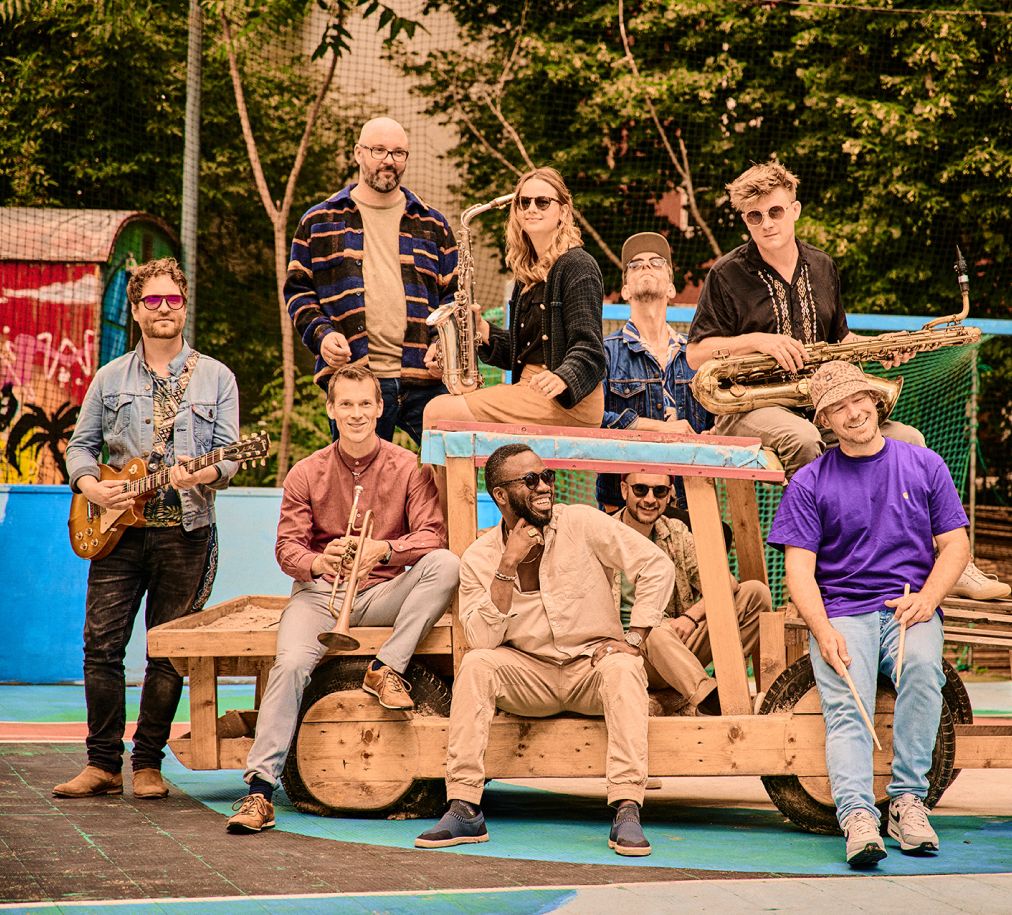
Members: Rapturous Apollo Helios aka RAH (vocals), Uwe Berwanger (drums), Joh Weisgerber (bass), Hendrik Stiller (keys), Botond Ikvai-Szabo (guitar), Jean-Luc Jossa (percussion, backing vocals), Lars Dieterich (saxophone), Lukas Fröhlich (trumpet), Friedrich Milz (trombone)
Interviewee: RAH
Current event: RAH & the Ruffcats are one of the acts appearing at the XJAZZ! 2025 festival in Berlin. For tickets, go here.
Recent release: RAH & the Ruffcats' debut album Orile to Berlin is out via Sonar Kollektiv.
If you enjoyed this RAH & the Ruffcats interview and would like to stay up to date with the band and their music, visit their official website. They are also on Instagram, Facebook, and bandcamp.
The XJAZZ! Festival is just around the corner. Tell me just a little bit about your performance at the Festival, please.
We are going to play at the Sonar Kollektiv showcase this year.
The stage is not that big, but we are going to play our full set with 9 people.
How, would you say are your live performances and your recording projects connected at the moment? How do they mutually influence and feed off each other?
We recorded our first album before we had even played one show. Since then, we played a tour and several festivals.
When we were at the studio to record our second album four weeks ago, we performed much better and arranged the music differently because we knew what makes people move.
In as far as you have any experience or insights, what's your view of the Berlin jazz scene?
I experienced the Berlin jazz scene as very dynamic and fast-changing.
There are lots of musicians coming from all over the world. You go to jam sessions, and if you miss one week, the next time you show up there are lots of people you haven’t met before :-)
The level and the creativity are really high, and it has a great uniqueness.
Tell me a bit about the sounds & creative directions, artists & communities, as well as the colleagues & creative hotspots of your current hometown, please. How do they influence your music?
I moved to Hamburg after living in Berlin for ten years.
Hamburg is, of course, much smaller, and it has a much smaller jazz scene, even though it has two big jazz festivals that have interesting bookings as well.
What does the term jazz mean today, would you say?
I don’t know, I think it still stands for spontaneity and improvisation. But to me, when I hear the term, I don’t automatically think of Duke Ellington or Miles Davis.
Its idea is still almost the same, only that there are now more ingredients.
Where do most of your inspirations to create come from – rather from internal impulses or external ones? Which current social / political / ecological or other developments make you feel like you need to respond as an artist?
Of course I feel the need to respond, because my music is my strongest voice.
But my creativity and the creation come mainly from internal impulses.
Thanks to technological advances, collaboration has become a lot easier. What's your view on collaboration and its ongoing role for the music you make?
Well, of course, the possibilities have become more plentiful, and collaborating has become much easier.
But personally, I am pretty tired of all the technology and enjoy meeting people and playing real music with real people in one room much more.
But that is just a mood, and normally I enjoy using all the possibilities as well.
What do you generally look for in a collaborator and what made you want to collaborate with the musicians you're playing with for your XJAZZ performance?
I enjoy making music with people who are prioritising uniqueness and style over technique and virtuosity.
The people I play with are my friends, and as much as we have the ambition to play great music, I need to have a good time with my band because we spend so much time together.
In terms of the results, the process, and the satisfaction, how do making music in the same room together versus filesharing compare to you, real concerts vs live streams?
Of course, the results of filesharing are something that you could not realize without spending great amounts of money. So this is something that helps.
But playing music with people in front of a crowd is something that you can’t compare to anything else.
What role do electronic tools and instruments play for your creative process?
The biggest role, I would say.
Improvisation is obviously an essential element of jazz, but I would assume that just like composition, it is transforming. How do you feel has the role of improvisation changed in jazz?
It depends. In our music, we focus much more on the composition and the arrangement.
But when you listen to people like, for example, Sullivan Fortner, the improvisation is still the main part and is constantly fresh and exciting.
What, would you say, are the key ideas behind your approach to improvisation?
It depends. With my band, the key is that the groove never stops because we want to make the people dance.
How would you describe your own relationship with your instrument – is it an extension of your self/body, a partner and companion, a creative catalyst, a challenge to be overcome, something else entirely?
It is transforming. It has always been demanding, but it is still one of my biggest love affairs, as corny as it sounds.
In a way, live performance remind us of the transitory nature of life. When an improvisation ends, is it really gone, just like a cup of coffee? Or does it live on in some form?
I guess it depends on how good the improvisation is. But there are people who are capable of talking to the universe.