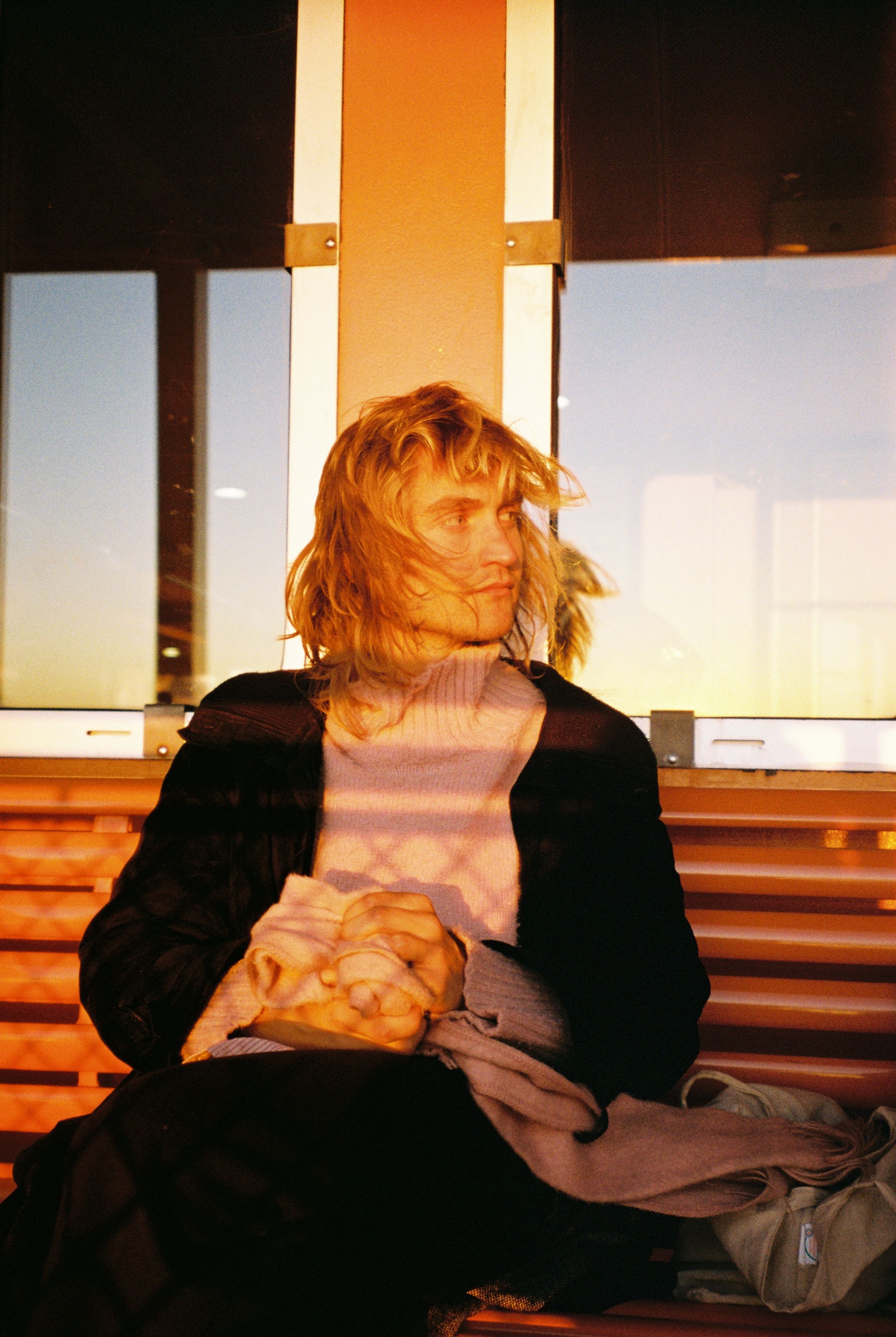
Published
Name: Ralph Heidel
Nationality: German
Occupation: Composer, producer, multi-instrumentalist, arranger
Current release: Ralph Heidel new album anyways. onto better things is out via Friends with Oranges. It features collaborations with Finn Ronsdorf, Selassie, Jun Miyake, and Douglas Dare.
Recommendation for Berlin: The Nan Goldin exhibition in Berlin!
Topic I rarely get to talk about: I have the pleasure that my friends listen to every little damn passion I care about, whether it’s a composer from the 18th century, a tube compressor or what kind of reeds I play on the saxophone.
[Read our Finn Ronsdorf interview]
[Read our Selassie interview]
If you enjoyed this Ralph Heidel interview and would like to know more about his music, visit his official homepage. He is also on Instagram, and Facebook.
What were some of the musical experiences which planted a seed for your interest in jazz?
My father had a Funk Band where they played the classics. It was there that I saw a saxophone for the first time and knew I’m gonna play it.
The first experience that planted a seed was a New Orleans/Dixieland sampler CD we had at home, though.
What does the term jazz mean today, would you say?
I don’t feel myself in a position to give this term a meaning.
I use it because no one came up with a better word for all the music that happened after the 60s and because I’m educated in jazz. So the way I understand, write and listen to music, is rooted in Jazz.
As of today, what kind of materials, ideas, and technologies are particularly stimulating for you?
I feel stimulated when I’m not stimulated.
Where do most of your inspirations to create come from – rather from internal impulses or external ones? Which current social / political / ecological or other developments make you feel like you need to respond as an artist?
I don’t feel like I respond directly to any development, besides the developments in my close surrounding.
Yet I think my upcoming album anyways. onto better things sounds so direct, honest and intimate because I am saturated with over produced albums with tons of effects and producer tricks - if you need a hypothesis, let’s say: I respond to AI with rawness.
Music has become a lot more global, and incorporating elements from other parts of the world or the musical spectrum is commonplace. Do you still think there are city scenes with a distinct, unique sound? How does your local scene influence your work?
The problem in Berlin is, that there is everything. I’m in the German Rap Scene, I’m in the Indie Scene, I’m in the Jazz Scene, the experimental electronic scene, the Ambient and Drone Scene.
That is what influences me. It’s all the same, it just works a bit different.
What role do electronic tools and instruments play for your creative process?
My analogue synthesizers play a very important role, since they give my work a sound identity.
I use a lot of samplers, granular synths, sequencers, also pedals and plugins for my sax. But try to use not everything at the same time and dose it well.
Thanks to technological advances, collaboration has become a lot easier. What have been some of the most fruitful collaborations for you recently and what approaches to and modes of collaboration currently seem best to you?
Yes, I recently collaborated with Jun Miyake. He always was a strong influence for me. Incredible that this happened.
He lives in NYC and when I sent him the music, he sent back a flugelhorn solo on my track “Wake Up.”
My next release will be with Douglas Dare, who lives in London. I love collaborating and since I make instrumental music there is a lot of space for vocalists or other instrumentalists.
It’s also good to know when the music doesn’t need a collaboration.
Jazz has always had an interesting relationship between honouring its roots and exploring the unknown. What does the balance between these two poles look like in your music?
As I said before, the way I understand harmonies and the way I talk about music is rooted in Jazz and everything that is sound design, and production is searching and studying for me.
Sound design and production have become as important as writing exciting harmonies and rhythms.
How much potential for something “new” is there still in jazz? What could this “new” look like?
There is no new, there are just new mixtures, new colors. But it’s all rooted in everything that was already here, from all genres, from all players. Frustrating but also always exciting.
And if there is a new we will know later, but not now.
For many artists, life-changing musical experiences take place live. How do you see that yourself?
Life changing musical experiences were always certain albums for me where I had the chance to make a deep dive.
But the music I enjoy seeing live the most is actually Jazz and improvised music. The energy is incomparable to anything else.
How, would you say are your live performances and your recording projects connected at the moment? How do they mutually influence and feed off each other?
I try to separate them completely.
I always have different live shows. At the moment I play solo a lot. A piano, synthesizers, a looper, pedals and my saxophone. I play everything live and it’s more intimate and spheric.
I also have a band which is a completely different vibe and energy. I play the same tracks though and I like to do both. In the end again - it’s the same it’s just another instrumentation.
Ímprovisation is obviously an essential element of jazz, but I would assume that just like composition, it is transforming. How do you feel has the role of improvisation changed in jazz?
I don’t think there is one right answer to this.
When it comes to the wave of today's UK Jazz I would say that energy and heart stands before technique and intellect. That wasn’t always the case, but it was already there at the same time.
What, would you say, are the key ideas behind your approach to improvisation?
A mixture of lines I have in my fingers, my mood on a given day, and the energy of the room.
Also, I do not play it safe. I fuck up a lot but the audience still knows what I’m trying to say.
If we were to have an in-person conversation, you would notice that the words I use are not too eloquent. I improvise how I talk - not too sophisticated.
Are there approaches, artists, festivals, labels, spaces or anyone/-thing else out there who you feel deserve a shout out for taking jazz into the future?
Not particularly Jazz - but Le Guess Who always has a fantastic line up. That deserves a shout out.
The Montreux Festival intends to preserve its archive of recordings for future generations. Do you personally feels it's important that everything should remain available forever - or is there something to be said for letting beautiful moments pass and linger in the memories of those that experienced them?
I’m a romantic when it comes to letting beautiful moments pass.
But God, save those tapes!