Published
Name: Razen
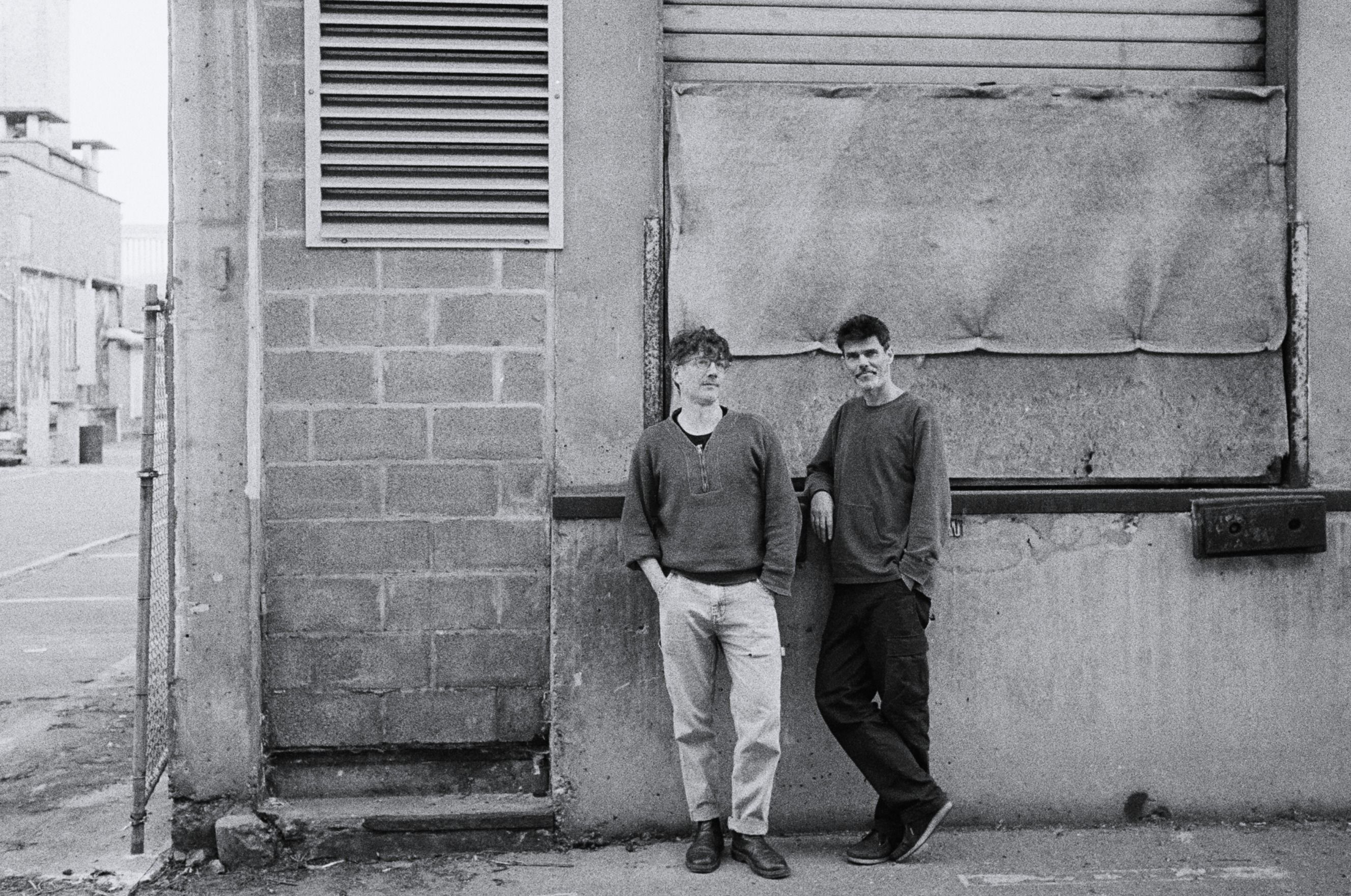
Members: Brecht Ameel, Kim Delcour
Nationality: Belgian
Current Release: Razen's new album Stained Glass Starling is out via VIERNULVIER.
When did you first consciously start getting interested in musical improvisation? What was your first improvisation on stage or in the studio and what was the experience like?
Kim Delcour: In 2009, Brecht invited me for an improv session, and it was very free and felt really natural. There was no preparation: just a sense of discovery in the moment.
I played the bagpipes, Brecht had an amplified santur and there was a friend with a drum kit. That was the beginning of our collaboration which has been going on for 17 years now. Recordings of that initial session went on to become part of the first Razen (split-) LP.
Tell me about your instrument and/or tools, please. What made you seek it out, what makes it “your” instrument, and what are some of the most important aspects of playing it?
Brecht Ameel: I am a classically schooled guitar player and somehow it makes little sense to me to use the acoustic guitar in the context of improvisation. For me the guitar is a composition tool.
In order to discover music and sound with as little preconceptions as possible, I feel I have to confront myself with instruments I know less about - instruments that force me to struggle in order to develop techniques that focus on sound and exploration rather than scales or harmonic fluency. The bowed monochord (as can be heard on “In the Reeds” on the new album) is a good example …
… or the meantone organ on the ‘Postcards from Hereafter’ album (Important Records, 2023).
How would you describe your own relationship with your instrument – is it an extension of your self/body, a partner and companion, a creative catalyst, a challenge to be overcome, something else entirely?
Kim Delcour: Since childhood I've been playing all kinds of wind instruments. I have a lot of different instruments, and in order to play them in a controlled fashion, I have to know their ways and peculiarities.
Basically, they’re all wooden sticks with holes, and the limitations of these instruments influence my musical decisions. They force me to look for solutions. I have to translate my musical thoughts of that moment to the instrument in my hands.
As such, the instrument partly decides the improvisation, and regularly pushes me in the direction of ‘less is more’.
Derek Bailey defined improvising as the search for material which is endlessly transformable. What kind of materials have turned to be particularly transformable and stimulating for you?
Brecht Ameel: The main fabric for our improvisations, live and on recordings, is sound. We are attracted to acoustic sounds that are unusual: the timbral shock of a shawm, a sopranino recorder, a tromba marina, a hurdy gurdy …
This fabric is transformable, maybe not endlessly so, but at least there is a reward, a satisfaction in the discovery of hidden and unexpected features, a liberating quality in pushing acoustic sound into extreme territories.
When you're improvising, does it actually feel like you're inventing something on the spot – or are you inventively re-arranging patterns from preparations, practise or previous performances? What balance is there between forgetting and remembering in your work?
Brecht Ameel: The music of Razen is about a shared outcome, a collective sonic tapestry.
Because we have kept a rotating cast of free-thinking and ego-less guest musicians, I think we managed to avoid the pitfalls of remembrance or “re-invention” – the moment when certain habits start to establish themselves, when the repetition of a certain type of dialogue is around the corner.
We mainly try to create the right situations and circumstances that allow uncharted bliss points or a sort of collective ecstasy to come to the surface, and we are thankful when it happens.
Artists from all corner of the musical spectrum, not just “free jazz” have emphasised the importance of freedom in their creativity. What defines freedom for your improvisations?
Kim Delcour: It’s total freedom, but within borders. Our borders are the instruments we play, and, like all improv-musicians, the style that you’re playing in.
We tried to make up our own idiom and keep it as adventurous and varied as possible, without losing a natural and musical recognisability. For us, this freedom is both a laboratoy and a playground.
Taking your recent projects, releases, and performances as examples, what, would you say, are the key ideas behind your approach to improvisation?
Brecht Ameel: Focus on the impact and intensity of sound, focus on expansive listening. The opening track of the album, “Stained Glass Starling”, has the sound of the erhu as its core: the improvisation is there in order to allow Dick to unfold and present this sound in all its gritty and other-worldly beauty.
Toward the end of the track, there is a countervoice with the serpent of Berlinde Deman. Both instruments have the quality of simultaneously sounding human(e) and transcendent.
This approach is key to the inception of all our recordings and concerts. If we go back to the ‘Endrhymes’ album (Kraak, 2016), the opener of the album, “Reaper”, is a track we improvised with full focus on the shrill, trance-y force of the bagpipes, countered by a basic analogue sequencer.
In your best improvisations, do you feel a strong sense of personal presence or do you (or your ego) “disappear”?
Kim Delcour: Improvising with Razen is not about the ego or showing off, it’s about total focus on the here and now, creating a world of our own, being an antenna capturing the environment, acoustics, colours, energies of the moment.
In a live situation, decisions between creatives often work without words. From your experience and current projects, what does this process feel like and how does it work?
Kim Delcour: Brecht and I never rehearse. Instead we take time to talk about writers, painters, filmmakers, composers, landscapes; about sources of inspiration.
Before each concert we work out a rough script, but in a live situation we don’t need to give obvious cues, we do not even have to look at each other. We’ve been playing together for a long time and we established a shared instinct about tension, about the narrative arc of an improvisation. Maybe that shared instinct was there from the start?
During a concert, we are fully focused on the bigger picture.
Stewart Copeland said: “Listening is where the cool stuff comes from. And that listening thing, magically, turns all of your chops into gold.” What do you listen for?
Kim Delcour: While improvising with Razen, listening is more crucial than playing. When one listens very closely, one can anticipate and react far better to musical actions and tensions. The less notes you play, the more room there is to focus on sound itself and on the interactions with each other.
We also listen very attentively with regard to tuning. Paul Van Nevel, the founder and artistic leader of Huelgas Ensemble, mentioned in an interview that it was his ensemble’s intonation, rather than the choice of voices / instruments / effects, that gave real power to their sound. We think that is very true and we share the same experience.
A very close attention to pitch – whether it’s meantone, just intonation, or deliberate out-of-tuneness – has been the source of our strongest moments.
As a listener, do you also have a preference for improvised music? If so, what is it about this music that you appreciate as part of the audience?
Brecht Ameel: As a listener I am digging for the same qualities we strive for in our music, but I do not necessarily find these qualities strictly in improvised music. I find them in a slowed-down Tresor 12”, in the brass work of Jacques Coursil, in the voice of Alton Ellis, just to name a fex examples.
I do enjoy live improvisation though and I vividly recall some very formative jams I witnessed many years ago, concerts that played an important role in the perception of what I liked about improvisation. Supersilent in Podewil (Berlin) in the year 2000; they had this combination of maniacal obsession and barely contained savage energy.
[Read our Supersilent's Ståle Storløkken interview]
Jean-Marie Aerts, this was a concert around the same time (maybe 1999): he was completely immersed in his own sound and concentration, and this deep focus drew me in as a listener.
A more recent example was the improvised solo set of Guilhem All and his three turntables at Beursschouwburg, Brussels, which was the incentive for our collaboration with him on the album ‘Mirages’ (Kraak, 2025).
In a way, we improvise all the time. In which way is your creative work feeding back and possibly supporting other areas of your life?
Kim Delcour: Being a perfectionist makes it really hard to listen to my own recordings and improvisations, because they are never perfect. There are always accidents and mistakes, or elements that can be perceived as such. It takes courage not to correct or erase these in the mix, but to accept and even embrace them, to see the things that went wrong as part of the narrative.
In the end, when constructing an album, we always choose the most naturally-flowing and expressive tracks, ‘mistakes’ or not. It’s a similar lesson when dealing with people; being a partner to someone, teaching, parenting.