Published
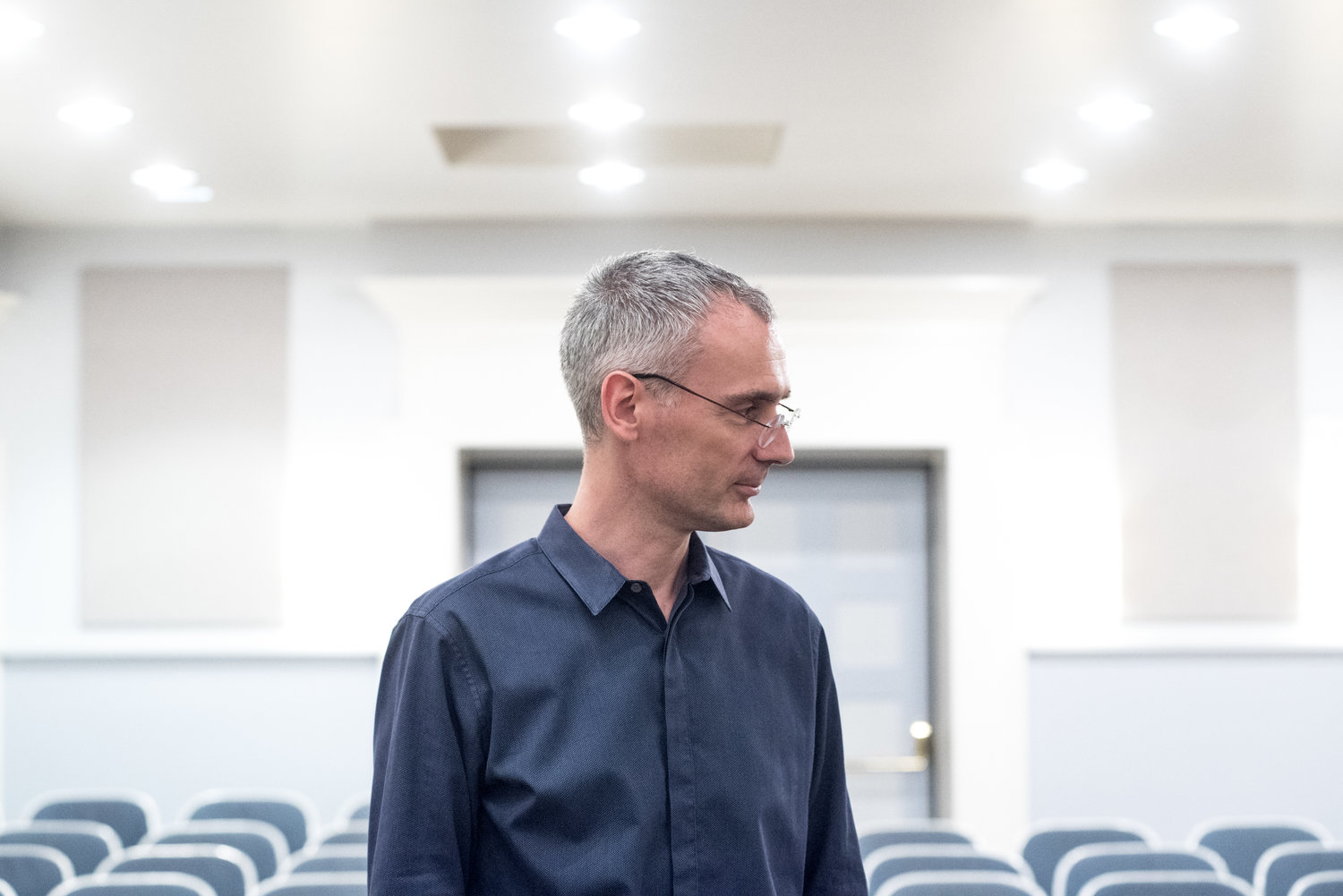
Name: Reiko Füting
Nationality: German
Occupation: Composer
Current release: Reiko Füting's new album distantViolinSound is out via New Focus. It features performances of his pieces by violinists Miranda Cuckson and Doori Na, pianist Jing Yang, trio Longleash, Quartet121, Unheard-of Ensemble, Noise Catalogue+, and SchallSpektrum, conducted by Jan Michael Horstmann.
Topics I rarely get to talk about: Using non-linear forms and quotations in music!
Global Recommendations: I live in Westchester County, just north of New York City. There is a bike trail nearby my home, the North-South County Trailway, which is a discontinued train line that connected Putnam and the Bronx. It now ends in Van Cortland Park, where one can find thirteen marble pillars. The marble came from different quarries, and the pillars were placed there to see how the winter weather would alter the stone. The aim was to pick the best marble to construct the Grand Central train station. I love how one can observe the effect time has on matter and therefore modifies form, in both simultaneous and different ways.
May I share one more? I am originally from Königs Wusterhausen in Germany, which is a suburb of Berlin. The first radio broadcast in Germany was transmitted from there to Berlin in 1920. There is a museum about the history of German radio broadcasting. What is fascinating is that the first broadcast was a live music performance, the instruments were a violin, a cello, and a harmonium. The experience of hearing live music through this medium for the first time must have been existential! And what happened to the harmonium? It used to be such a popular instrument!
Here is one last one, I promise! 370 Riverside Drive in New York City. That was the home of Hannah Arendt, who to me is one of the most inspiring thinkers of the 20th century. She said: “We, though we must die, are not born in order to die, but to begin.”
If you enjoyed this Reiko Füting interview and would like to know more about his music, visit his official homepage.
Many people perceive classical music and contemporary composition as having high barriers of entrance, both for listeners and musicians. What have your own experiences been in this regard?
That is true, but I am also interested to put this phenomenon into context.
Arnold Schoenberg founded his Society for Musical Performances in 1918 for a variety of reasons, one of them being that (a certain kind of) contemporary music did not get a chance to become as familiar as music of the past. With the beginning of the 19th century, there was an increasing interest in programming older music, which did not exist to that extent in earlier times. As a result, living composers increasingly found themselves in the context of composers of the past.
By the beginning of the 20th century, an aesthetic gap existed between (again, a certain kind of) contemporary music and music of the past which became harder to cross, especially once the threshold of tonality was crossed. That gap might be symptomatic of the state of Western culture at large, but that’s a different topic.
Several solutions were realized, such as spaces that exclusively programmed contemporary music (such as Schönberg’s Society for Musical Performances), contemporary music that focused on more familiar soundscapes (Carl Orff comes to mind), etc.
I frequently reference older music in my compositions, and these earlier works are often familiar to general audiences or are even programmed alongside my music. My experience shows that this creates a bridge or a door, allowing audiences less familiar with contemporary music to approach new soundscapes with greater openness and curiosity.
For example, my composition for solo violin, tanz.tanz, incorporates fragments of Bach’s Chaconne, enabling listeners to recognize familiar music to varying degrees. This naturally ties into my general interest in cognition and recognition.
But I feel it is important to cultivate audiences open to being challenged, stepping into the unknown, or “to embrace insecurity,” as Helmut Lachenmann put it. Or, as I learned in the podcast Philosophy Bites, something is challenging so we care about it, and something is challenging so we care about ourselves.
I am sorry that this was a long answer, I promise to be more concise from now on! :-)
As of today, what kind of materials, ideas, and technologies are particularly stimulating for you?
Two ideas that I find continuously stimulating are the concept of nonlinear systems and the concept of digital replication.
The former allows me to realize musical form in many ways, creating conceptual layers and the potential of any idea to dramatically change functionality and hierarchical place. The latter allows me to deal with the phenomenon of repetition musically and to fully explore its ambivalence.
Both are highly complex and therefore full of potential for musical, artistic, and human expression.
Where do most of your inspirations to create come from – rather from internal impulses or external ones? Which current social/political/ecological or other developments make you feel like you need to respond as an artist?
One social, political, and ecological development that compels me to respond (to confront, to encounter, to deal with, to process) as an artist is migration. With increasing political instability, unequal wealth distribution, and environmental catastrophes, people are forced to leave their homes, often having nothing left to lose.
The migration of refugees from Syria to Europe, which began in 2015, profoundly impacted me. It was around that time that I discovered the writings of Vílem Flusser, whose essays on migration are something I find myself returning to repeatedly because of their high relevance and inspiration. To paraphrase one of his ideas: a culture’s identity can be found in its immigrants, as their mere presence influences that culture by creating awareness and prompting an assessment of its conditions.
As a composer, I am interested in dealing with concepts and ideas such as “the other” and its degrees of assimilation and integration. I am interested in creating pluralist soundscapes.
I used quotations from Flusser’s writing in my composition for piano trio, free: whereof – wherefore, written for the longleash piano trio.
Composing has always had an interesting relationship between honouring its roots and exploring the unknown. What does the balance between these two poles look like in your music?
I feel that this relationship between tradition and exploration is essential for each artist to understand in their way. To quote Gustav Mahler, “Tradition is not the worship of ashes, but the preservation of fire.”
I am not quite sure if it is possible to create a balance between these two, or if that is even necessary. I think what is fascinating is to navigate through the space between these two poles. I feel that in that sense I am a highly traditional composer, as I frequently respond to music written in the musical tradition which I was born into.
I also feel that expression needs to go way beyond self-expression. That ties into the concept of necessity, which in the Western Classical music practice was first formulated by Beethoven: “Must it be? It must be!”
How much potential for something “new” is there still in composition? What could this “new” look like?
There will always be potential for something “new”, as I understand “new” as a “new arrangement”.
Every sound is a composition in its true sense, it is “put together”, and there are infinite ways of doing that. It is a bit like chess, there is a practically infinite number of games to be played with a set number of specific pieces and rules. However, we cannot know what this “new” would look like as we don’t know the context in which future artists will work in and respond to.
I know I am quoting a lot in my answers here, but often I feel others have expressed ideas in a much more convincing way than I would ever be able to. Henri Bergson, in his essay "The Possible and the Real," wrote: “If I knew what the great dramatic works of tomorrow will be, I would write them.”
I knew teachers who would lecture on the future of music, which in a way is fascinating but also highly speculative, to an extent that I am not sure of its value. After all, as I learned in the above-mentioned podcast, our imagination is not infinite.
Working with long forms, complex concepts or new vocabulary is potentially more challenging today because they require us to remember things that happened perhaps minutes ago – while most of us are finding it hard to focus even on what's happening right now. Both as a composer and as a listener yourself, how do you deal with this?
Indeed, our current time does not allow us to be patient, or at least it makes it very challenging. However, I also feel that artists have responsibilities. To paraphrase Helmut Lachenmann, artists have the responsibility to break the magic. To paraphrase James Baldwin, artists have the responsibility to disturb the peace.
“Magic” and “peace” are wonderful metaphors. In other words, as much as artists can follow current movements – and I feel they should always be curious about current movements – they also can encounter them, in the true sense of the word: en-counter them, to go against them, and to move in a different (opposite?) direction.
Every current – how wonderful that “current” is both an adjective and a noun! – also creates a countercurrent, and that is a fascinating space to be in.
For many artists, life-changing musical experiences take place live. Few works these days, however, are performed beyond their premiere. What, do you feel, does this mean for composers, and the music they write, and how does this reality influence your own work?
It has always been the case that few compositions were performed beyond their premiere. For one, to compose a piece of music was a kind of service. It was done for a specific occasion, at a specific time and place. In the Western Classical practice, Beethoven was the first composer to reject the service idea. Art started to exist for its own sake. But still, for the music practice to establish a kind of worship, a repeated return to certain pieces of music, was mostly unusual.
Over time, I feel that my focus has shifted away from the work and toward the practice of composing. The best part of being a composer is the act of composing! Everything else is a bonus: a performance, an amazing performance, a second performance, a review, etc.
I also admit that I like writing music for a specific occasion and to respond to it. I would then have to see if and how a composition could exist beyond that specific circumstance and whether that is possible, possible with adjustments, or impossible.
The very nature of music is – because it exists in time – that it is transient. Isn’t it also beautiful that something only existed once? Like the swan song in the Greek myth? There still will be a memory …
My composition, light, asleep, for violin and piano, includes the following quote by Jean Paul at the end of the score: “Memory is the only paradise from which we cannot be expelled.”
Also, my composition for chamber ensemble, von der Stadt, was written to be performed in the city of Magdeburg, and it specifically deals with the events in Magdeburg during the 30-year war.
In its original conception, this piece is very local. I feel that – at least a first – all art is local.
How, would you say are live performances of your music and your recording projects connected at the moment? How do they mutually influence and feed off each other?
To me, live performances and recordings are very different experiences. Live performances allow us to socially experience a piece of music, its performance aspect, its temporal aspect, its spatial aspect, etc.
Recordings, on the other hand, allow us to experience every subtle sonic detail in our own time and space. I love both!
Are there approaches, artists, festivals, labels, spaces or anyone/-thing else out there who you feel deserve a shout out for taking composition into the future?
There are a few, but for now I would like to list two: Arts, Letters, and Numbers in Averill Park, NY, realized by David Gersten, and The Loretto Project in Nerinx, KY, realized by the longleash piano trio.
The general artistic, creative, open-minded, and community-oriented space that Arts, Letters, and Numbers creates is beyond special. And so is the direct, personal, and interactive approach created in The Loretto Project.
The Montreux Festival intends to preserve its archive of recordings for future generations. Do you personally feel it's important that everything should remain available forever - or is there something to be said for letting beautiful moments pass and linger in the memories of those that experienced them?
Generally, I passionately support the idea of access.
So yes, I feel that it is important for something to remain available, if it includes the freedom to approach it in as many ways as possible.