Published
Part 1
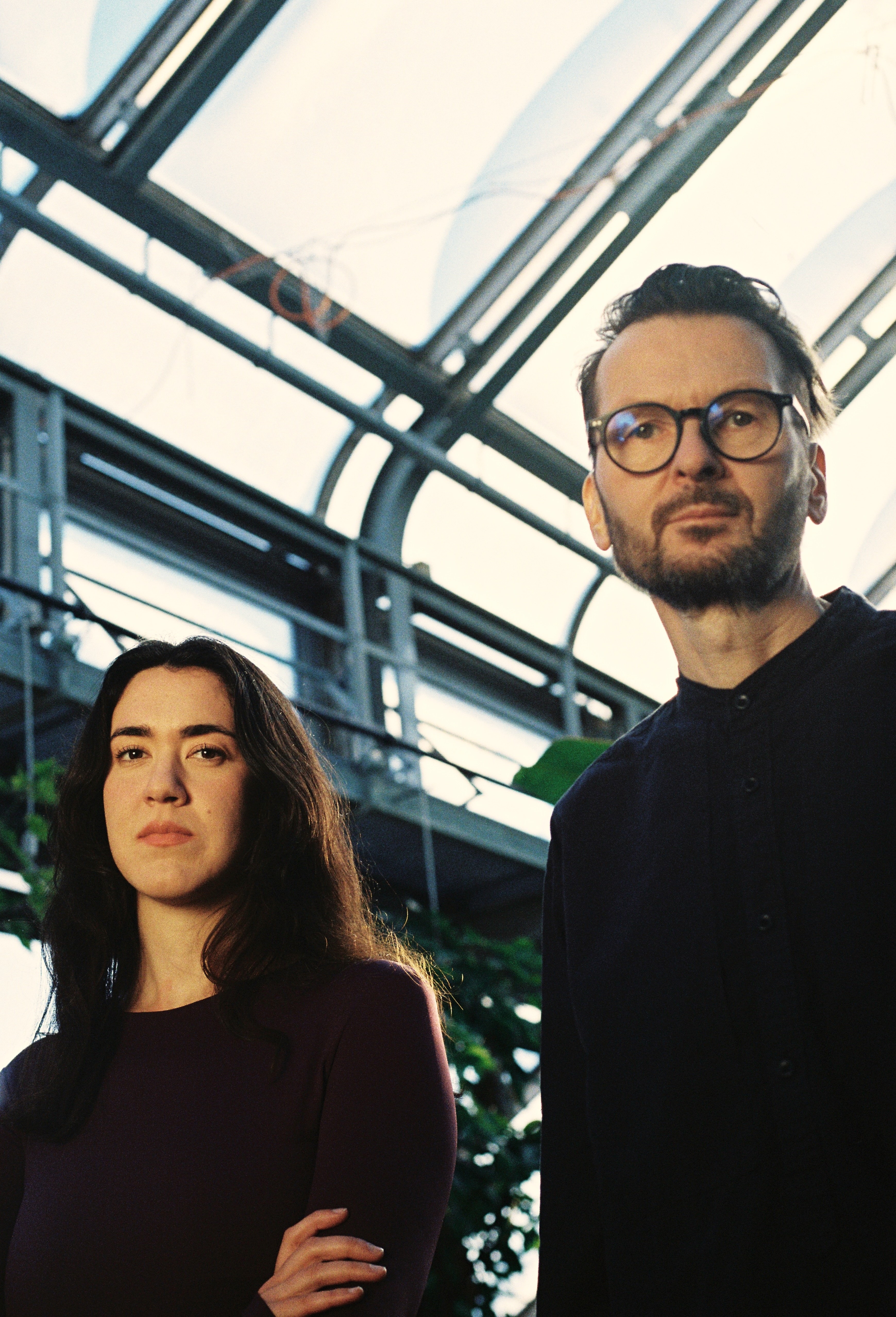
Name: Robert Lippok
Nationality: German
Occupation: Producer, composer
Current release: Robert Lippok teams up with Anushka Chkheidze for their new collaborative album Uncontrollable Thoughts, out October 31st 2025 via Morr.
Current event: Robert Lippok and Anushka Chkheidze will perform live at Galiläakirche, Berlin, on November 2nd 2025. For more information, go here.
Recommendations for Berlin, Germany: On a foggy, cold November day, I like to stand on the shore of the Flughafensee in Reinickendorf. It's not for everyone, but I find it kind of romantic.
Topic I feel passionate about but rarely get to talk about: The rise of fascism in Germany or making organic apple cider. Omg, where to start?
[Read our Anushka Chkheidze interview]
If you enjoyed this Robert Lippok interview and would like to know more about his music, visit his official homepage. He is also on Facebook, Soundcloud, Instagram, and bandcamp.
The path to becoming a producer is a process - but from many interviews, I am under the impression that there are nonetheless one or a few defining moments. If this was the case for you – what were they and why were they so incisive?
I think I need to answer this question in relation to my experience of listening to Laurie Anderson’s 1982 record Big Science and DAF's 1981 record Alles Ist Gut. DAF's first record was produced by the genius Conny Plank.
In the early '80s, as a fourteen/fifteen-year-old, I was really into post-punk and electronic music, but those two records took my listening, enjoyment and understanding of music to another level.
I guess it was the choice of instruments and what producers call Tiefenstaffelung — I think the correct translation is 'depth of field' — as well as the use of space and reverb, and the combination of production and musical decisions, that made me curious to find out what could be done with sounds. I also came to understand the power and creative impact of a producer.
An analogue bassline never sounded so deep again as in Planck’s productions, not because he was particularly passionate about it, but because he had the knowledge and heart to make it sound unique.
Robert Görl's drumming style reminded me of Jaki Liebezeit of CAN, who once told me that he never improvises; he only plays the necessary notes.
I’m not a huge Laurie Anderson fan, but Big Sience opened doors and made me realise how limited my taste in music was.
The production is great — very good craftsmanship, but not magical. It was more about the freedom she took for herself in songwriting and arrangement, shaping her own artistic language. Using a bagpipe in a track, omg!
Well, those examples are from a long time ago. There are many more things I could mention such as, working in different mastering studios, watching Grammy Award-winning producer Francesco Donatello mixing in his Weissensee studio, or listening to SOPHIE's exceptional work.
Tell me about one or two of your early pieces that you're still proud of (or satisfied with) in terms of production – and why you're content with them.
I like all the early to rococo rot releases. 'Proud' is not the right word; a better description would be that I still feel very close to them, like the very first one.
Stefan and Ronald met for the first time ever in the studio, and two days later they had recorded the album. A month later it was released, and shortly after we toured the world.
I'm also fond of my first solo EP, Open Close Open, released on Raster-Noton. It was the result of a collaboration with the Japanese artist Takehito Koganezawa around the year 2000.
I produced soundtracks for 99 short video clips that he created for an installation. Many of the videos had original sounds, such as street noises and birds (crows). I used these sound fragments and processed them by adding synthesised layers and samples.
This was my first deeper engagement with what you might call field recordings. I used a part of Mahler’s symphony in one track on a very spontaneous whim. It took me two weeks to create a loop that felt right. I spent hours using Metasynth, which I still use today, to make tiny corrections. The result still sounds fresh, and I have continued to practise this artistic technique ever since.
Over the last two decades, I have created two versions of the EP: one on the Japanese label FLAU, and more recently, in 2024, on Morr Music.
Currently, I am preparing an Open Close Open live performance at the beautiful HELLERAU – European Centre for the Arts theatre in southeastern Germany. The material never really feels finished.
In how far, would you say, was your evolution as an artist connected to the evolution of your music set-up and studio? Were there shared stepping stones?
The evolution of my music setup was there to help me understand my artistic process. It took me a little while to figure it out. I was constantly asking myself: What is my method? Or do I even have a method?
After years of searching, I realised that there is not one way of expressing myself in music, but many. Once I accepted that, it became easy.
There are artists who can realise their ideas best with a traditional – or modified – piano interface, others with a keyboard and a mouse, yet others by turning knobs or touching screens. What's your preferred and most intuitive/natural way of making music and why?
I produce most of my music for sound installations or theatre performances, rather than for record releases.
My most recent project involved creating a sound piece based on the poems of the Dadaist artist Emmy Hennings. This piece was presented in a bamboo grove at Villa Romana in Florence. Actress Johanna Lemke recorded the voiceover and sent it to me. The production was completed on location.
My approach to music is more about layering, constructing and collaging than playing chords and melodies on a keyboard. Therefore, I need a computer or iPad to sketch my ideas and produce my music. I don't often need a controller or keyboard either.
For my collaboration with Anuska, I used Ableton Push 3 to develop the melodies. I like the feel of the pads and the easy access to all kinds of tuning.
Tell me about the space of your current studio/workplace and how you've set it up to optimise creativity.
When I’m not travelling, I work in the studio in my apartment. The term 'studio' is misleading. It's a room containing three desks, two speakers, lots of books, even more records, two Technics record players, a mixer, and, of course, some musical equipment.
The main purpose of the space is to nurture my creative curiosity. I've never felt the need to optimise the room acoustically. It's not about achieving the perfect balance between the bass and kick drum or anything like that. Well, sometimes it is exactly about that.
My working method is very erratic; sometimes I work on a detail for hours, and sometimes I start and finish a track in a few minutes. What's more important than perfect acoustics is the room's atmosphere and the ability to work there at any time of day or night.
From the earliest sketches to the finished piece, tell me about the production process for Uncontrollable Thoughts, please.
Sometimes there is only one step from the first sketch to the finished track. With Anushka it was almost like that.
We'd worked together before on a project called Glacier Music which let us work on the topic of glaciers, climate change, constant transformations, and also field recordings and collective improvistations. I knew I could trust her one hundred percent.
We hired a very simple rehearsal space in Berlin and basically just started. We didn’t talk much, we naturally navigated through our musical now.
Late producer SOPHIE said: “You have the possibility with electronic music to generate any texture, and any sound. So why would any musician want to limit themselves?” What's your take on that?
Yes, that's very true, but I don't think that's how she actually worked. She was very free in her work, but she was always aware of the context.
For example, in her track “L.O.V.E.,” she freely oscillated between noise and contemporary pop music. Her strength lay in combining familiar elements in surprising ways, as in the famous quote by the poet Lautréamont, which was highly regarded by the Surrealists around André Breton:
‘as beautiful as the chance encounter of a sewing machine and an umbrella on a dissecting table’.
She didn't create anything entirely new, but her approach to combining things was unique. I rate her importance as highly as that of artists like Aphex Twin.
However, your question reminds me of something Andrei Tarkovsky once said: that he uses electronic sounds because, unlike classical instruments such as the violin or cello, they are not yet emotionally charged. I think we left this point of 'innocence' behind a long time ago.
There are only a few blank spots left on the map of electronic music, and yet I keep hearing things that excite and surprise me.
Tell me about your aesthetic preferences for picking effects like reverb, delay, compression, chorus etc … - what was the role of these effects in the production of your current release?
Anuska and I wanted to produce something that sounded pure and timeless. To achieve this, we used fairly standard effects: saturation, reverb and delays. Over a decade ago, mastering engineer Bo Kondren recommended using the Lexicon native reverb collection. I have used it ever since.
In 'Uncontrollable Thoughts', we used a nearly infinite delay with a touch of saturation on the drum machine to add layers to the original sounds.
I usually employ numerous effect sends and lengthy effect chains, commencing with an EQ, pitch transposer, high-cut filter, distortion, reverb, additional distortion, an extra filter and a small room reverb. These effects move through the source material like a swarm of fish following a whale. Sometimes they shine in the sunlight; at other times, you barely notice their presence.
I do a lot of layering by doubling MIDI or audio tracks and cutting or filtering the notes.