Published
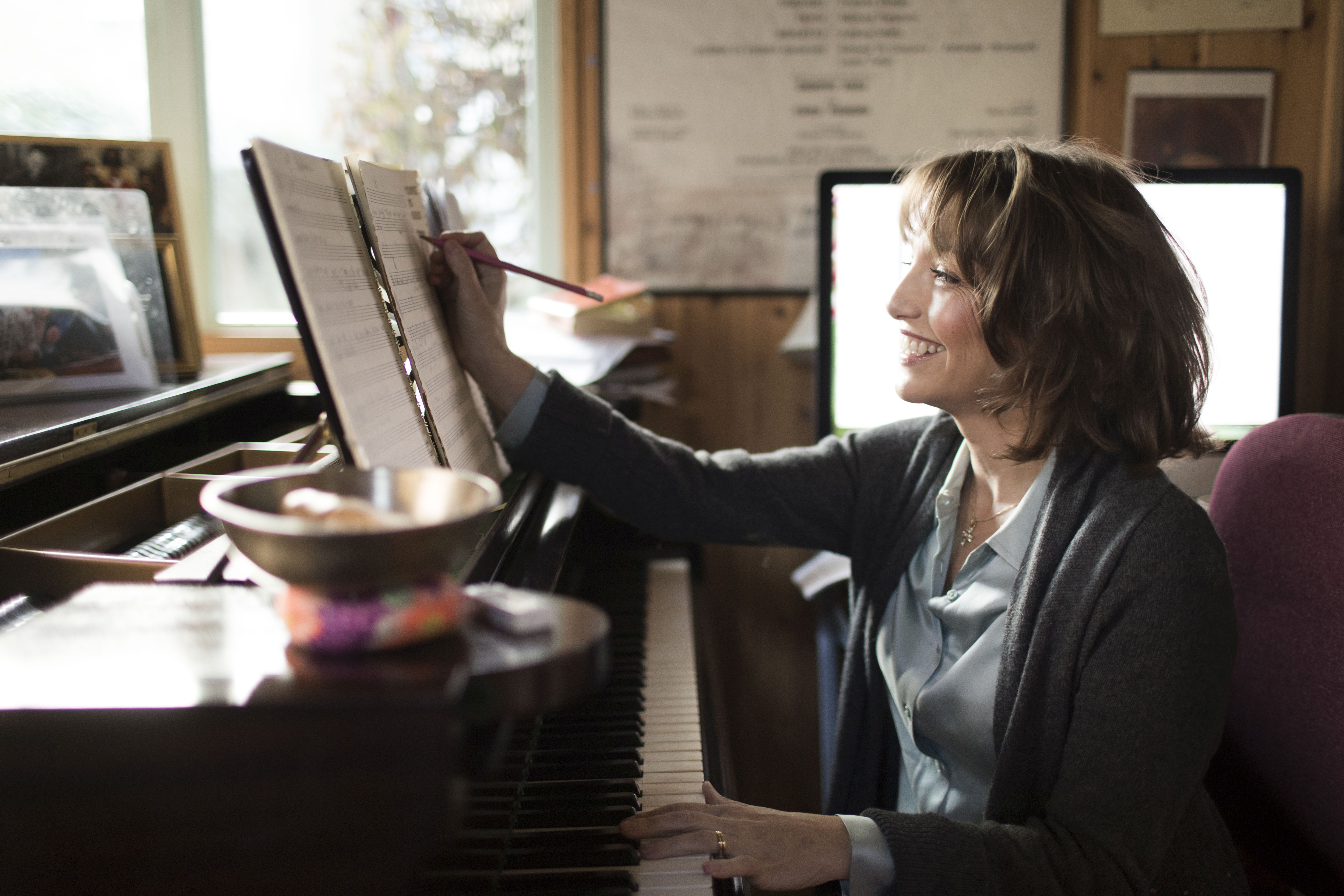
Name: Roxanna Panufnik
Nationality: British
Occupation: Composer
Current event: Roxanna Panufnik was awarded the Ivor Novello Award for Outstanding Works Collection at the Ivors Classical Awards on 12th November, which recognises the composer of a consistently exceptional body of classical compositions.
If you enjoyed this Roxanna Panufnik interview and would like to know more about her music, visit her official homepage. She is also on Instagram, and Facebook.
What were some of the musical experiences which planted a seed for your interest in composition?
It was inevitable that being born into a musical household (my father was composer Sir Andrzej Panufnik) audio seeds were being planted from the very start.
When I was 3 years old, after watching Ida Haendel playing on the TV, I turned round to my Mum and said: “I want a violin with a stick to make it sing.” This started a process throughout my childhood of wanting to play various instruments but not anyone else’s music!
I drove my poor teachers mad with my improvising all the time ...
The borders between producers, sound artists, and even songwriters are becoming increasingly blurry. What does being a composer mean today, would you say?
I am so jealous of those composers who can morph into conductors / instrumentalists / recording producers - it would be great to have other skills. But I do worry that that when different jobs morph, that means someone becomes unemployed.
Luckily for my performer colleagues, I am a strictly behind-the-scenes person and all my working time is dedicated to creating something that nobody else would (hopefully!).
Composition was about a lot more than just music for many decades. For you personally, is music still a way of life or a way of seeing life – and if so, in which way?
Music is the most powerful connector of people from all faiths, cultures, nationalities and backgrounds. It’s a universal language understood by all (except my beloved late Uncle Oliver who was resolutely tone-deaf!) and has enormous power to bring all these people together.
Most of the composers I know, including myself, live / eat / breathe music - there’s no escaping...
Many people perceive classical music and contemporary composition as having high barriers of entrance, both for listeners and musicians. What have your own experiences been in this regard?
Sadly, dwindling music provision in our state schools means that anyone who wants make a go of classical music is stopped before they can start. But I’m very excited about the fantastic work opera houses, orchestras and choirs are doing to counter-balance this.
And there are so many kinds of classical and contemporary music. Much of it extremely listenable (to my fussy ears!) and we are all falling over ourselves to bring in audiences who might not normally come to a classical concert. Many of the more austere visual barriers (such as unsmiling performers in tailcoats) have gone and both audiences and artistes tend to be much more relaxed. Royal Ballet & Opera sell tickets for less than a Tottenham Hotspur match (I’ve checked!).
Also, the most stunningly beautiful and moving music is performed for free every day in our churches and cathedrals. When my son was a chorister at Westminster Abbey, I saw tourists of all ages and nationalities queuing round the block to get in to an Evensong. Though it’s not just for religious people or tourists - anyone of any faith can come.
The Oxford Dictionary defines music as “vocal or instrumental sounds (or both) combined in such a way as to produce beauty of form, harmony, and expression of emotion.” As of 2024, what kind of sounds and which kinds of results are particularly stimulating for you?
Anything performed emotionally and where the performer connects with the listener.
I particularly love Arabic and South Asian music but also marvel at how Bach’s gorgeous and poignant harmonic progressions can reach out to us, 274 years after he died.
What, would you say, are the key ideas behind your approach to composition?
Harmony is the most important thing. It’s what dictates the mood and how quickly/slowly that mood changes.
Collaboration - either with a writer, director or performers is the source of my inspiration. For each project, I try to imagine what it is that an audience would like to take away from it.
Composing has always had an interesting relationship between honouring its roots and exploring the unknown. What does the balance between these two poles look like in your music?
I’m pretty traditional when it comes to pitches and how I use voices / instruments.
The unknown element would be where I take you, emotionally, next …
What role do electronic tools and instruments play for your creative process?
I have a bizarre form of rhythmic dyslexia - I can hear and appreciate rhythm but I can’t do it. I have a cringe-worthy memory of singer-songwriter Eddy Grant sitting across a keyboard from me, in the mid-1990s, with his head in his hands because I couldn’t play a repeated riff in time ...
So, I rely heavily on music software notation to playback what I’ve written to make sure it’s what I was thinking of.
What are currently direction in contemporary composition or adjacent communities which you personally find interesting?
I am crazy about music from other countries, faiths and cultures.
I’m a big mix myself (a recent Ancestral DNA test revealed that I have Egyptian, Iberian and Croatian in me, as well as English and Polish!).
I’m most interested in the things I can’t do - so electronica, for instance, is particularly fascinating. Because I’m blinded by technology I don’t hold out much hope of ever being able to incorporate it in my music.
I have, however, had a fantastic time working with my dance music producer and composer brother, Jem Panufnik (a.k.a. Jem Stone).
Working with long forms, complex concepts or new vocabulary is potentially more challenging today because they require us to remember things that happened perhaps minutes ago – while most of us are finding it hard to focus even on what's happening right now. Both as a composer and as a listener yourself, how do you deal with this?
I’m not sure this is true - if a piece of music is moving you enough you’ll be gripped.
Also, I tend to have a story in the pieces I write so make sure at least that my live audiences know what the piece is about.
For many artists, life-changing musical experiences take place live. How do you see that yourself?
By connecting with the audience, before and after the performance - I get much more nervous introducing a piece than the performance itself but it’s really important!
How, would you say are live performances of your music and your recording projects connected at the moment? How do they mutually influence and feed off each other?
They aren’t, to be honest! I will soon be releasing an album of collaborations with musicians from other genres - I can’t see any of these fitting easily into a live concert programme!
To some, the advent of AI and 'intelligent' composing tools offers potential for machines to contribute to the creative process. What are your hopes, fears, expectations and possible concrete plans in this regard?
Until machines are sentient (and God forbid if they become so!) I don’t feel too threatened ...
There are various models to support composers, from financial help to mentorships/masterclasses. Which of these feel like the best way forward to you?
I always tell composers starting out in their careers that the most important thing is to keep in touch with what’s going on in the music world - reading various music magazines and blogs. You can find out who’s doing what you’re interested in and who you might think will be interested in you.
Our trade mag, Classical Music, is brilliant as it also has lists of available grants and supporting foundations. And I expect 15 Questions provides well more than 15 answers to your readers!