Published
Name: Ruckus Early Music
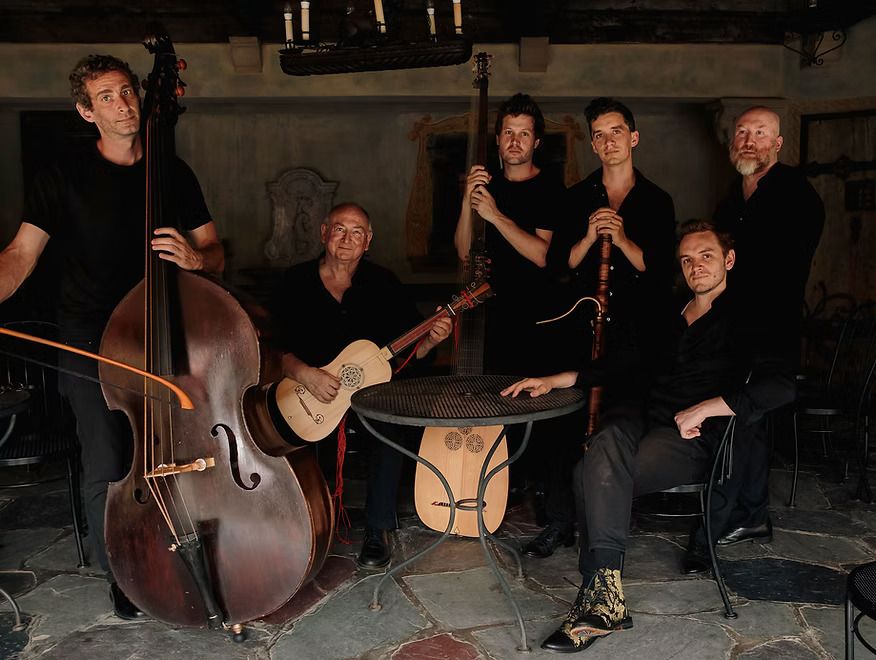
Members: Keir GoGwilt (violin), Douglas Balliett (baroque bass, viola da gamba), Rami El-Aasser (percussion), Elliot Figg (harpsichord, organ), Fiona Gillespie (voice), Paul Holmes Morton (baroque guitar, theorbo), Clay Zeller-Townson (baroque bassoon, spoons)
Interviewee: Clay Zeller-Townson
Current Release: Ruckus Early Music's new album The Edinburgh Rollick is out March 11th 2025.
Global Recommendation: So, if you’re in Southern Vermont you gotta stop at The Readsboro General Store in Readsboro, VT and get a huge sloppy sandwich.
If you enjoyed this Ruckus Early Music interview and would like to know more about the ensemble and their music, visit their official homepage. They are also on Instagram.
When did you first start getting interested in musical interpretation?
Isn’t it always there? Isn’t it just some part of being alive and the gift of making music?
I can remember embellishing tunes in the High School jazz band, even the tunes that I hated could be made palatable by the interest generated by improvising ornamentation. I remember singing familiar songs in new speeds in elementary school. No one is ever just “reading the notes” BUT sometimes it can seem like a very narrow set of parameters in classical music.
So, sometimes you gotta take a trip down the hallway to the musty-smelling room of floral print skirts, beards and harpsichords and hear a viola da gamba player preach about how music - old music, even - should be so viscerally performed that it’s dangerous to listen to when you’re driving your car.
It should ACTUALLY make you careen off the road.
Which artists, approaches, albums or performances captured your imagination in the beginning when it comes to the art of interpretation?
When it came to putting together The Edinburgh Rollick, our collaborator Keir GoGwilt had sent me some Martin Hayes and Denis Cahill records which still to this day are on constant rotation …. perfect music.
Early on in Ruckus’ days a few of us obsessed over old time fiddler Bruce Molsky together. Our energy couldn’t be more different on the surface than those guys but we revere them.
For this record we also got up into The Bothy Band, an Irish band from the 70’s that rocks really hard, and uses a old school synth with an electronic harpsichord patch, which is pretty rare in that scene, and obviously revelatory to hear how that sound fit in, given how much of our sound is Elliot Figg wailing on the harpsichord.
Of course Jordi Savall is big for us, he’s probably the most influential ‘Early Music’ leader on us collectively as a group – his sense of open borders when it comes to music, his sense of groove, texture. The serenity of it.
Our guitarist named his firstborn after Jordi.
How much creativity is there in the act of interpretation? How much of your own personality enters the process?
In Ruckus, we did this thing during the pandemic where we all talked about music that was important to us growing up.
There was like Mariah Carey and 60s Beach Music and The Beatles and Clarence Clemmons and all this stuff that doesn’t have anything to do with baroque music, but we could all immediately see how certain tracks were in our music already.
The whole thing for us is that we just want to make Awesome Music, so it’s gotta taste a little bit like all these things that are in our ears and beloved. The goal is for as much of everyone’s personality to be contained in the room as is possible.
In many cases, the score will be the first and foremost resource for an interpretation. Can you explain about how “reading” a score works for you?
Most of us don’t prepare. We show up and sound bad for a day, and laugh and try out stupid shit. A few of us prepare, and we humor them and do their ideas. And then we do it a million times.
In terms of the score, we are reading this archaic kind of notation, with numbers over a melodic bass line that tells you what harmony you’re passing through, like a lead sheet, and we are also sensing the energy contained in the musical references in the melodies of the piece.
One of the key phrases often used with regards to interpretation are the “composer's intentions”. What is your own perspective on this topic and its relevance for your own interpretations?
So, even though we are DEEP into baroque music and culture, in Ruckus I think we generally start from a place of ‘I don’t really care what Handel wanted.’ (He’s not in the band, you see) Music for us is best served as a liberating force. If you really drill down on ‘who was the person’? ‘What exact instruments did they have in mind?’ ‘What is THE tempo’ etc.
Tere are just no definitive answers. WHICH IS GREAT. So, I guess we unconsciously choose the historical techniques that suit our needs in a given piece and then make it Awesome otherwise.
I am infinitely fascinated by radically different or even “wrong” interpretations – the tempi of Toscanini, Kempff's Goldberg Variations. Are there extreme interpretations that you enjoy as well? Do you personally draw a line – and if so, what happens when we cross it?
It is always helpful to find the too-far line. We don’t always discuss where it is, you’ve gotta trust the self-editing process a lil bit, maaaybe we will hint that we found it. But it’s also good to remember the ‘yes-and’ theater kid mantra. No one will take a risk if the culture in the room is to lead with ‘No.’
Extreme interpretations that I enjoy? YES, there is this 80s pop cover of ‘Every Valley’ from Messiah that came up on my Instagram feed the other day and it is full of big hair and synths, additional vocal harmonies and has a sick bass drop - it is DELICIOUS.